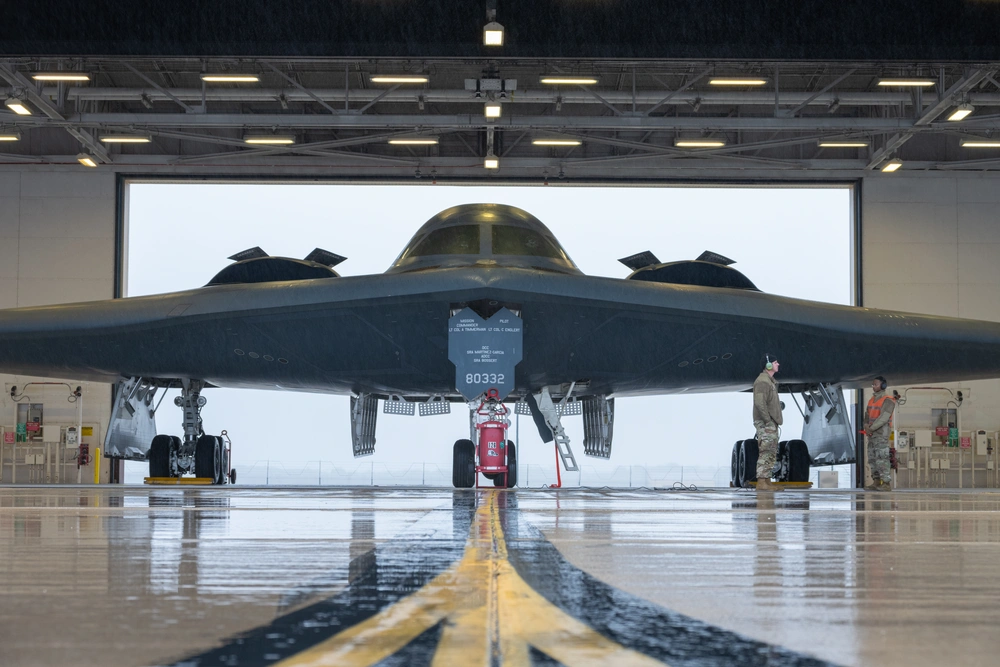
The U.S. Air Force has awarded Ophir Corp. of Littleton, Colorado, a $34,619,699 firm-fixed-price contract to repair the B-2 Spirit’s Pilot Alert System, the rear-looking laser sensor that warns crews when the stealth bomber starts leaving a visible condensation trail. The sole-source award, announced October 9, 2026, runs through October 2036, with the full amount obligated at award from fiscal 2026 working capital funds. The Air Force Sustainment Center at Tinker Air Force Base, Oklahoma, is the contracting activity.
The award lands as the Air Force rewrites the B-2’s exit plan. The service had expected to retire its 19 Spirits in the early 2030s as the Northrop Grumman B-21 Raider arrived. Its fiscal 2027 budget request instead plans roughly $1.35 billion in B-2 modernization between fiscal 2027 and 2031 and sets no retirement date. A ten-year repair line for a niche sensor fits that longer horizon.
How the B-2 Pilot Alert System Detects Contrails in Flight
Radar-absorbent shaping and coatings do nothing against a contrail, the line of ice crystals that forms when water vapor in engine exhaust freezes in cold, humid air at altitude. A contrail points straight at the aircraft for any ground observer, fighter pilot, or electro-optical sensor. The original B-2 design reserved bays outboard of the main landing gear for a chemical contrail-suppression system that never entered service. The Air Force instead funded a lidar warning sensor in the mid-1990s as a fleet retrofit.
Ophir’s patent for a rear-looking contrail detector, filed July 28, 1992, and granted February 8, 1994, sets out the operating principle. A random-modulation continuous-wave lidar transmits a pseudorandom on-off laser sequence into a detection volume behind each engine, and cross-correlating the return against the stored code yields a range-resolved backscatter profile. Contrail onset appears as a sharp peak at a nearly fixed distance, which the patent places 20 to 50 meters behind the engine. Cirrus produces weaker returns spread across range that drift aft as the aircraft flies on, which lets the system separate a self-generated contrail from cloud. Each engine receives its own code; on the B-2, that would identify which of the four General Electric F118-GE-100 turbofans is producing the trail. The patent also describes a graded cockpit warning, including a caution when formation is imminent, prompting the crew to change altitude. The fielded configuration has not been publicly detailed.
Why Ophir Built a Low-Signature Laser for a Stealth Bomber
An active emitter on a low-observable aircraft creates its own signature problem, and the sensor’s design reflects that. Ophir chose a continuous-wave source over a pulsed laser because, according to a technical account by a company executive, pulses would contrast too sharply with the background. The patent’s preferred embodiment uses an 823-nanometer gallium aluminum arsenide laser diode rated at 100 milliwatts, falling to about 20 milliwatts of average output after modulation and optical losses.
That wavelength sits in a strong water-vapor absorption band, so energy not scattered back by a contrail is largely absorbed before it reaches a distant observer; the patent states that transmission to the ground from a 29,000-foot cruise altitude approaches zero. A bistatic layout, with laser and receiving telescope offset from each other, blinds the receiver to the first 10 meters behind the aircraft to prevent detector saturation. A pressure-based interlock disables the laser below a set altitude for eye safety. The trade is deliberate: the sensor only needs to see roughly 100 meters aft, so it gives up range for discretion.
Ophir Contract Triples the Value of the 2020 Repair Vehicle
The new award succeeds a May 2020 Ophir contract, an $11,281,000 indefinite-delivery/indefinite-quantity vehicle for repair of the B-2 pilot alert assembly and laser energy monitor, issued by the same Tinker contracting activity and originally set to end in May 2025. Federal procurement records show its ordering period was extended to November 2025. The new contract is roughly three times larger and twice as long, averaging about $3.46 million a year against about $2.26 million under its predecessor.
Despite the firm-fixed-price label, the “D” in contract number FA8119-27-D-0001 designates an indefinite-delivery vehicle, matching the 2020 structure. The asterisk in the Pentagon announcement identifies Ophir as a small business. The Air Force issued a sources-sought notice in April 2024 to test whether repair of the B-2 laser energy monitor optical assembly could be competed, yet the requirement again went sole-source. The announcement did not specify how many units the contract covers.
Analysis: Committing to repair a 1990s-era electro-optical subsystem through 2036 signals that the Air Force expects the B-2 to fly well beyond the early-2030s retirement it once planned, and that visual signature management still shapes its mission. Operation Midnight Hammer illustrated the profile in June 2025, when seven B-2s flew about 18 hours from Whiteman Air Force Base, Missouri, with minimal communications before dropping 14 GBU-57 Massive Ordnance Penetrators on Fordow and Natanz, a weapon only the B-2 currently employs in combat. The award also exposes a dependency: a single small Colorado firm sustains the sensor behind the fleet’s contrail discipline, and laser and detector components of that vintage carry real obsolescence risk over another decade.
Next milestones include the first delivery orders under the new vehicle, final fiscal 2027 appropriations for the B-2 modernization line, and the first B-21 arrivals at Ellsworth Air Force Base, South Dakota, in 2027, with Whiteman later becoming the second Raider base. Open questions remain on the number of units under repair, whether the work funds obsolescence fixes, and whether the Air Force will publish a revised B-2 retirement date.