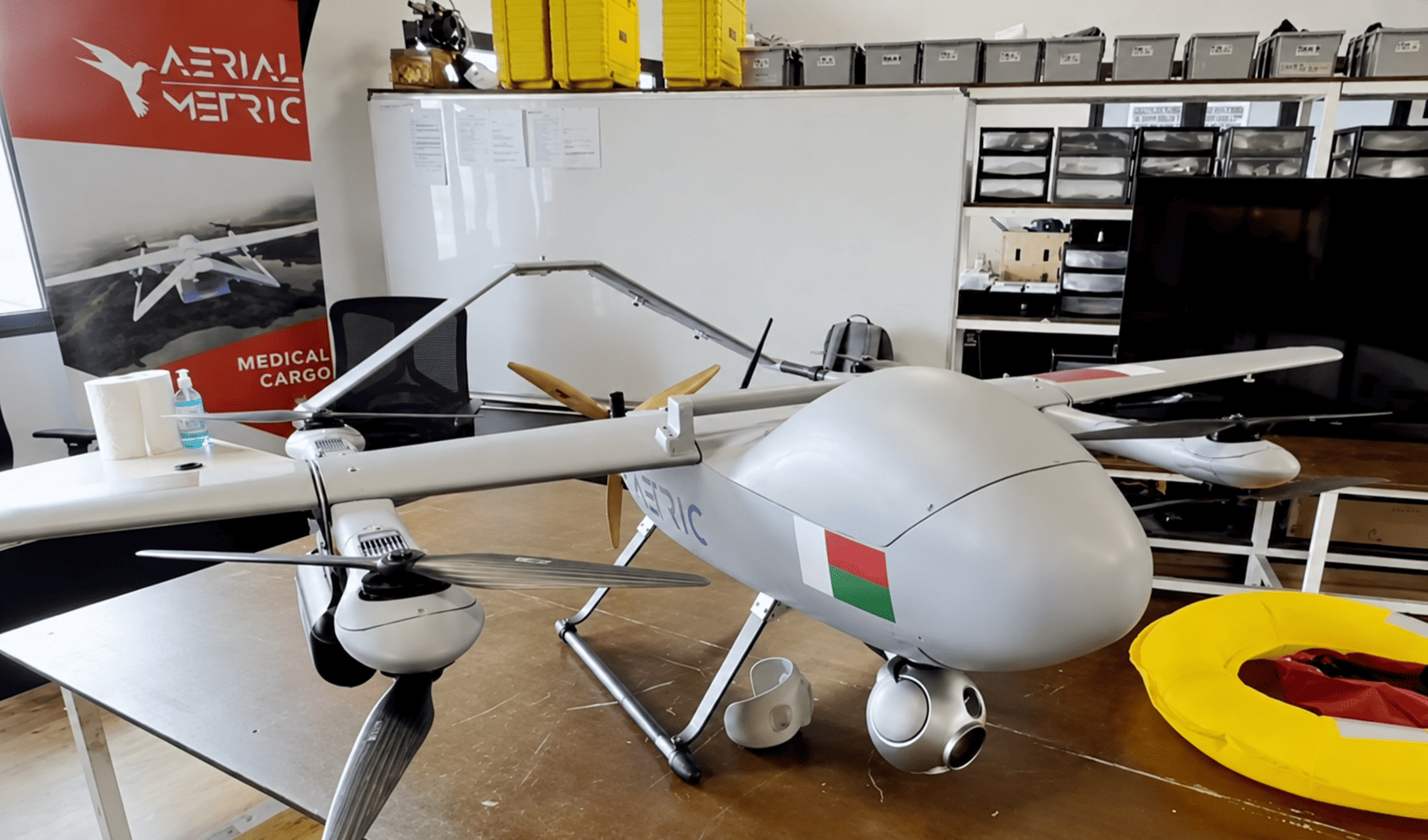
France formalized the donation of a long-range surveillance drone to the Malagasy armed forces on October 6, 2026, during a brief visit to Antananarivo by Minister of the Armed Forces and Veterans Affairs Catherine Vautrin. Paris also pledged roughly 100 additional surveillance and reconnaissance drones and signed a drone training agreement with Madagascar’s army, as the island’s military government deepens its security ties with Moscow.
Vautrin spent only a few hours on the ground. She met her counterpart, Minister of the Armed Forces Gen. Ely Razafitombo Maminirina, then the President of the Refoundation of the Republic, Col. Michaël Randrianirina, who seized power in October 2025 after weeks of youth-led protests; no readout of that second meeting was released. Since the takeover, Moscow has become the junta’s most visible arms supplier. Asked about that shift, Vautrin avoided any comparison with Russia, said Madagascar chooses its own partners, and framed the relationship around common security interests in the Mozambique Channel.
Madagascar Drone Donation: Thermal Payload, Training, and 2027 Timeline
The French Ministry of the Armed Forces values the first long-range drone at no less than €150,000. It carries a thermal imaging camera and offers an endurance of more than two hours, a profile built for coastal patrol and the detection of illegal fishing. Eight Malagasy service members will be trained to fly and maintain the aircraft, and a second long-range drone is due for delivery by January 2027.
Paris has not disclosed the manufacturer, model designation, airframe configuration, range or datalink architecture. The declared value and endurance point to a small tactical unmanned aircraft rather than a medium-altitude, long-endurance (MALE) platform, whose sorties are measured in tens of hours. That distinction matters operationally. Madagascar has roughly 4,800 kilometers of coastline, according to publicly available figures, and a single airframe with a two-hour sortie window can cover only a narrow slice of it. The training component and the follow-on deliveries therefore carry more weight than the first aircraft itself.
According to the ministry, the roughly 100 additional drones will support humanitarian missions, route reconnaissance and the delivery of supplies to isolated areas. Some local accounts of the ceremony described part of the batch as combat drones; French officials have cited only non-kinetic missions, and the mix of types remains unconfirmed. A cooperation agreement signed between the two armies covers training Malagasy personnel in the development and use of drone technology. The ceremony also included the handover of a first allotment of drones, along with computers and components for joint peacekeeping exercises and military maneuvers the two forces plan to conduct in 2027.
Russian Arms Deliveries Test France’s Mozambique Channel Posture
Moscow moved quickly after the change of government. A December 2025 cargo flight delivered assault rifles, sniper rifles and military drones, some assigned to the presidential guard, and Russian instructors began training Malagasy personnel on January 14, 2026. On February 27, the government received two Mi-8 helicopters, which officials described as unarmed, and six military trucks alongside cyclone relief. An April 1 consignment at the 1st Paratrooper Battalion camp in Ivato added tracked armored vehicles, small arms, ammunition and uniforms. It followed Randrianirina’s trip to Moscow to meet President Vladimir Putin, a visit he made before traveling to Paris. The deliveries build on a five-year military cooperation agreement the two countries signed in 2022.
Razafitombo sought to narrow that relationship during Vautrin’s visit, stating that cooperation with Russia is limited to training for the protection of state authorities and that the Malagasy army can work with any nation when doing so serves the national interest. That description does not account for the helicopters and armored vehicles delivered this year.
France’s regional posture frames the offer. The day before, on La Réunion, Vautrin announced 272 additional military positions for La Réunion and Mayotte, 165 of them in 2026, a light surveillance aircraft permanently stationed there since October 1, and a second overseas patrol vessel for 2027. Her visit also coincided with PEGASE 26, the French Air and Space Force’s seventh long-range air power projection mission, which runs from September 8 to October 15 and includes a stop at Air Base 181 on La Réunion with four Rafale fighters, three A330 MRTT Phénix tankers and two A400M Atlas transports.
Analysis: The donation is modest in hardware terms, but it shows how Paris intends to compete in Antananarivo: low-cost maritime surveillance tied to training and multi-year exercise commitments, rather than matching Moscow’s heavy equipment. That approach leans on a structural French advantage, a permanent force presence in La Réunion and Mayotte and a shared operational stake in the Mozambique Channel, where officials link rising traffic to the conflict in the Middle East. It also runs into a ceiling. France administers the Scattered Islands in and around the channel, four of which Madagascar claims, and that dispute limits how far maritime cooperation can deepen without a political settlement.
The next markers are the delivery of the second long-range drone by January 2027, the certification of the eight Malagasy operators, and the 2027 joint exercises. Paris has not said when the larger batch of roughly 100 drones will ship or which systems it includes. Whether Russian deliveries continue at their 2026 pace will show how far Antananarivo intends to balance between its two partners.