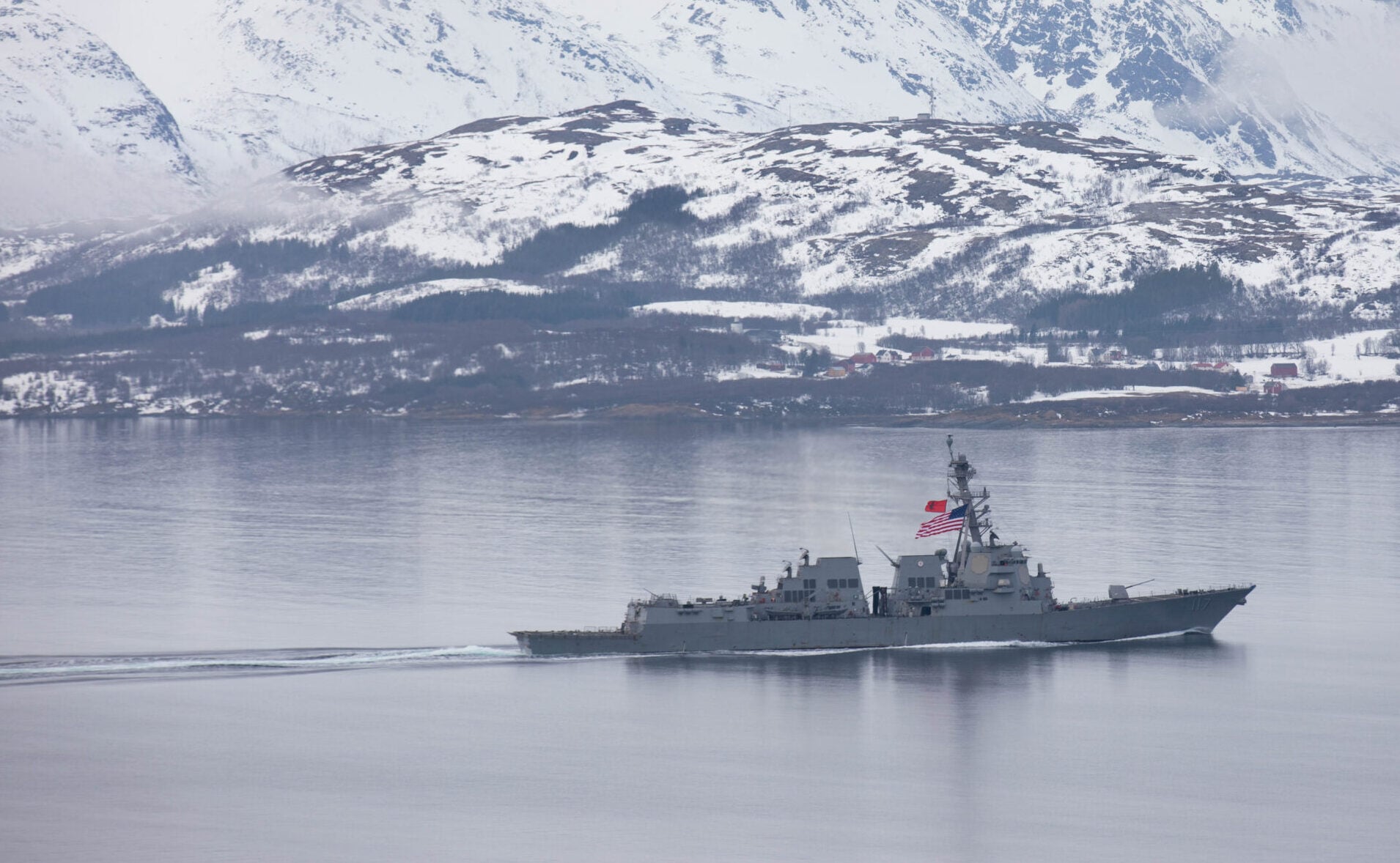
The U.S. Navy Arleigh Burke-class guided-missile destroyer USS Paul Ignatius (DDG 117) arrived in Helsinki on October 8, 2026, after a multi-day transit of the Baltic Sea and the Gulf of Bothnia with Swedish and Finnish navigators embedded in its navigation department. The passage closed with trilateral air defense drills and live firing against unmanned surface targets alongside the Swedish and Finnish navies, according to U.S. 6th Fleet.
The Gulf of Bothnia, the roughly 450-mile northern arm of the Baltic separating Sweden and Finland, carries sea lines of communication that the Swedish Armed Forces describe as essential for moving goods and materiel in peace, crisis and war. Allied units rarely join the Swedish and Finnish drills held there. The transit follows Finland’s NATO accession on April 4, 2023, and Sweden’s on March 7, 2024, and 6th Fleet presents it as part of a defensive framework linking the North Atlantic, the High North and the Baltic.
How USS Paul Ignatius Integrated Swedish and Finnish Navigators
Paul Ignatius reached Stockholm on October 1. Swedish and Finnish ship riders embarked there on October 5 and joined the destroyer’s navigation department, standing watch together as specialized navigators. They supplied the local knowledge and hydrographic expertise needed to take a deep-draft U.S. warship through the shallow channels of the northern Baltic to Helsinki’s Hernesaari harbor.
The at-sea phase paired the destroyer with the Swedish Visby-class corvette HMS Karlstad and the Finnish minelayer FNS Hämeenmaa. According to the Swedish Armed Forces, roughly 450 sailors from the three nations took part in drills covering combined air defense, anti-surface warfare, small-caliber weapons training and construction of a shared operational picture. The U.S. Navy said the live firing validated combined targeting protocols and joint air defense integration.
Vice Adm. J.T. Anderson, commander of U.S. 6th Fleet, met in Stockholm and Helsinki with Finland’s chief of defense, Gen. Janne Jaakkola; Sweden’s chief of navy, Rear Adm. Johan Norlén; and the commander of the Finnish Navy, Rear Adm. Tuomas Tiilikainen. Talks centered on critical maritime infrastructure protection and High North response options. Anderson said Finnish and Swedish expertise ensures NATO “remains prepared to deter aggression and defend every single inch of Allied territory.”
Flight IIA Aegis Capabilities and the Atlantic Thunder SM-6 Demonstration
Paul Ignatius, commissioned on July 27, 2019, is the second of eight Flight IIA “technology insertion” destroyers, which incorporate elements of the Flight III design. It has been homeported at Naval Station Rota, Spain, since June 2022 as part of Forward Deployed Naval Forces-Europe, supporting NATO’s Integrated Air and Missile Defense architecture.
Publicly available specifications for Flight IIA ships indicate a length of about 509 feet, a full-load displacement above 9,000 tons and four General Electric LM2500 gas turbines driving two shafts for speeds above 30 knots. Combat capability rests on the Aegis Combat System and its AN/SPY-1D(V) radar, 96 Mk 41 vertical launch cells able to host Standard Missile and Evolved SeaSparrow Missile interceptors, a 5-inch/62-caliber Mk 45 gun and hangars for two MH-60R helicopters.
Before entering the Baltic, Paul Ignatius took part in Atlantic Thunder 2026, a U.S.-U.K. multidomain sinking exercise in which, according to the Navy, it demonstrated the maximum damage and range capabilities of the anti-surface variant of the Standard Missile 6 (SM-6). The service has released no performance figures. In confined northern waters, that magazine lets a single destroyer extend area air defense over ports and shipping lanes while holding surface contacts at risk. Tiilikainen said the destroyer “brings unique and highly effective capabilities to the region” for maritime and air defense.
Sea Ceptor, Luleå-Class Frigates and Nordic Command Integration
Stockholm used the drills as a training pipeline. Two Swedish officers worked aboard Paul Ignatius to learn integrated air defense ahead of the introduction of Sea Ceptor, ordered in 2023, on the five Visby-class corvettes and on the future frigates. The Swedish Navy has not operated a shipborne air defense missile since retiring the Seacat in the early 1980s.
Those frigates are now under contract. The Swedish Defence Materiel Administration (FMV) signed an approximately SEK 47 billion deal with Naval Group on August 31, 2026, for four Luleå-class ships based on the French Frégate de Défense et d’Intervention (FDI), and steel was cut for the lead ship in Lorient on October 1. Deliveries run from 2030 to 2034. The Swedish configuration pairs Aster 30 area defense missiles with the Common Anti-air Modular Missile Extended Range (CAMM-ER). Gen. Michael Claesson, supreme commander of the Swedish Armed Forces, cited the new frigates and integration with the U.S. Navy as evidence that Sweden’s navy now operates well beyond its own coast.
In the week of September 28, 2026, the Visby-class corvette HMS Helsingborg operated under Finnish Navy command to monitor Finnish territorial waters, which the Swedish Navy described as the first time a Swedish ship had been placed under direct Finnish command. Under the arrangement, Swedish vessels hold the same peacetime powers as Finnish units, including the use of military force, with a Finnish officer in command.
Analysis: The transit marks the Gulf of Bothnia’s shift from a Nordic interior sea to NATO operating space. Its sea lines give Finland a supply and reinforcement route that runs far from Kaliningrad and the eastern Gulf of Finland, but the waters are shallow and confined, and neither the Swedish nor the Finnish navy yet fields a ship armed with long-range area air defense missiles. Ship riders solve the first constraint with local hydrographic expertise; a forward-deployed Aegis destroyer covers the second as a bridge capability until the Luleå class arrives. The open question is whether 6th Fleet turns one transit into a recurring presence pattern before 2030.
Next markers include the Visby class’s progress toward an operational Sea Ceptor capability, HMS Luleå’s 2030 delivery and the lessons from the first Swedish-Finnish territorial surveillance mission. The Navy has published no schedule for follow-on transits and has not said whether Paul Ignatius was the first U.S. destroyer to operate in the Gulf of Bothnia.