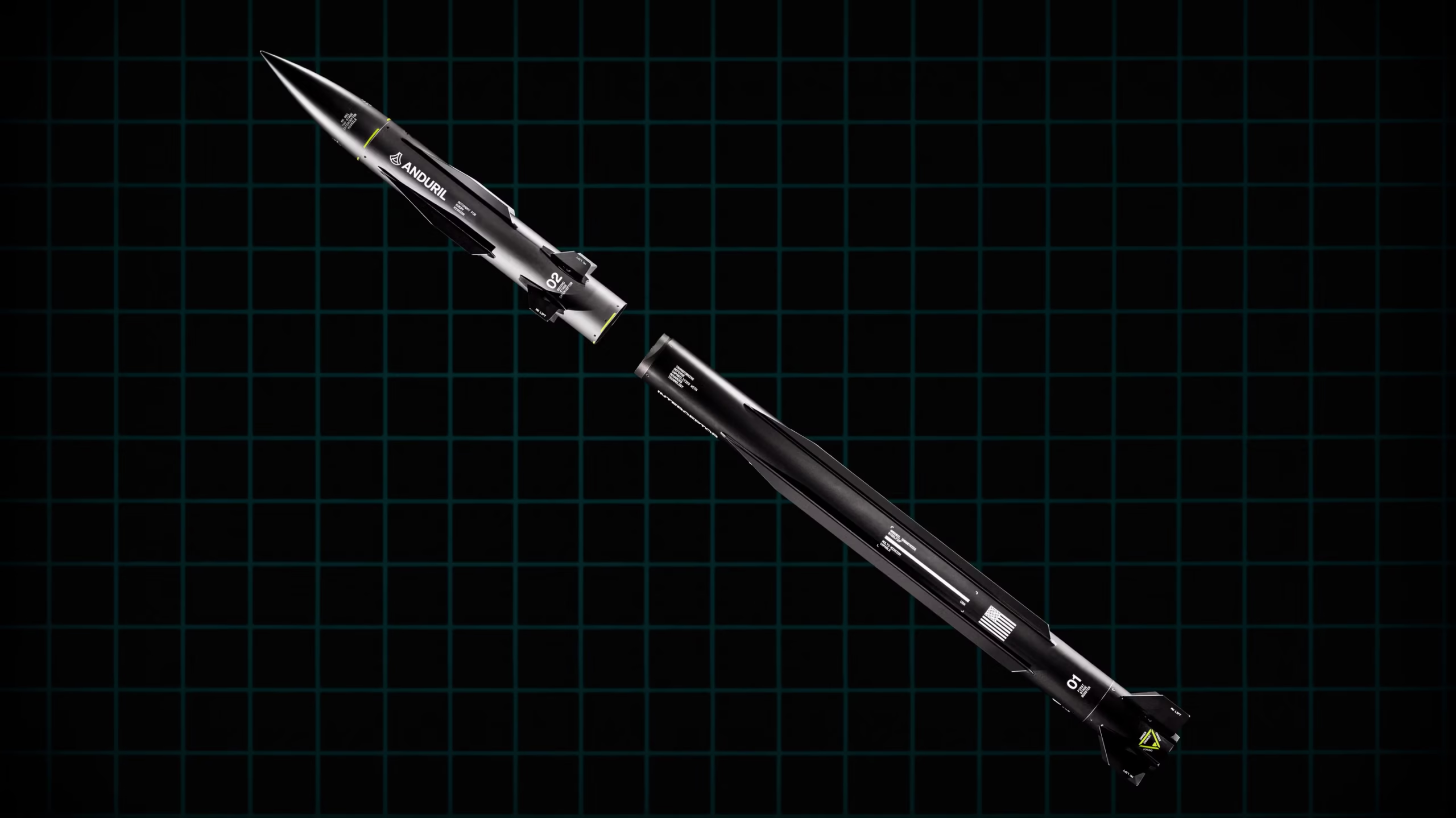
Anduril Industries unveiled Steelfin on October 12, 2026, a family of two-stage surface-to-air interceptor missiles built on a common architecture and designed to engage cruise, ballistic, and hypersonic missile threats. The company said it plans to produce several thousand Steelfin rounds per year in the near term and will begin flight testing variants in 2027.
Steelfin arrives as the Pentagon tries to fix a lopsided cost-exchange ratio in air and missile defense. The Army’s Fiscal Year 2027 budget request prices each Patriot Advanced Capability-3 Missile Segment Enhancement (PAC-3 MSE) interceptor at about $5.3 million, and the 2026 campaign against Iran sharpened concerns over US interceptor inventories. On May 15, 2026, the Army issued request for information MOSAIC-26-03 for a Low Cost Interceptor priced under $1 million per round and compatible with the M903 Patriot launcher and the Integrated Battle Command System (IBCS). In July, Lockheed Martin unveiled the PAC-3 Adapted Capability Effector (ACE), pitched at less than half the cost of an MSE.
Steelfin Interceptor Architecture: Swappable Boosters, Common Terminal Stage
Steelfin divides the missile into a first-stage booster and a second-stage terminal interceptor. The first stage accepts different solid rocket motor boosters, selected for required range, kinematic performance, launch configuration, or packing density. The second stage keeps one baseline across every variant: the same airframe, avionics, software, flight control system, and subsystem interfaces. Open, modular interfaces inside the terminal stage let Anduril integrate different seekers and mission systems without redesigning the round.
The design logic is reconfiguration rather than redesign. Instead of a new missile for each threat class, Anduril pairs one terminal vehicle with different boosters and payload packages. The company says the family will span point defense, lower-tier integrated air and missile defense, and upper-tier ballistic missile defense, while targeting “a fraction of the cost of today’s benchmark interceptors in each mission class.” In the lower tier, that benchmark is the PAC-3 MSE. In the upper tier, Missile Defense Agency budget data put a Terminal High Altitude Area Defense (THAAD) interceptor at roughly $12.4 million in Fiscal Year 2026.
For operators, a common terminal stage implies a shared software baseline, common test equipment, and simpler training across interceptor types, provided that commonality survives integration. For program managers, a seeker or software upgrade could in principle reach the entire family at once.
Anduril has not released dimensions, launch weight, speed, range, or intercept altitude for any variant. It has not disclosed seeker types, whether the terminal stage relies on hit-to-kill or a fragmentation warhead, or a unit price. Without those figures, Steelfin’s claimed capability against maneuvering hypersonic weapons cannot be independently assessed.
Production Scale and Launcher Integration From M903 to Mk 41
Anduril’s second argument is industrial. Legacy interceptors each depend on their own tooling, processes, suppliers, and facilities, which fragments volume across programs. Because Steelfin variants share components, they run down one production line with the same tooling and technicians, allowing Anduril to surge whichever variant demand requires. For scale, Lockheed Martin’s January 2026 framework agreement with the government aims to lift PAC-3 MSE output from 600 to 2,000 missiles a year over seven years.
Open interfaces in the terminal stage also allow commercial off-the-shelf components and multi-vendor competition for subsystems, broadening the supplier base. Propulsion remains the likeliest constraint. Anduril operates a 450-acre solid rocket motor complex in McHenry, Mississippi, which began full-rate production in August 2025 with a target of 6,000 tactical motors per year by the end of 2026. The company has not said whether Steelfin boosters will be built there.
On the launcher side, Anduril says Steelfin variants are compatible with the M903A2 Patriot launcher, the Mk 41 Vertical Launch System, the Army’s Typhon launcher, and emerging containerized systems. The missile is designed to integrate with fielded fire control software, including the Aegis Combat System and IBCS. That footprint covers Army Patriot batteries, Mk 41-derived Typhon units, and the vertical launch cells aboard Arleigh Burke-class destroyers and allied warships, which, if borne out, would spare services from buying new launchers.
Compatibility is not certification. Each new round must still clear integration, safety, and live-fire qualification with every launcher and combat system, and Anduril has published no timeline for any of them.
Analysis: Steelfin positions Anduril as a prime contractor for rocket-powered interceptors, not only a motor supplier. The company already builds the solid rocket motor for Boeing’s entry in the Army’s Integrated Fires Protection Capability Increment 2 Second Interceptor competition, which advanced to its next phase in September 2026. The Army’s Low Cost Interceptor effort, which splits its $1 million target into four subsystem groups capped at $250,000 each, rewards the modular, multi-vendor model Anduril describes. The technical risk sits in the terminal stage. A single airframe and flight control baseline must serve both point defense and upper-tier ballistic missile defense, where energy, divert, and seeker demands diverge sharply. Swapping boosters solves energy; it does not by itself deliver end-game agility against a maneuvering glide vehicle.
Anduril says it has spent years developing Steelfin, investing alongside multiple customers it did not name, and has completed ballistic testing with representative air vehicles. Flight testing of Steelfin variants begins in 2027. The decision points to watch are which variant flies first, whether Anduril discloses unit costs and customers, and whether Steelfin appears in Low Cost Interceptor awards or a Navy surface-to-air requirement.