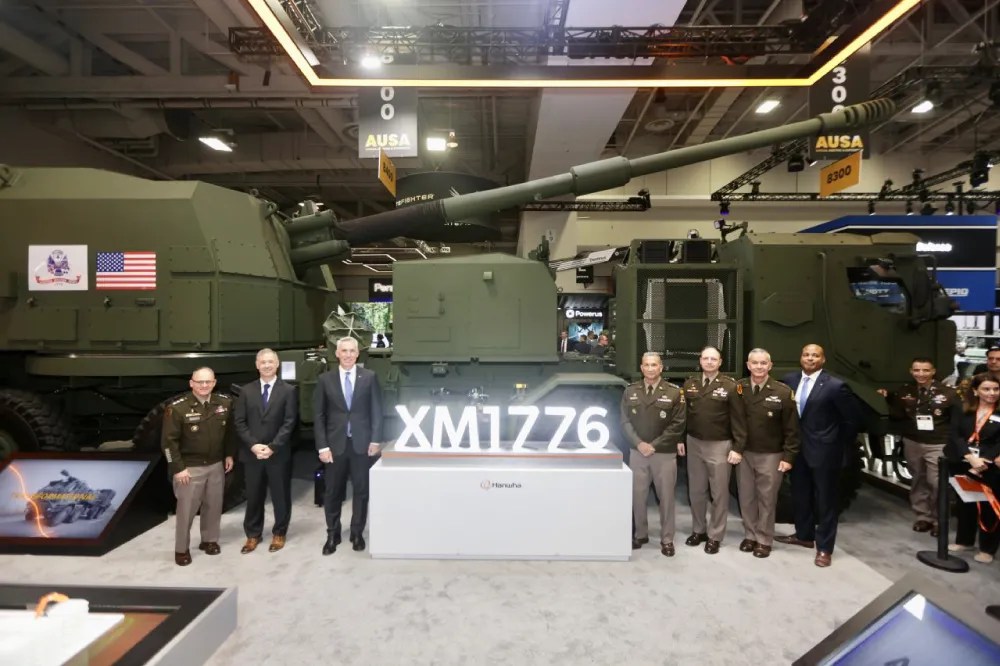
The U.S. Army and Hanwha Defense USA (HDUSA) unveiled the XM1776 Mobile Tactical Cannon (MTC) on October 12, 2026, formally assigning an American designation to the wheeled K9 Mobile Howitzer (K9MH) at a naming ceremony during the Association of the U.S. Army (AUSA) 2026 Annual Meeting and Exposition in Washington, D.C. HDUSA also announced that the Army has now ordered nine prototype XM1776 systems, with an option for nine more.
The designation caps a fast-moving acquisition. On August 18, 2026, the Army awarded HDUSA a competitively selected, firm-fixed-price Other Transaction Authority agreement covering up to 18 wheeled self-propelled howitzers for prototyping, testing, and soldier experimentation over an estimated four-year period of performance. The initial action was valued at $100,302,961, with a total cumulative face value of $262,903,274. The original six-plus-12 structure has since become nine-plus-nine, keeping the ceiling at 18 systems and, reportedly, the maximum value unchanged. If approved for fielding, the XM1776 will replace M777 towed howitzers in select formations, according to the Army.
XM1776 Mobile Tactical Cannon: K9A2 Turret on an 8×8 Chassis
The XM1776 is not a tracked K9 Thunder converted to wheels. Hanwha began developing the K9MH in 2024 by mounting the automated turret of the K9A2, the latest tracked variant, on an 8×8 truck chassis. Publicly available specifications indicate a combat mass under 40 tonnes, a CN98 155mm/52-caliber cannon, and a crew of three seated in an armored cab, down from five on the original K9.
The defining feature is the autoloader, which handles both projectiles and modular propellant charges. Hanwha cites a sustained rate of fire of eight to nine rounds per minute, a Multiple Rounds Simultaneous Impact (MRSI) capability, and 40 projectiles carried on board. The company also states the vehicle can fire and leave its position in under 30 seconds. Standard range exceeds 40 km, and published figures suggest roughly 70 km with extended-range munitions. The Army has not released performance data for the XM1776 configuration.
Mobility drives the program logic. Hanwha claims a road speed of about 100 km/h and an operational range of 700 km, against roughly 60 km/h and 360 km for the tracked K9. For units that rely on the M777, that means displacing in seconds rather than hitching a towed gun and loading a crew of seven to eight. On a battlefield where counter-battery radars and loitering munitions can locate and strike a firing position within minutes, displacement speed and crew protection now carry as much weight as range.
Opelika Plant and a 70-Supplier Artillery Industrial Base Coalition
HDUSA is establishing a Phase I site in Opelika, Alabama, as the U.S. integration and test facility for the XM1776 and the broader family of K9 Mobile Howitzers. The company signed a three-year lease there earlier in 2026, and Phase I is expected to create approximately 40 jobs. Under the initial plan, components ship from South Korea for final assembly in Alabama.
The more consequential effort sits upstream. Company leadership will meet more than 70 existing and potential suppliers to build an Artillery Industrial Base Coalition aimed at accelerating supply chain localization. Hanwha points to prior localized K9 production in Australia, Egypt, Poland, and Romania as the template.
Scale is Hanwha’s central argument. More than 2,500 K9 howitzers have been fielded worldwide, and the family is in service or on order with NATO members including Poland, Norway, Finland, Estonia, Romania, and Türkiye, the latter through the T-155 Fırtına derivative. HDUSA says that installed base offers the Department of War both a mature production model and interoperability with allies already operating K9 variants.
Mike Smith, HDUSA chief operating officer and president of land systems, framed the ceremony around speed: “The XM1776 Mobile Tactical Cannon represents the launch of the U.S. Army’s new long-range precision fires modernization effort and its powerful partnership with HDUSA to produce this system at speed and scale.”
How the XM1776 Fits Army Fires Modernization After ERCA
The XM1776 fills a gap left by the Army’s previous long-range cannon effort. The service canceled the Extended Range Cannon Artillery (ERCA) program, built around a 58-caliber gun on a modified M109A7 chassis, in its fiscal 2025 budget request after prototypes struggled with barrel wear. It then held vendor demonstrations in the United States and overseas. The Army said those events confirmed several vendors could offer mature, mobile cannon platforms; competitors for the MTC reportedly included Rheinmetall, BAE Systems, and General Dynamics.
Originally conceived as a wheeled 155mm system for Stryker brigades, the MTC runs separately from the Self-Propelled Howitzer Modernization (SPH-M) effort for the tracked fleet, where Hanwha has also entered the K9.
Soldiers will use the prototypes in operational experiments assessing performance, reliability, and supportability under realistic combat conditions, and the results will inform senior leaders’ fielding decisions. The Army has not disclosed which units will conduct the experiments or a target fielding quantity.
Analysis: An XM number moves the system into the Army’s own development and test architecture rather than leaving it a vendor product under evaluation, and raising the firm order from six to nine prototypes within two months points to a service moving faster than its four-year agreement implies. For the defense industrial base, the program tests a different model: a production-mature foreign design localized through a U.S. subsidiary. If Opelika and the supplier coalition deliver, the Army gains a wheeled 155mm system sharing a gun and turret lineage with weapons already in NATO inventories on the alliance’s eastern and northern flanks. The near-term risk is dependency: until localization matures, core components continue to ship from South Korea.
The next milestone is prototype delivery. Earlier schedules called for the first system before the end of 2026 and five more by mid-2027; HDUSA has not published a timeline for the three additional units. Open questions include when the Army exercises the option for nine more XM1776s, which formations receive the system first, and how quickly Opelika moves beyond final assembly. Any production decision will hinge on soldier feedback from the field experiments.