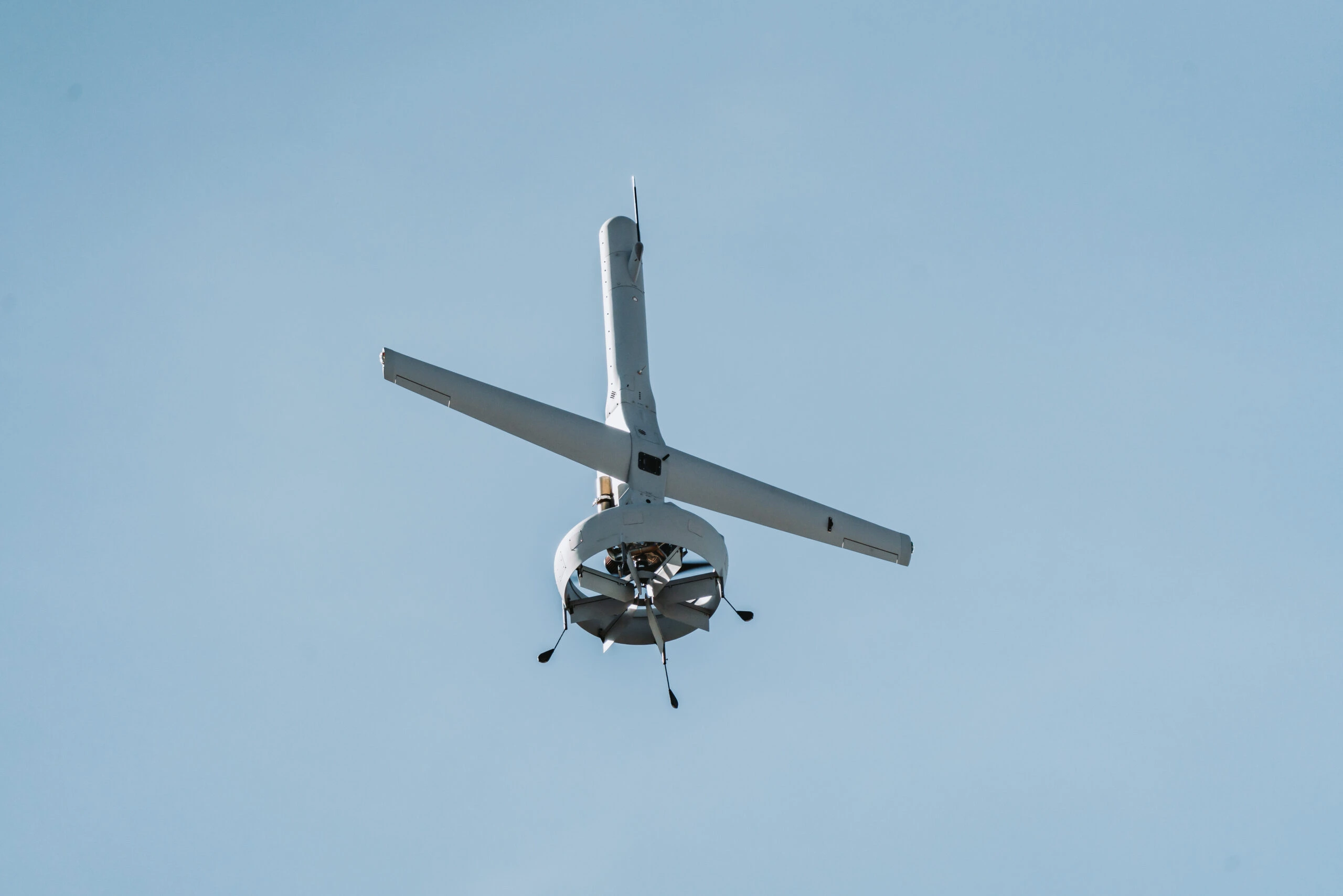
Taiwan’s Coast Guard Administration (CGA) has received its first V-BAT vertical take-off and landing (VTOL) uncrewed aircraft from Shield AI, the U.S. company announced on October 13, 2026. The airframe is the first of 12 V-BATs due over the coming months under the CGA’s Shipborne UAV program, a competition Shield AI won in July 2026 with its Taiwanese partner, Aerospace Industrial Development Corporation (AIDC).
The delivery puts a persistent airborne sensor aboard the cutters of Taiwan’s maritime law enforcement agency as China Coast Guard vessels continue to patrol inside the restricted waters around Kinmen and Chinese-crewed ships remain under scrutiny for damage to undersea cables near Taiwan. On October 7, the CGA displayed the newly arrived aircraft at the Port of Taipei for Ocean Affairs Council Minister Kuan Bi-ling and National Security Council Secretary-General Joseph Wu. AIDC told investors the contract is worth NT$1.2 billion, or roughly $37.7 million, for the 12 aircraft.
Taiwan Coast Guard V-BAT Deliveries Under the Shipborne UAV Program
The CGA will operate V-BAT from ships to sustain maritime domain awareness (MDA) for surveillance, coastal patrol and law enforcement missions. Because the aircraft launches and recovers vertically, it needs no runway, catapult or recovery net, which shrinks the shipboard footprint and crew requirement. The CGA has not said which vessels will embark the aircraft or how the 12 airframes will be distributed across its fleet.
Shield AI will train CGA operators and maintenance personnel, while AIDC builds a localized support system for the fleet. That arrangement flows from the Teaming Agreement the two companies signed in September 2025, which covers sustainment, training and autonomy integration. Under that deal, AIDC said it would service the aircraft in Taiwan and progressively replace maintenance parts with domestically produced components. At roughly NT$100 million per aircraft, the price likely bundles ground equipment, training and support; no breakdown has been published.
“V-BAT will give Taiwan’s Coast Guard the maritime domain awareness and intelligence picture needed across the Taiwan Strait and its maritime borders,” said Brandon Tseng, Shield AI president and co-founder. He pointed to the U.S. Coast Guard, where he said V-BAT helped intercept more than 100,000 pounds of narcotics last year. AIDC President Jennifer Chuang said Shield AI had shown it was “vested in helping build the local expertise and infrastructure” behind Taiwan’s maritime security.
MQ-35A V-BAT Specifications: Endurance, Payload, and Shipboard Recovery
V-BAT, designated MQ-35A in U.S. Navy service, is a Group 3 uncrewed aircraft system built around a single heavy-fuel engine, running on JP-5, that drives an enclosed ducted fan. The aircraft takes off on its tail, transitions to wing-borne cruise, and returns to a vertical attitude to land. Publicly available specifications indicate a maximum gross takeoff weight of 161 pounds (73 kilograms), a payload capacity of up to 40 pounds (18 kilograms) and 600 watts of power available to mission systems.
Shield AI rates endurance at more than 12 hours, rising past 13 hours with an electro-optical/infrared (EO/IR) payload. The company also states the aircraft can launch and recover in winds up to 25 knots from a deck moving at 10 knots, a key margin for cutters in the Taiwan Strait’s winter monsoon. Published line-of-sight control ranges are 130 kilometers with an MPU5 radio and 180 kilometers with a C-band link, with a satellite communications option for beyond-line-of-sight operations. Payload options include EO/IR turrets, synthetic aperture radar and the ViDAR passive wide-area search sensor, which applies machine learning to detect small surface contacts.
Shield AI’s Hivemind autonomy software allows the aircraft to continue reconnaissance tasks when GPS is denied or datalinks are jammed, and V-BAT has been operated in Ukraine. For the CGA, the practical gain is reach: a cutter’s mast-mounted radar sees only to the horizon, while a V-BAT on station for a full patrol shift can track and identify vessels far beyond it.
Taiwan Navy V-BAT Plans and the Wider Drone Buildup
Taiwan’s Navy has budgeted NT$36 billion from 2026 to 2029 for 280 shipborne V-BATs, 140 control systems and 82 transport vehicles, alongside NT$16.78 billion for 32 Albatross II drones developed by the National Chung-Shan Institute of Science and Technology (NCSIST). The Navy has justified the purchase as insurance against a joint fire strike designed to paralyze command-and-control networks early in a conflict, arguing that dispersed, jam-resistant drones can sustain a common operating picture in a degraded electromagnetic environment. Requirements for its next-generation frigate reportedly call for a hangar sized for the MQ-35A or an equivalent aircraft.
Taiwan joins a growing list of V-BAT maritime operators. Japan’s Maritime Self-Defense Force selected the aircraft in January 2025 as its first shipborne ISR platform, and Poland, the Netherlands and Greece have also acquired it. Beijing placed Shield AI on its unreliable entity list in April 2025, citing military technology cooperation with Taiwan.
Analysis: The sequencing matters more than the quantity. By fielding V-BAT first with the CGA, a civilian agency under the Ocean Affairs Council, Taiwan builds the training pipeline, maintenance skills and AIDC-run spares network on a 12-aircraft fleet before the Navy’s 280-aircraft buy arrives, reducing integration risk on the larger program. It also matches Beijing’s chosen instrument. China has applied pressure around Kinmen and in the Strait largely through coast guard and maritime militia vessels framed as law enforcement; giving Taiwan’s own law enforcement agency persistent overhead ISR lets Taipei document and answer gray-zone activity without committing military assets. Because Taiwanese law allows the CGA to be integrated into the armed forces in wartime, the same aircraft and data would extend the Navy’s sensor network in a crisis.
The remaining 11 aircraft are due over the coming months, though neither company has given a completion date or disclosed the sensor configuration ordered. The Navy’s NT$36 billion line still faces Legislative Yuan review as part of the 2027 defense budget. AIDC, meanwhile, is pursuing Green UAS certification to position its drone work for U.S. government supply chains that exclude Chinese components, a step that could extend its V-BAT sustainment role beyond Taiwan.