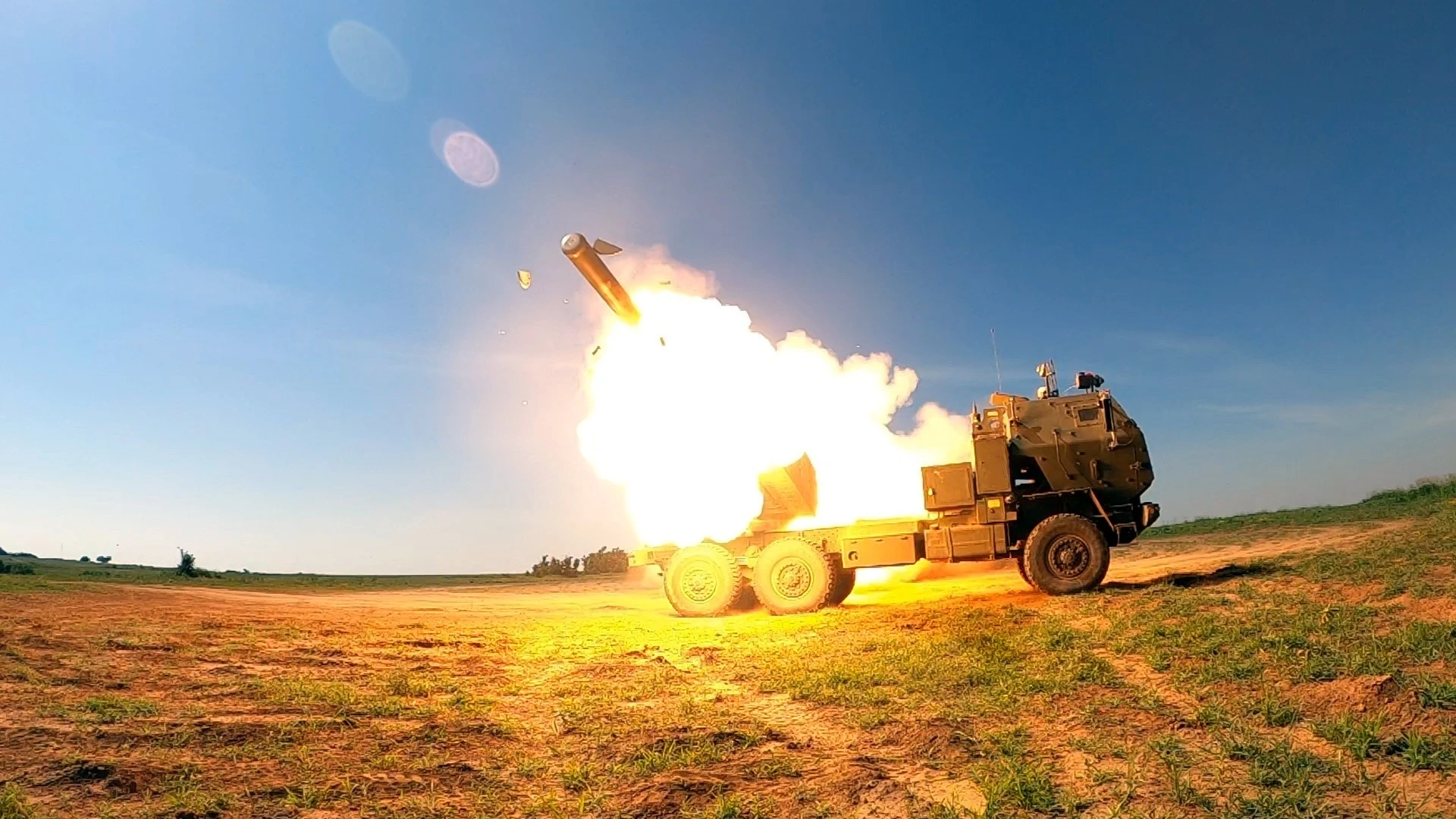
The U.S. Army on October 15, 2026, opened a competition for the Common Autonomous Multi-Domain Launcher-Lite (CAML-Lite), seeking complete autonomous launcher prototypes able to fire live munitions in Australia during Talisman Sabre 2027 in August. Solutions briefs are due October 23, and Phase 1 prototype Other Transaction Agreements (OTAs) are expected on December 18, 2026, according to the Request for Solutions Brief (RFSB) issued through the Army’s Rapid Capabilities and Critical Technologies Office (RCCTO) contracting office at Redstone Arsenal, Alabama.
CAML-Lite adds a light tier to a program the Army opened in June 2025 with medium and heavy variants. CAML seeks an autonomous or optionally crewed launcher that fires offensive and defensive munitions, reloads with minimal human involvement and could eventually take over the missions of the Typhon Mid-Range Capability, which Army leaders have described as very large. The Georgia Tech Research Institute became CAML weapon systems integrator in August 2026, under an OTA worth up to $33.4 million. Frank Lozano, the Army’s Portfolio Acquisition Executive for Fires, said on October 14 that the light variant will be developed with the Australian military and involve more than one vendor.
Nine Capability Objectives Shape the CAML-Lite Autonomous Missile Launcher
The RFSB sets three minimum requirements: a complete, integrated system combining mobility, launcher and reload capability; evidence it can fire live munitions in August 2027; and a commitment to fire at Talisman Sabre or an approved alternative event. The attached Statement of Objectives (SOO) then defines nine capability objectives, each with a threshold and an objective value.
The gap between the two is wide. Any live shot meets the OBJ-1 threshold; the objective is firing both offensive and defensive munitions during the demonstration. OBJ-2 allows human-assisted reload at threshold if the vendor supplies all materiel handling equipment, against fully autonomous reload with no external logistics equipment as the objective. OBJ-4 seeks an optionally crewed vehicle with teleoperation, waypoint and leader/follower convoy modes, and OBJ-9 accepts external launcher power at threshold, with self-sustaining onboard power as the goal.
Two objectives point at Indo-Pacific employment. OBJ-5 requires C-130 transportability unloaded at threshold and with a loaded missile pod at objective, which would let a launcher land ready to fire rather than wait for a separate resupply lift. OBJ-8 asks, at objective, for movement across mud, sand, snow and water under three feet deep, including from a ship through up to three feet of seawater onto shale or sandy beaches. The OBJ-7 command and control threshold only requires fire missions from non-tactical systems, with legacy and modernized Department of War systems as the objective.
The Army does not specify munitions, chassis or weight class; bidders propose munition types and quantities and whether they will supply them or request them as government-furnished items.
Cost Share, Tiered Options, and Data Rights in the CAML-Lite OTA
The effort runs under 10 U.S.C. § 4022: selected respondents receive a Request for Prototype Proposal (RFPP) on November 6, with proposals due November 20. Phase 1 funds a firm-fixed-price demonstration in two payments, at award and on acceptance of deliverables, but the Army says it will not cover the full cost. Cash performer investment is mandatory, and a larger committed share scores better regardless of business size. Prior research spending and existing assets do not count, and payments will not precede certified evidence that scheduled investment has been spent.
Each OTA also carries a priced, unexercised Phase 1 Prototype Acquisition Option: firm-fixed-price tiers of one to six additional prototypes, plus New Equipment Training (NET) and Contractor Logistics Support (CLS). The Army may exercise it until 90 days after its demonstration report, weighing delivery lead time, performance, price and right-to-repair terms, after requesting post-Talisman Sabre pricing that can only go down. Units can also be bought for international partners, including Australia.
The Army wants Unlimited Rights in interface definitions, form, fit and function data, and operations, maintenance, installation and training data, plus Government Purpose Rights in major system interfaces. Accepting minimum Right to Repair terms is a condition of award. Only U.S.-based firms cleared to handle SECRET information and hardware may bid. A successful prototype could lead to follow-on production without further competition under 10 U.S.C. § 4022(f).
From December Award to August Live Fire at Talisman Sabre 2027
The schedule leaves roughly eight months between award and live fire: a kickoff review within 30 days, a system checkout and readiness review in March 2027, a final planning conference in May, site preparation in Australia in July and the demonstration in August. Talisman Sabre, the biennial U.S.-Australian exercise, already hosted a Typhon live fire in 2025. Capabilities blocked by classification, export or range limits may be shown at an alternative government-sponsored event no later than September 30, 2027.
Vendors carry the burden. No soldiers will operate, maintain or repair the systems, and each performer must ship to Australia and handle customs, biosecurity inspection, export compliance and Australian explosive ordnance licensing. Required artifacts include a Safety Assessment Report, cybersecurity documentation for an Interim Authority to Test and an Open System Management Plan. Demonstration systems remain company property.
Purchased prototypes would support soldier experimentation, including with the 25th Infantry Division in Hawaii. Phase 2 would mature selected designs into production-representative prototypes on the common CAML architecture, with a technical data package allowing future competition of the system or its modules.
Analysis: CAML-Lite inverts the usual risk balance of an Army prototype effort. Industry funds part of a live fire abroad, prices production options before the first shot, accepts downward-only repricing and concedes interface and repair rights, all on an eight-month clock. That favors firms already holding launcher hardware, autonomy kits and cleared facilities, while the low power, reload and command and control thresholds show the Army is buying speed to a credible demonstration rather than maturity. A loaded C-130 objective, ship-to-shore mobility, a Hawaii-based light division and an Australian partner frame CAML-Lite as a distributed fires tool for the Indo-Pacific littoral, where Typhon’s footprint proved hard to manage. The open question is whether several designs built to loose thresholds can converge on the common CAML architecture.
Next come the October 20 virtual industry session, solutions briefs on October 23 and RFPP issuance on November 6. The Army has not disclosed demonstration funding, the number of awards, expected munitions or Australia’s contribution. Lozano said a CAML Medium award could come within 30 days, while a heavy variant, potentially carrying the Long-Range Hypersonic Weapon, is planned for 2028 to 2029.