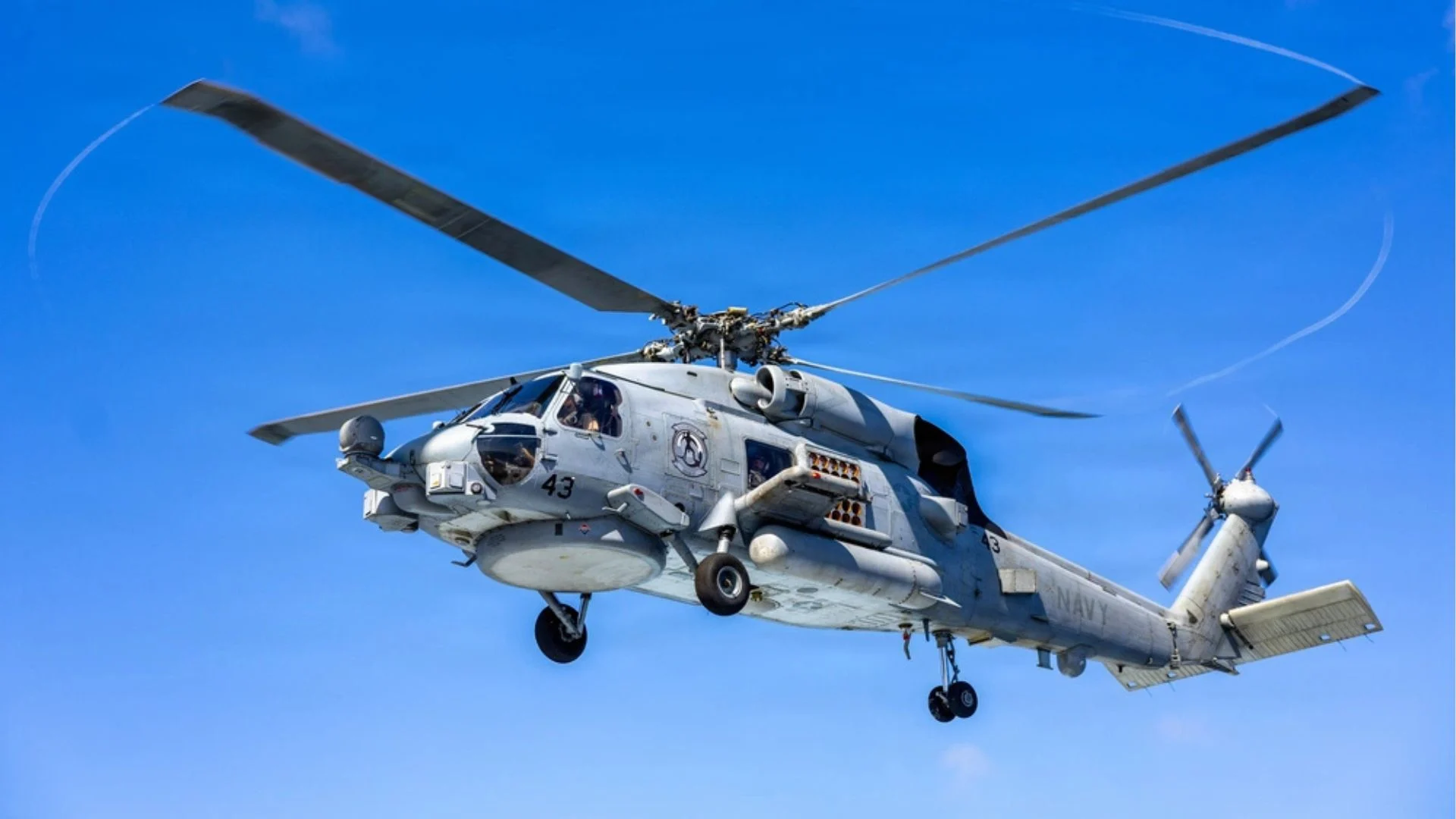
New Zealand has signed an agreement with the United States government to buy five Sikorsky MH-60R Seahawk maritime helicopters, with associated systems, spares and weapons, the New Zealand Defence Force (NZDF) announced on October 16, 2026. Deliveries begin in 2030. The project carries a capital cost of NZ$1.648 billion, roughly US$925 million.
The Foreign Military Sales (FMS) agreement closes a process launched on August 21, 2025, when Wellington named the MH-60R its preferred replacement for the Kaman SH-2G(I) Super Seasprite and skipped a competitive tender. The US State Department cleared the sale on June 5, 2026, at a ceiling of US$1.5 billion, alongside a separate US$69 million package of Mk 54 lightweight torpedoes. The helicopters rank among the costliest items in the 2025 Defence Capability Plan (DCP), a NZ$12 billion, four-year program meant to move defense spending toward 2% of gross domestic product within eight years.
New Zealand Seahawk Package: Radar, Sonar, Hellfire and Mk 54
The MH-60R is the US Navy’s standard ship-based multi-mission helicopter and has served with the US fleet since 2006. NZDF figures give a length of 19.76 meters, a maximum speed of 333 km/h (180 knots), a range of 963 km (520 nautical miles), a crew of three and more than 1,500 kg of payload in utility configuration. Two General Electric T700-series turboshafts power the airframe.
The sensor suite listed in the US approval defines the aircraft’s value: the APS-153(V) multimode radar, the AN/AAS-44C(V) electro-optical and infrared targeting system, the AN/ALQ-210 electronic support measures suite, an airborne low frequency dipping sonar, a digital magnetic anomaly detector and AN/SSQ-36, -53 and -62 sonobuoys. The AN/ARQ-59 Hawklink datalink feeds sensor data to the host ship, while a Multifunctional Information Distribution System Joint Tactical Radio System (MIDS-JTRS) terminal puts the helicopter on Link 16.
The weapons package covers 65 AGM-114R Hellfire missiles, 225 Advanced Precision Kill Weapon System (APKWS) laser-guided rockets with WGU-59A/B guidance kits, M299 launchers, LAU-61 digital rocket launchers, GAU-21 .50-caliber guns and five M240D 7.62 mm machine guns. The Mk 54 provides the primary anti-submarine kill weapon.
Operationally, dipping sonar, sonobuoys and Mk 54 give each Anzac-class frigate an anti-submarine warfare (ASW) reach well beyond its hull sonar and torpedo tubes. Hellfire and APKWS cover small boats and fast attack craft, relevant to maritime counter-terrorism and Pacific patrol tasks. Neither replaces a long-range anti-ship missile: HMNZS Te Kaha and HMNZS Te Mana carry none.
How New Zealand Will Field the MH-60R From 2030
The Seahawks keep the hybrid manning model used on the Seasprite. Royal New Zealand Navy (RNZN) aircrew will fly them, and Royal New Zealand Air Force (RNZAF) personnel will maintain them at RNZAF Base Auckland, Whenuapai, home of the Seasprite’s No. 6 Squadron. The agreement funds infrastructure design and temporary facilities there. Permanent infrastructure, training systems and what the NZDF calls complementary uncrewed aerial systems are left to later investment decisions, consistent with a Ministry of Defence plan to run the project in three tranches.
On top of the capital figure, the government has budgeted average operating funding of NZ$110 million a year over the next 10 years, which places the decade-long cost near NZ$2.75 billion before the later tranches are priced.
Fleet size remains the main point of debate. Five MH-60Rs replace an eight-airframe SH-2G(I) fleet, three of which the NZDF withdrew to supply spare parts for the remaining five. Then-Defence Minister Judith Collins argued in August 2025 that the Seasprites were available only 23% to 25% of the time, so a smaller, newer fleet should produce more usable flight hours. That argument will be tested when both frigates need embarked aircraft while training and deep maintenance continue ashore.
Interoperability with Australia, New Zealand’s only formal ally, drove the selection. The Royal Australian Navy (RAN) introduced the MH-60R in 2014 and ordered 13 more in 2022 to bring its fleet to 36. Common airframes, weapons, sonobuoys and datalinks open the way to shared training, pooled spares and routine cross-decking between RAN and RNZN ships.
Analysis: The signature turns a 2025 political choice into a contracted capability. The more than NZ$2 billion signalled at selection covered both capital and operating costs, so it does not compare directly with today’s NZ$1.648 billion capital figure. The risk now sits in the unfunded tranches. Without permanent hangars, a training system and the planned uncrewed aircraft, Wellington could field a high-end ASW helicopter that five airframes and one squadron struggle to keep at sea. The deal also carries a political message. Budget 2026 puts New Zealand’s defense spending at 1.23% of GDP, and at the 2026 Shangri-La Dialogue US Secretary of Defense Pete Hegseth described even a 2% target as freeloading. A common trans-Tasman MH-60R fleet gives Canberra and Washington a tangible measure of Wellington’s contribution.
Deliveries are due from 2030. The NZDF has not published a Seasprite retirement date, an aircrew conversion timeline or a delivery sequence for the five aircraft, and it has not said whether a gap will open between the two types. The next markers are Cabinet decisions on permanent Whenuapai infrastructure, training systems and the uncrewed aircraft meant to work alongside the Seahawk.