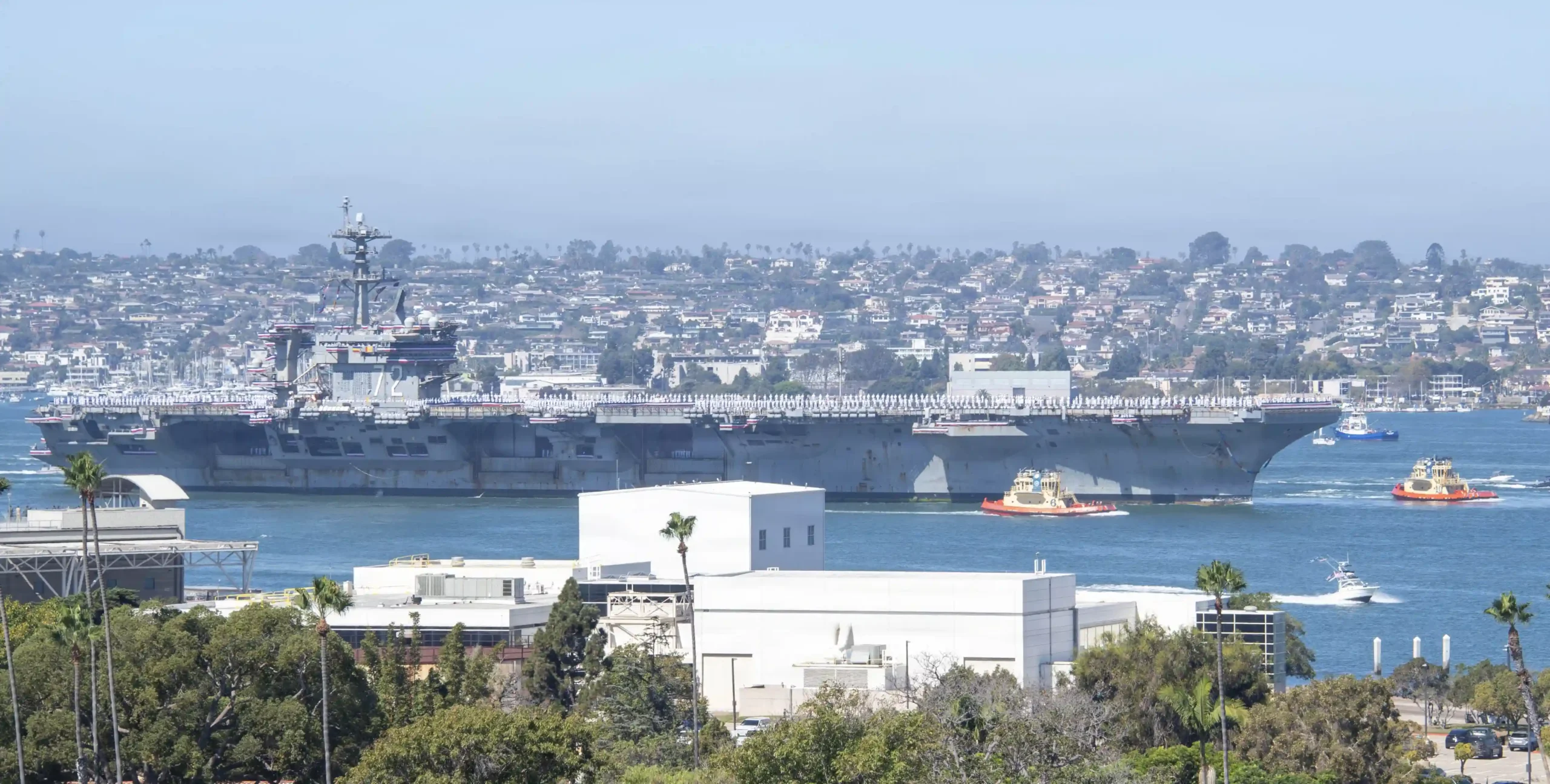
The Nimitz-class aircraft carrier USS Abraham Lincoln (CVN 72) will shift its home port from San Diego to Bremerton, Washington, later this year to complete a long-planned maintenance availability, Commander, Naval Air Forces announced on October 19, 2026. The Navy will execute the move as a permanent change of station (PCS) for the crew and their families.
The announcement comes 11 days after Lincoln returned to Naval Air Station North Island on October 8, 2026, from a deployment of more than 10 months across the U.S. 3rd, 5th and 7th Fleet areas of operations. Based in San Diego since January 2020 as flagship of Carrier Strike Group (CSG) 3, the carrier sailed on November 21, 2025, less than a year after returning from its previous deployment, in a break from the 36-month Optimized Fleet Response Plan (OFRP) cycle. Redirected to the Middle East, it arrived in theater in January 2026 to support Operation Epic Fury, the U.S. campaign against Iran.
USS Abraham Lincoln Heads to Bremerton After Record 265 Days at Sea
Lincoln logged a record 265 consecutive days at sea without a port call before stopping at Laem Chabang, Thailand, on September 2, 2026. The Japan-based USS George Washington (CVN 73) relieved it in the Middle East in August.
On October 7, Defense Secretary Pete Hegseth presented the crew with the Presidential Unit Citation for 40 days of combat operations and a maritime blockade of Iran. According to the citation, the Lincoln strike group flew 3,693 combat missions, delivered 1.37 million pounds of ordnance, launched 450 Tomahawk cruise missiles, shot down 77 one-way attack drones, sank 64 Iranian warships and destroyed 21 anti-ship cruise missiles. Lincoln is the second carrier, after USS Gerald R. Ford (CVN 78), to earn the award after an extended Iran war deployment. The deployment also drew congressional scrutiny over crew welfare and supply shortages.
Publicly available specifications put Lincoln at 1,092 feet in length and more than 100,000 tons full-load displacement, with two A4W pressurized-water reactors driving four shafts at speeds above 30 knots. Commissioned on November 11, 1989, the ship supports up to 90 aircraft; embarked Carrier Air Wing (CVW) 9 flies F-35C, F/A-18E/F, EA-18G, E-2D, CMV-22B and MH-60 aircraft. Sustained flight operations concentrate wear on the flight deck, catapults, arresting gear and hull. The Navy says the period will extend Lincoln’s service life and return it to its highest state of material readiness.
Why Puget Sound Naval Shipyard Anchors Pacific Carrier Maintenance
Bremerton hosts Puget Sound Naval Shipyard and Intermediate Maintenance Facility (PSNS & IMF), home to the West Coast’s only public dry dock able to take a nuclear-powered carrier. The Navy has not disclosed the type, duration or cost of Lincoln’s availability, nor whether it includes dry-docking. It framed the move as part of its “continued commitment to the strategic dispersal of ships.”
Earlier Bremerton home port shifts preceded docking work. USS Carl Vinson (CVN 70) moved there in 2018 ahead of a docking planned incremental availability (DPIA), and USS Ronald Reagan (CVN 76) completed an 18-month DPIA at the yard in September 2026. Lincoln knows the yard: it underwent a dry-dock rehabilitation there from 1995 to 1996, a DPIA from 2006 to 2007 and a nine-month planned incremental availability that ended in January 2010.
Chief of Naval Operations Adm. Daryl Caudle signaled the move in June, saying during a visit to Naval Base Kitsap that Lincoln would probably join Reagan there, with USS John F. Kennedy (CVN 79), the second Ford-class carrier, to follow from 2029. Capacity is the constraint. The existing carrier dock dates to 1962, cannot fully support Ford-class ships and falls short of current seismic standards. Under the Shipyard Infrastructure Optimization Program (SIOP), the Navy is soliciting bids for a new multi-mission dry dock through a contract vehicle worth about $15 billion, with proposals due December 1, 2026.
Analysis: The Bremerton move carries the maintenance cost of the Iran surge to the Pacific Fleet. Ford entered a planned incremental availability at Norfolk Naval Shipyard after its own 326-day deployment; Lincoln now follows on the West Coast after back-to-back deployments. The depth of its work package will determine how long the Pacific Fleet operates one carrier short. Concentrating Reagan, Lincoln and eventually Kennedy at Kitsap also deepens reliance on a single, aging carrier dock in a seismically active region, raising the stakes on SIOP delivering on schedule.
The Navy has said only that the shift will occur later this year. Open questions include the availability’s start date, scope and duration, whether Lincoln enters dry dock, and whether it returns to San Diego afterward. Milestones to watch include the multi-mission dry dock contract awards expected in 2027 and Kennedy’s planned commissioning in March 2027.