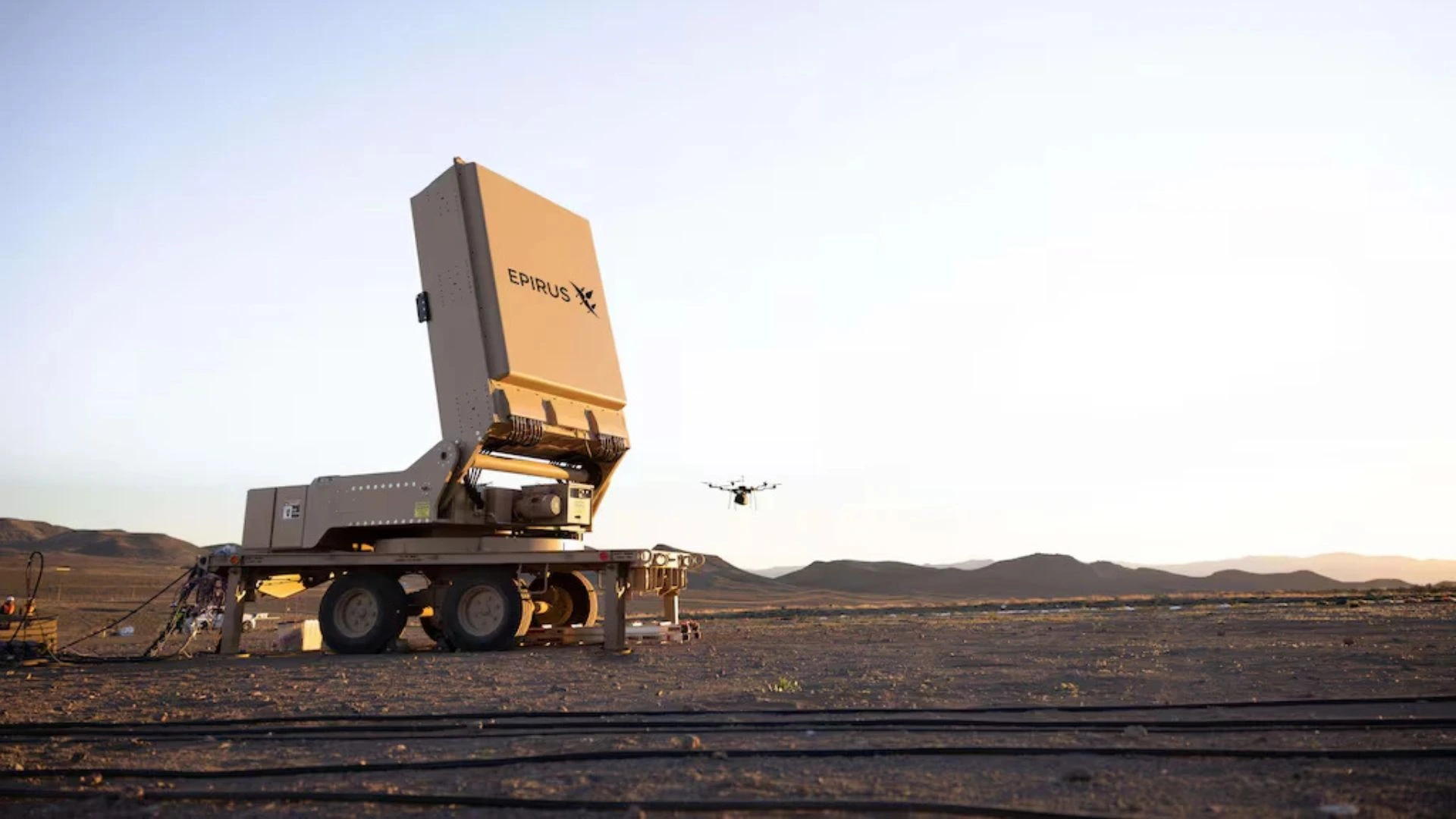
Epirus’ Leonidas high-power microwave (HPM) counter-drone weapon has been added to the Counter-Unmanned Aircraft Systems (C-UAS) Marketplace operated by Joint Interagency Task Force 401 (JIATF 401), opening a pre-validated ordering channel for U.S. military units and federal agencies. The California-based company said the system met the task force’s criteria for inclusion, but it did not disclose pricing, which Leonidas configurations are listed, or whether any customer has placed an order.
The listing follows the Department of War’s October 5, 2026, selection of Leonidas as the only microwave weapon among the first four systems in JIATF 401’s homeland directed-energy pilot, alongside AeroVironment’s Palletized High-Energy Laser, Kord Technologies’ Firefly and Boeing’s Compact Laser Weapon System. Mandated by the Fiscal Year 2026 National Defense Authorization Act (NDAA), the pilot will operate directed-energy weapons at U.S. installations for about a year, with Fort Huachuca, Fort Bliss, Naval Base Kitsap, Grand Forks Air Force Base and Whiteman Air Force Base identified as host sites. The marketplace adds a faster acquisition route alongside the Army prototyping effort under way since 2023.
How the Epirus Leonidas Listing Fits JIATF 401’s Marketplace
JIATF 401, the Army-led body directed by Brig. Gen. Matt Ross and created in 2025 to synchronize counter-drone work across the Department of War and interagency partners, declared initial operational capability for the marketplace on February 24, 2026. Hosted on the Army’s Common Hardware Systems (CHS) electronic catalog, the portal lets authorized users, including the Department of Homeland Security (DHS) and the FBI, compare sensors, effectors and components, review government test data, and place orders without launching a standalone contract each time. Only systems that pass the task force’s test and evaluation process are listed, and JIATF 401 has said it intends to carry all validated counter-UAS equipment not already tied to a program of record. Vendors post technical specifications, repair information and compliance data, and task force administrators approve each listing before it goes live; authorized users reach the portal at cuas.mil.
Sales have grown steadily since launch. The first four purchases, worth $13 million combined and covering low-collateral defeat effectors, sensors, radars and electronic warfare systems, were announced on April 15, 2026, when the catalog carried about a dozen counter-UAS systems. Cumulative sales reached $21 million by early August, according to the task force. In May, JIATF 401 awarded software company Kaizen a $15 million contract to prototype an upgraded platform, and the Army has since signed agreements allowing Australia, Poland, South Korea, the United Kingdom and Romania to buy through it. Whether Leonidas will be available to those partners through the same channel has not been disclosed.
Gallium Nitride Arrays and the Fiber-Optic Drone Problem
Leonidas uses a phased array of solid-state gallium nitride (GaN) amplifiers to emit pulses of microwave energy that disable the electronics inside unmanned aircraft. Its digitally formed, software-defined beam can focus on one target, cover a sector, or exclude friendly aircraft. Publicly available reporting indicates pulse widths extending to roughly one millisecond, longer than typical radar pulses. The tactical payoff is a one-to-many engagement: in an August 26, 2025, live-fire demonstration at Camp Atterbury, Indiana, Leonidas defeated all 61 drones flown across five scenarios, including a 49-drone swarm disabled with a single pulse, according to Epirus. Those results are company-reported.
Fiber-optic-guided first-person view (FPV) drones, now used extensively by both Russian and Ukrainian forces, have no radio link to jam. In January 2026, Epirus released footage of a Leonidas VehicleKit disabling a fiber-optic-guided drone during a December 2025 government test, attacking the onboard electronics directly rather than the control link. Epirus says Leonidas also defeats radio-controlled and autonomous drones; autonomy, like fiber-optic control, removes the link jammers exploit.
Engagement range has not been published for any configuration. The Army’s Indirect Fire Protection Capability-High-Power Microwave (IFPC-HPM) effort bought four first-generation prototypes under a $66.1 million Other Transaction Authority agreement in January 2023, all delivered by May 2024, then ordered two Generation II systems for $43.55 million in July 2025. Epirus projects Generation II will more than double the first generation’s maximum effective range and raise power by about 30 percent, adding high-density batteries and a high-duty burst mode for faster multi-target engagement. The family also includes the Marine Corps’ Leonidas Expeditionary, sized for a Joint Light Tactical Vehicle (JLTV) trailer, a maritime variant built to stop boat engines, and TRX Leonidas, which mounts the array on General Dynamics Land Systems’ 10-ton Tracked Robot.
Analysis: The listing matters less as a sale than as a change in how directed energy reaches users. Leonidas has not been publicly confirmed as a program of record despite three years of Army evaluation. A catalog entry lets installation commanders and federal agencies buy a tested configuration against an immediate threat, bypassing the multi-year program cycle. It also targets the two threats that strain layered defenses most: saturation attacks that exhaust one-to-one interceptors, and fiber-optic or autonomous drones that defeat jammers. Buyers will now scrutinize cost per engagement and sustainment, not lethality.
The next milestone is the directed-energy shoot-off JIATF 401 will host at Dugway Proving Ground, Utah, in December 2026, where task force leadership has said strong performers could receive purchase orders immediately. Key unknowns remain: Leonidas unit pricing, power and sustainment demands at fixed sites, which variants the marketplace carries, and whether the Army will move IFPC-HPM toward a formal production program. The first disclosed marketplace order will test operational demand.