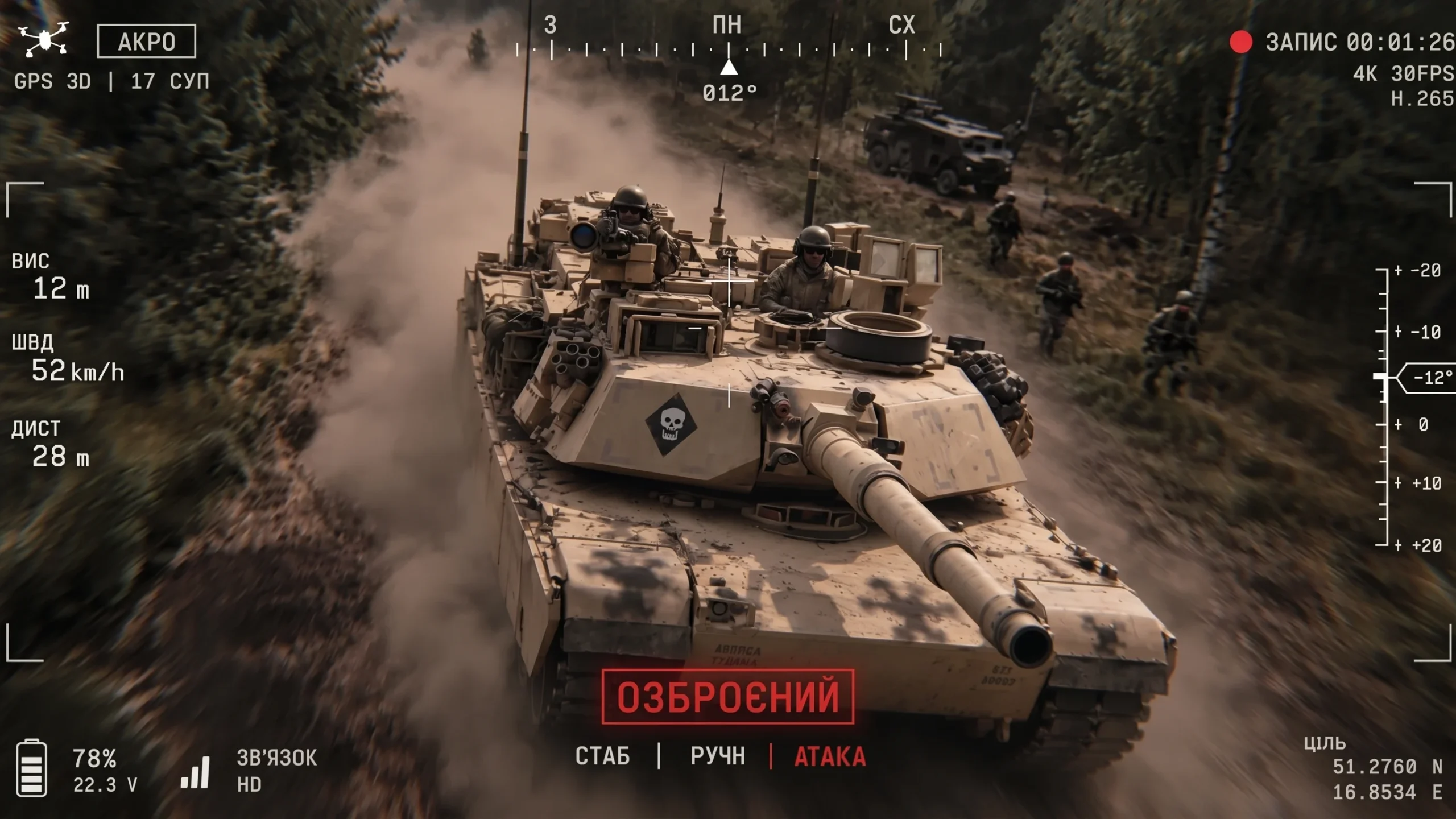
Ukrainian drone operators caused approximately 70% of the casualties suffered by the US Army’s 3rd Armored Brigade Combat Team (ABCT), 1st Cavalry Division, in the first three days of Exercise Combined Resolve 26-07 in Germany, according to an account by brigade commander Col. Michael Ziegelhofer and six of his officers in the Army journal Military Review. By day three, the brigade, known as “Greywolf,” had pushed that share below 30% despite undiminished enemy pressure.
The rotation ran from April 9 to May 10, 2026, at the Joint Multinational Readiness Center (JMRC) in Hohenfels with more than 3,600 participants from seven nations. JMRC’s resident opposing force, the Warrior Battalion, was reinforced by a detachment from the 412th Regiment of Ukraine’s Unmanned Systems Forces, known as “Nemesis,” which initiated drone contact more than 750 times.
How Ukrainian Drone Operators Forced a Fieldcraft Reset at Hohenfels
Enemy drones inflicted losses through direct strikes and by spotting for artillery. The brigade’s Protection Cell distributed counter-unmanned aircraft system (C-UAS) and electronic warfare systems to battalions by priority, with jammers projecting protective bubbles up to 2 km in radius around maneuver elements. Those systems had to be emplaced at static positions and bounded forward, opening vulnerability windows during the attack. Moving formations kept taking hits, and the equipment was less effective against the smaller number of fiber-optic drones, which are steered through a physical cable rather than a jammable radio link.
More than half of the formation therefore depended on fieldcraft: overhead cover and concealment, dispersion, react-to-drone-contact battle drills fast enough to displace before artillery landed, and concealed secondary routes in place of high-speed avenues of approach. Troops had rehearsed these techniques, the authors note, but only heavy simulated casualties in the opening days forced genuine adherence. They estimate that roughly 60% of the brigade-level C-UAS fight comes down to fieldcraft and battle drills.
Survivability carried a measurable cost. Vehicles gave up Blue Force Tracker satellite links, radio reach and even Starshield connectivity to shrink their electromagnetic signature, and formations traded wide fields of fire for narrow engagement areas from covered positions. Sustainment took twice as long as planned because the opposing force hunted the brigade’s resupply network, forcing logisticians to favor concealment and unpredictability over efficiency. Dense forest also left digital friendly-position data stale, forcing voice clearance of fires.
How 700 Drones and a Forward Fire Line Enabled Two Breaches
Greywolf fought the first half of the rotation without control of the 3rd Battalion, 504th Parachute Infantry Regiment (3-504), then an experimental drone battalion. For the offensive phase, the brigade gained 3-504 and employed more than 700 drones from platoon to brigade echelon. Using loitering repeater drones, nearly all of the battalion’s aircraft could range 25 to 40 km, enough to cover the entire 14-by-27 km training area.
That abundance broke the brigade’s doctrinal collection tools. The information collection matrix and synchronization matrix, built for scarce and centrally controlled sensors, proved unworkable, so the staff shifted to mission command, tasking 3-504 like a cavalry squadron with intelligence requirements, target priorities and the commander’s intent. Instead of the doctrinal deep-to-close approach, the brigade placed its coordinated fire line forward of the cavalry squadron, giving drones and artillery free rein against anything beyond it.
A high-payoff target guidance matrix set the order of attack: enemy drone ground control stations, command posts, radars and electromagnetic warfare assets first, for immediate destruction; then engineer vehicles such as the GMZ minelayer and IMR-2M; then air defense systems including the 2S6M, SA-8 and SA-15. The brigade withheld part of its drone munitions for the decisive point and reserved narrow air corridors for attack helicopters and medical evacuation, separating most other aircraft by altitude. Greywolf then breached at two points roughly 6 km apart. Unable to identify the main effort, the opposing force stopped neither breach and lost its reserve before committing it.
Proposed Multifunctional Strike Troop Design: Three UAS Platoons per Brigade
The authors recommend that ABCTs house aerial drones in multifunctional strike troops (MFST) and armored strike platoons, a concept the 1st Armored Division’s Ready First Brigade tested earlier in 2026. Their proposed MFST comprises three UAS platoons: one flying long-endurance surveillance drones out to at least 40 km; one fielding medium and heavy bomber drones carrying four to eight high-explosive or shaped-charge munitions; and one pairing strike drones with repeaters to match that reach. The electronic warfare platoon would move to the cavalry squadron, and the MFST would report directly to brigade headquarters. Armored strike platoons would mirror the troop one echelon down for battalion commanders.
System incompatibilities kept drone feeds off the brigade’s sensor common operational picture, and the main command post never knew how many drones were airborne, where they flew or what they observed. The authors want every brigade drone on a shared picture, citing Ukraine’s Delta battlefield management system as the model. On protection, they call for layered C-UAS that works on the move: hard-kill active protection on every vehicle, mobile systems at platoon and company level, and longer-range radar and defeat systems at battalion and brigade.
The account does not identify the drone types flown by 3-504 or the Ukrainian detachment, nor the C-UAS systems the brigade fielded.
Analysis: The central finding is structural. Army collection, targeting and airspace frameworks were built around scarce sensors and shooters, and each buckled under abundance. Greywolf recovered by decentralizing sense-and-strike within commander’s intent, much as Ukrainian drone units operate in combat. For US and NATO armored forces on the eastern flank, the lesson cuts both ways: drones restored freedom to choose where and when to attack, but only after soldiers accepted degraded connectivity, slower sustainment and a fieldcraft discipline no jammer replaces.
The authors frame the MFST as an interim home for drones, not a final design. Key indicators include whether the Army revises Field Manual (FM) 3-60 targeting and FM 2-0 intelligence doctrine for drone-saturated formations, and how quickly armored brigades field mobile C-UAS.