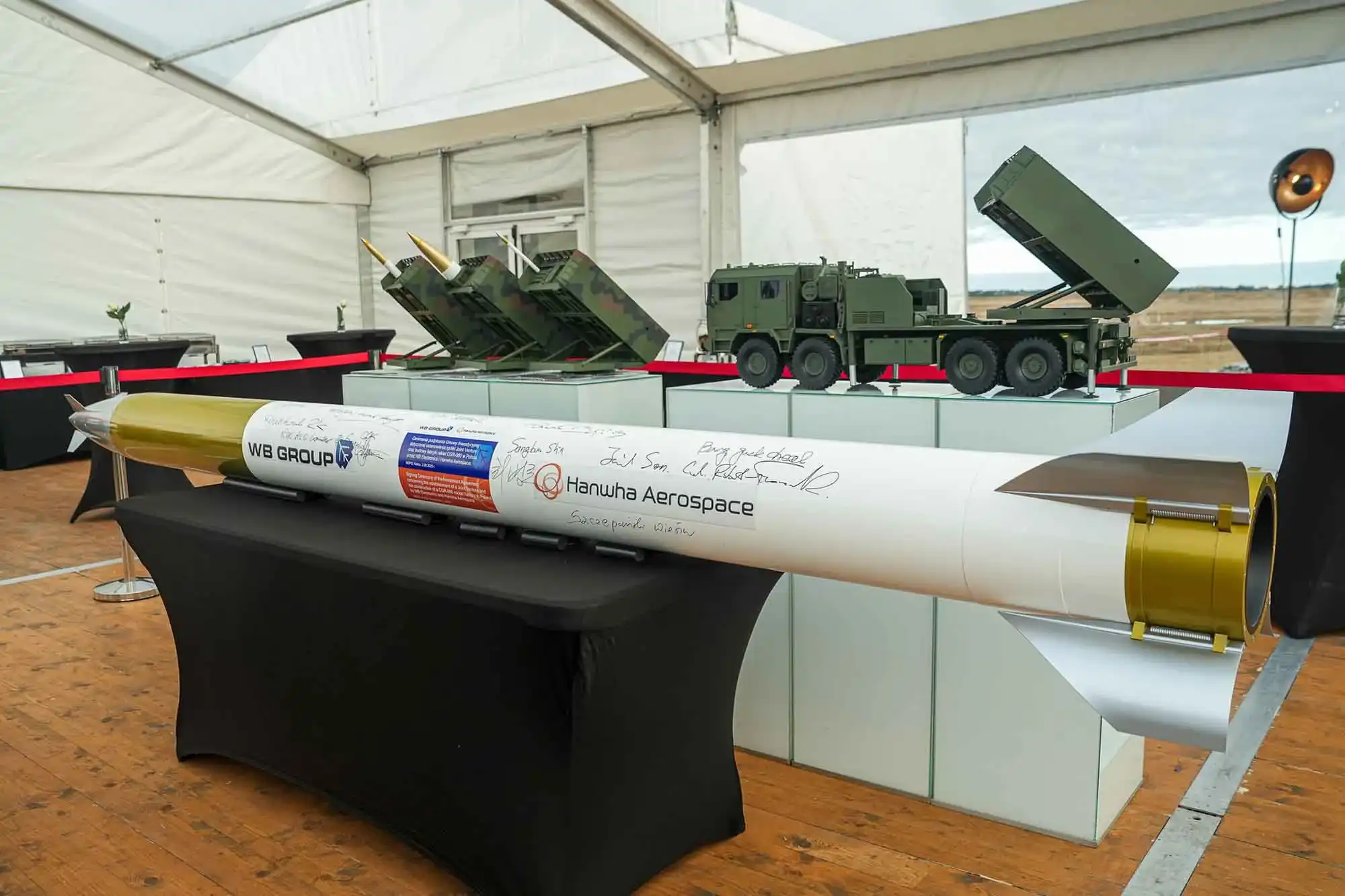
Hanwha WB Advanced System (HWBAS), the Polish joint venture of South Korea’s Hanwha Aerospace and Poland’s WB Electronics, broke ground on November 4, 2026, on a plant in Gorzów Wielkopolski that will manufacture CGR-080 guided rockets for Poland’s Homar-K multiple rocket launchers. Initial production is scheduled for late 2029, with full-rate output and the first contracted deliveries to the Polish Armed Forces due in 2030.
The project executes the third contract under the Homar-K framework, signed on December 29, 2025, between Poland’s Armament Agency and a consortium led by HWBAS. The agreement is worth about 14 billion zlotys gross, or roughly $4 billion, and reported volumes exceed 10,000 rockets, with deliveries scheduled to run through 2033. Two earlier contracts, signed in November 2022 and April 2024, covered 218 and 72 launchers respectively, for a planned fleet of 290. Rockets delivered to date have come from South Korean production.
CGR-080 Guided Rocket Plant Moves From Contract to Construction
Hanwha Aerospace holds 51 percent of HWBAS and WB Electronics 49 percent. The partners signed a technology transfer, production line and license agreement in October 2024 and formed the company in September 2025. A License Agreement between Hanwha Aerospace and HWBAS now provides the framework for manufacturing in Poland. Hanwha Aerospace describes Gorzów as its first guided weapons production base outside South Korea.
The site covers about 116 hectares in the Lubuskie region of western Poland. Preparatory works began in July 2026, and completion is targeted for 2028. Magdalena Sobkowiak-Czarnecka, Secretary of State at the Polish Ministry of National Defence, said the complex will comprise more than 60 buildings and create more than 250 jobs; other published estimates range from about 150 to about 500. Estimates of the plant’s cost have ranged from more than 1 billion to about 2 billion zlotys, and the November 4 announcement gave no final figure.
The scope extends beyond the factory to technology and know-how transfer and maintenance, repair and overhaul (MRO) capabilities across the system’s life cycle. A letter of intent with the CEZiB vocational education center in Gorzów covers internships, apprenticeships, workshops and curriculum development. WB Group President Piotr Wojciechowski described the site as “Poland’s first facility of this kind” for advanced artillery missiles.
What the 239 mm Round Adds to Polish Long-Range Fires
The CGR-080 is a 239 mm guided rocket with a range of up to 80 kilometers. Publicly available specifications indicate a length of 3.96 meters, GPS-aided inertial navigation, and a circular error probable (CEP) of about 15 meters. The design accommodates a high-explosive penetrating warhead, developed for a South Korean Army requirement against bunkers, and a submunition variant. The November 4 announcement did not specify which warhead Poland will produce.
Rockets are loaded six to a transport-launch container, and each Homar-K launcher carries two containers, for 12 rounds per load. The same launcher can instead carry two CTM-290 tactical ballistic missiles with a range of up to 290 kilometers. Homar-K mounts the launcher module of the South Korean K239 Chunmoo on a Polish Jelcz truck chassis. Because rockets are handled as complete pods, reload tempo depends on container output as well as rocket output, and the plant is expected to deliver rockets already installed in locally built pods.
The CGR-080 falls in the same range class as the US Guided Multiple Launch Rocket System (GMLRS), which publicly available data credit with up to 85 kilometers. Poland also operates the M142 HIMARS launcher that fires GMLRS, but talks on Polish production of that rocket were still ongoing at last public report. That leaves the CGR-080 as the 80-kilometer-class round with a contracted production line in Poland.
Analysis: Gorzów addresses magazine depth, the factor that determines how long a rocket artillery force can sustain fire. More than 10,000 rockets across 290 launchers equates to about 34 rounds per launcher, or just under three full loads, before counting rounds bought under earlier contracts. The degree of Polish control over that magazine is less clear. Plans made public in July call for more than 100 rocket components and the containers to be made in Poland, but the domestic content share has not been disclosed. Propellant, warhead and guidance sourcing will determine how independent the line becomes.
Hiring is expected to begin in the second half of 2027, ahead of plant completion in 2028 and technology transfer, testing and certification before initial production. The partners said in September 2025 that initial serial production would reach an advanced stage before the end of 2028, so the current schedule runs about a year later. Exports remain prospective: Hanwha Aerospace CEO Billy Boo-hwan Lee cited “potential opportunities in European markets,” and Sobkowiak-Czarnecka named Norway, Estonia and Croatia as likely buyers, but no purchase from Gorzów has been announced.