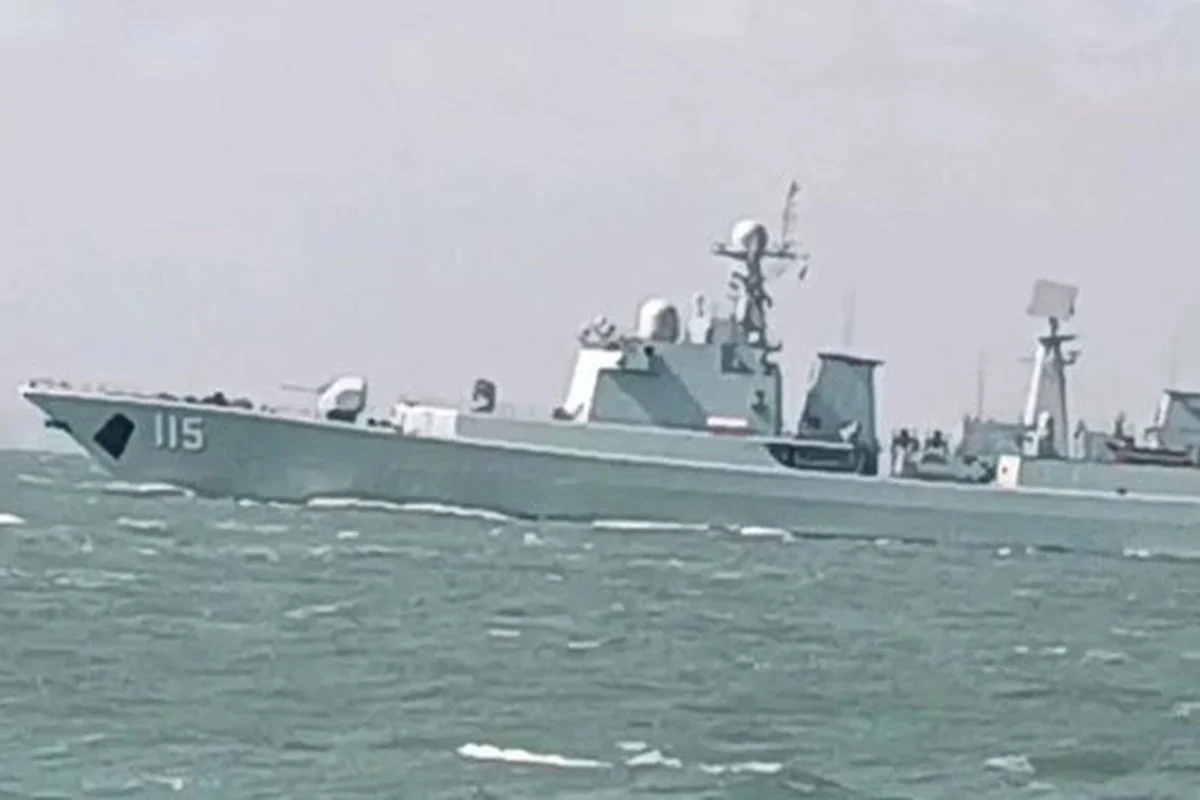
The People’s Liberation Army Navy (PLAN) Type 051C destroyer Shenyang, hull number 115, has been photographed on sea trials with its Russian-built S-300FM long-range air defense system apparently removed and four eight-cell HQ-10 short-range missile launchers installed in its place. The images, which surfaced on Chinese social media in mid-October 2026, are the first public look at the Luzhou-class lead ship in more than a year.
The refit arrives as the PLAN retires warships built around imported or first-generation systems. On August 28, 2026, the Navy decommissioned the Type 052 destroyer Harbin, hull number 112, in Qingdao after 32 years of service, as Type 052D and Type 055 destroyers keep joining the fleet. Shenyang and her sister ship Shijiazhuang, hull number 116, were commissioned in 2006 and 2007 as a stopgap, giving the PLAN fleet-area air defense before its domestic HHQ-9 vertical launch ecosystem matured.
Type 051C Destroyer Refit: From S-300FM to HQ-10 Point Defense
Built at Dalian Shipyard on an enlarged derivative of the Type 051B hull, the Type 051C displaces about 7,100 tons at full load, measures roughly 155 meters with a 17-meter beam, and runs on steam turbines for a top speed near 30 knots, according to publicly available specifications. Its defining weapon was the S-300FM, designated SA-N-20 by NATO, with 48 missiles in six eight-round revolver launchers: two behind the 100 mm gun and four on the aft deckhouse.
The system relied on track-via-missile guidance from a single 30N6-series Tomb Stone phased-array fire-control radar. Open-source figures credit it with engagement ranges out to about 150 kilometers, altitudes from 10 meters to 27 kilometers, and up to six targets engaged simultaneously. That envelope made the two Luzhou-class hulls, alongside the early Type 052C destroyers, the core of PLAN fleet-area air defense in the late 2000s.
The new photographs show the revolver launchers and the Tomb Stone radar gone. In their place sit four eight-cell HQ-10 launchers of the type fielded on Type 056 corvettes. The HQ-10 is a point-defense missile comparable in role to the U.S. Rolling Airframe Missile, combining passive radio-frequency and imaging infrared homing, with a published reach of about 9 kilometers against subsonic targets and 6 kilometers against supersonic ones. If the imagery is read correctly, ready rounds fall from 48 to 32 and the engagement radius contracts from about 150 kilometers to 9.
Other modifications are visible but uncharacterized. It is unclear whether the Russian Fregat-MAE-5 (Top Plate) 3D search radar has been replaced, whether medium-range vertical launch system (VLS) cells were added, or which combat management system now ties the ship together; none of this has been independently confirmed.
How the Shenyang Refit Compares With Shenzhen and Sovremenny Upgrades
Replacing imported subsystems with domestic equivalents is long-standing PLAN practice. The first two Type 956E Sovremenny-class destroyers bought from Russia, Hangzhou and Fuzhou, emerged from midlife refits with 32-cell VLS for HQ-16 medium-range missiles in place of single-arm Russian launchers, YJ-12A supersonic anti-ship missiles instead of the 3M80E Moskit, a 24-cell HQ-10 launcher, and domestic radar and electronic warfare suites. The one-off Type 051B destroyer Shenzhen traded its HQ-7 launcher for 32 HQ-16 cells in a mid-2010s refit. Even the Russian-built Kilo-class submarines received Chinese communications gear, electrical systems, and optronic masts.
Those programs preserved or improved medium-range air defense. On current evidence, Shenyang has received point defense only. One plausible explanation is structural: the S-300FM revolver drums occupy deep below-deck magazines, and converting that volume for a modern VLS would require heavy rebuilding of a ship that the South China Morning Post (SCMP) estimates has about 10 years of service life left. Another is architectural: according to the SCMP, the imported equipment is difficult to integrate with the PLAN’s current data-sharing networks, and sustaining a small Russian missile inventory for just two ships carries cost and supply-chain exposure that domestic HQ-10 rounds avoid.
Steam Propulsion and No Hangar: Limits of a 2000s-Era Hull
The refit does not resolve the class’s platform constraints, several of which the SCMP also highlighted. Steam turbine propulsion is less fuel-efficient than the gas turbine plants on newer PLAN destroyers. The large aft launcher bank also prevented the ships from carrying a full helicopter hangar, leaving only a flight deck sized for a Ka-28-class helicopter; whether removing those launchers freed space for a hangar is unknown. The hull also predates the reduced radar cross-section shaping of later Chinese designs.
The remaining armament, per publicly available specifications, centers on surface action and self-defense: eight YJ-83 anti-ship missiles, a 100 mm gun, two Type 730 30 mm close-in weapon systems, and two triple 324 mm tubes for Yu-7 lightweight torpedoes. Whether the YJ-83s were retained is not yet clear.
That loadout points away from the fleet-area mission. Area air defense in PLAN task groups now rests on Type 052D destroyers with 64 VLS cells and Type 055 destroyers with 112, both carrying the HHQ-9 family. A refitted Shenyang fits naturally into second-line duties such as near-seas patrol, escort of auxiliaries, and training.
Analysis: The Shenyang refit reads less as a modernization than as a managed demotion. On the available imagery, the PLAN has traded a 150-kilometer area-defense umbrella for a 9-kilometer self-defense bubble, accepting the loss of reach in exchange for full compatibility with domestic logistics, missile stocks, and combat networks. That trade only makes sense for a navy that no longer needs the Type 051C to protect anyone else, because dozens of Type 052D and Type 055 destroyers now carry that mission. For U.S. and allied planners, the signal is depth: the PLAN can strip a 7,000-ton destroyer of its primary weapon and still keep the hull usefully employed.
Key unknowns remain. No official details of the refit have been released, and the status of Shijiazhuang, also absent from public view, is unconfirmed; a matching conversion would indicate a class-wide decision. Follow-on imagery should show whether a new 3D radar, medium-range VLS, or hangar has been fitted. The next clear indicator will be Shenyang’s assignment after trials: front-line escort, near-seas patrol, or training.