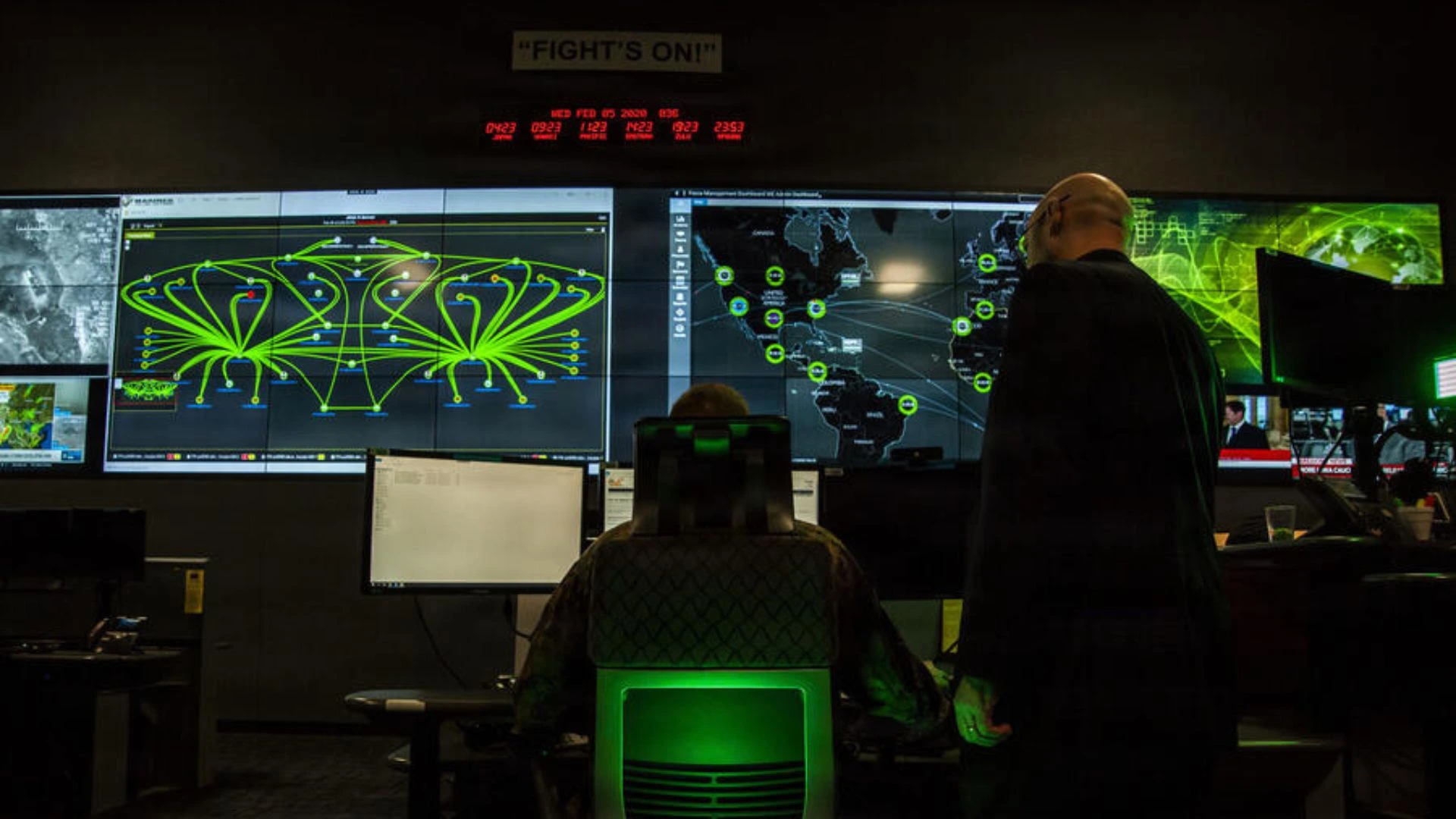
Leidos has secured a five-year, $160 million U.S. Cyber Command contract to help the command plan and conduct full-spectrum military cyber operations, the Reston, Virginia-based company announced on October 21, 2026. The award covers the integration and coordination of offensive and defensive cyber operations, including operational support to secure, operate and defend the Department of War Information Network (DoWIN).
The award arrives as U.S. Cyber Command (USCYBERCOM) reshapes how it generates and employs cyber forces. The command is implementing its revised force generation model, known as CYBERCOM 2.0, which builds on congressionally granted service-like authorities such as Enhanced Budget Control and acquisition authority. Its defensive arm, the former Joint Force Headquarters-Department of Defense Information Network (JFHQ-DODIN), was elevated to a sub-unified command in May 2025 and now operates as the Department of War Cyber Defense Command (DCDC). Gen. Joshua Rudd, confirmed by the Senate in March 2026 in a 71-29 vote, leads both USCYBERCOM and the National Security Agency (NSA) under the dual-hat arrangement.
What the $160 Million Cyber Command Contract Covers
According to the company, Leidos will deliver four lines of support to the command:
- Cyber defense
- Operational planning
- Emerging threat analysis
- Development of tactics, techniques and procedures (TTPs)
The stated objective is to help USCYBERCOM coordinate and synchronize full-spectrum cyber operations across its mission partners. Joint doctrine groups cyberspace missions into three categories: offensive cyberspace operations (OCO), defensive cyberspace operations (DCO) and the network operations required to secure and run the department’s information enterprise. The Leidos scope touches all three. That breadth separates the award from narrower defensive support or network operations contracts, and places the contractor inside the planning cycle that connects intelligence on adversary activity to operational options for the command.
Several contractual details remain undisclosed. Leidos did not identify the contract vehicle, the award type, whether the effort was competed, the number of offerors or the place of performance. The company also did not specify which USCYBERCOM components, such as the Cyber National Mission Force or DCDC, will draw on the support. Spread evenly across five years, the ceiling averages roughly $32 million per year, a figure consistent with a specialized planning and analysis workforce rather than a large-scale capability build.
Jason O’Connor, president of Leidos Intelligence, framed the requirement around tempo and adversary knowledge. “Cyberspace operations demand speed, deep technical expertise and an understanding of how adversaries operate,” he said.
How Kudu Dynamics Shapes the Leidos Offensive Cyber Offer
O’Connor said the team assembled for the contract draws on the full Leidos cyber portfolio, including the recently acquired Kudu Dynamics. Leidos closed the roughly $300 million all-cash acquisition on May 23, 2025, its first purchase in two and a half years. Founded in 2013 and based in Chantilly, Virginia, Kudu employed around 170 people at the time of the deal and built its business with Department of Defense and intelligence community customers.
Kudu specializes in automated targeting, scalable hardware reverse engineering and the generation of non-kinetic effects against military-relevant systems. Leidos acquired it specifically to accelerate AI-enabled offensive cyber, electromagnetic spectrum operations and vulnerability research. For a contract that pairs operational planning with TTP development, that profile matters: planners who understand how exploitation and effects are engineered can frame more realistic options and assess adversary tradecraft with greater precision.
The award also advances the Leidos NorthStar 2030 strategy, which identifies cyber as a key growth driver. In financial terms, the contract is modest for a company that reported approximately $17.2 billion in revenue for the fiscal year ended January 2, 2026. Its value lies in positioning: it places Leidos at the operational core of USCYBERCOM rather than at the network periphery.
Analysis: The award illustrates how heavily USCYBERCOM still depends on contractor capacity for planning, threat analysis and TTP development while CYBERCOM 2.0 reworks force generation across the services. Bundling offensive and defensive coordination under one support effort mirrors the logic behind the elevation of DCDC: a senior Pentagon official said at the time that separating offensive and defensive cyber operations was not ideal. For the defense industrial base, the contract signals that firms combining offensive capability development with operational support, as Leidos now does through Kudu, are well placed as the command gains more control over its own budget and acquisition.
Next milestones include any formal contract announcement that clarifies the vehicle and competitive history, further CYBERCOM 2.0 implementation decisions, and the command’s use of its acquisition authorities in the fiscal 2027 budget cycle. Leidos may also provide additional detail in its next quarterly earnings report. Until then, the precise division of work between offensive planning and DoWIN defense remains unknown.