The US Air Force has awarded Air Space Intelligence Federal Inc. of Cambridge, Massachusetts, a $26,020,100 firm-fixed-price purchase order for commercial software licenses covering the Flyways Artificial Intelligence (Flyways AI) platform, a cloud-hosted decision-support tool that the 618th Air Operations Center will use and customize at Scott Air Force Base, Illinois. The order was awarded on September 28, 2026, announced by the Department of War on November 9, 2026, and runs through September 28, 2031.
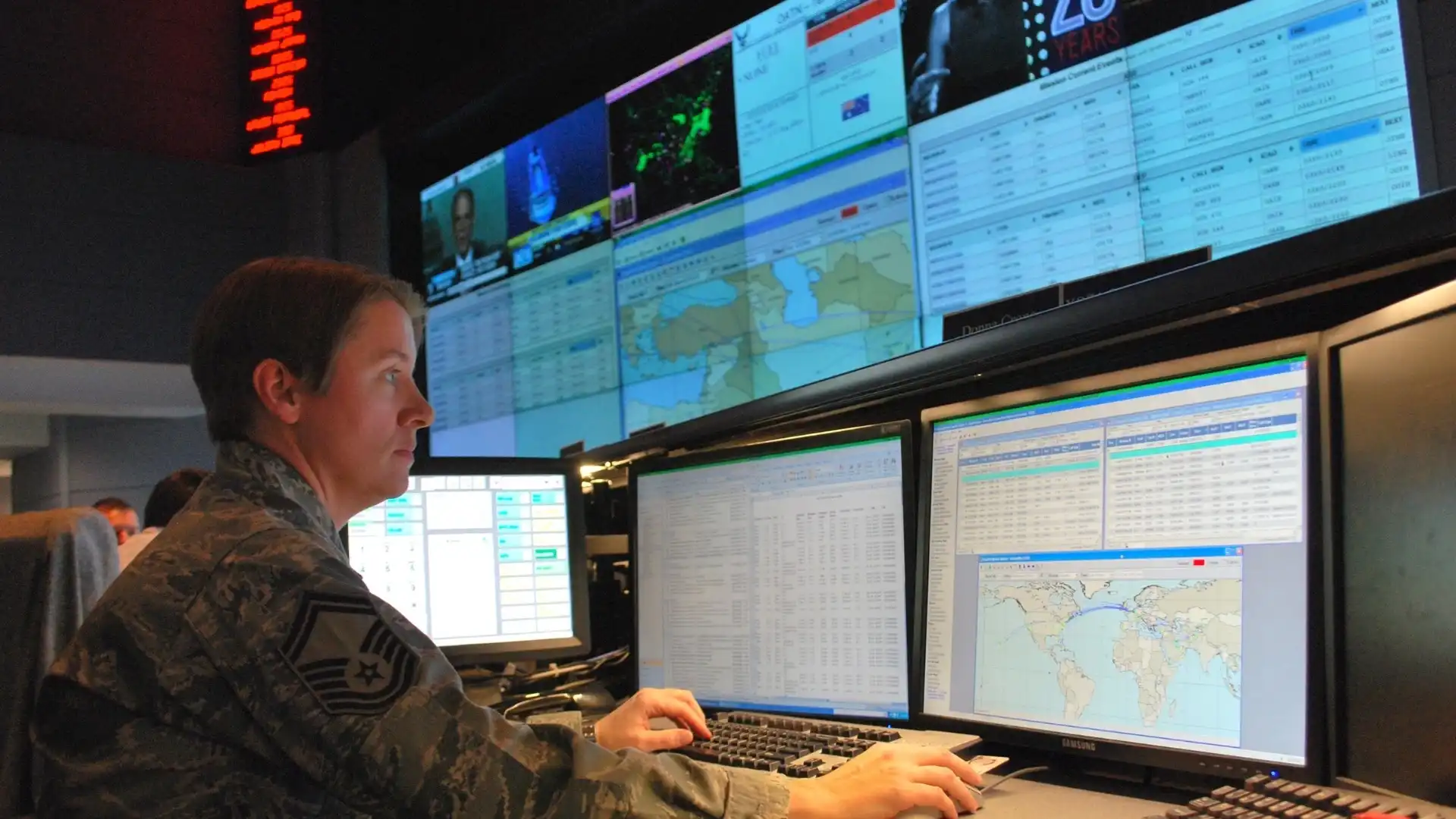
The 618th Air Operations Center (Tanker Airlift Control Center), or 618th AOC (TACC), is Air Mobility Command’s global air operations center, supporting all 11 combatant commands. About 800 personnel plan, schedule and direct a fleet of nearly 1,100 mobility aircraft for airlift, air refueling and aeromedical evacuation, and the center works with commercial contractors to meet airlift requirements as needed. The license places a commercial artificial intelligence (AI) platform inside that planning cycle and extends an existing relationship between Air Mobility Command (AMC) and Air Space Intelligence (ASI), as the same software scales across US civil aviation.
Flyways AI Contract Terms and Transportation Fund Financing
The purchase order was a sole-source acquisition, meaning the Air Force did not compete the requirement. The 763d Enterprise Sourcing Squadron at Scott AFB awarded contract FA4452-26-P-0019. The announcement lists the company as a small business.
The license covers both use and customization of the platform. That distinction matters for an operations center whose workflows differ sharply from those of an airline: customization rights let the 618th AOC adapt a commercial product to military mission sets without funding a bespoke development program. The announcement does not specify the number of users or the security accreditation level of the cloud environment hosting the platform.
At award, the Air Force obligated $5,000,000 in fiscal 2026 Transportation Working Capital Funds (TWCF), about one-fifth of the total. The TWCF is a revolving fund managed by US Transportation Command (USTRANSCOM) and replenished by customer payments for transportation services, not a direct modernization appropriation. Financing the license from this fund ties the software to the business of moving cargo and passengers, the mission the 618th AOC executes for USTRANSCOM. The firm-fixed-price structure places cost risk on the vendor.
The award is not ASI’s first with AMC. In October 2025, the company announced it would transition its NITMRE-Geo application, developed under the command’s Next-Generation Information Technology for Mobility Readiness Enhancement (NITMRE) effort, into full production, and quoted then-Air Force Chief of Staff Gen. David Allvin describing NITMRE as a leading example of the Air Force adopting commercial technology. ASI says NITMRE-Geo gives mobility operators AI-enabled capabilities that power core operational workflows. The November 9 announcement does not reference NITMRE, and it remains unclear whether the purchase order funds the same capability, an expansion of it, or a separate license.
From Airline Dispatch to Air Mobility Command and Control
ASI, headquartered in Boston and backed by Andreessen Horowitz, built Flyways for commercial flight operations before adapting it for defense. At Alaska Airlines, the platform weighs weather, winds, turbulence, airspace constraints and traffic volume to propose more efficient routes, providing decision support to dispatchers. Alaska reported that Flyways-optimized routes saved more than 1.2 million gallons of fuel in 2023. The platform also supports flight routing for Delta Air Lines and United Airlines, and the company claims it touches more than 40 percent of US air traffic.
The civil footprint is growing. In June 2026, the Federal Aviation Administration (FAA) selected ASI for a 12-year contract, valued by the company at $875 million, to deploy two traffic management systems, Flow Management Data and Services (FMDS) and Strategic Management of Airspace, Routing and Trajectories (SMART), across the National Airspace System.
Defense work has followed. In February 2026, ASI announced a Defense Innovation Unit (DIU) prototype agreement for a Joint Sustainment Decision Tool (JSDT) that generates logistics courses of action for commanders in contested environments. In late September 2026, the Army awarded the company a five-year indefinite-delivery, indefinite-quantity (IDIQ) contract with a $99 million ceiling, with an initial task order for Corps-level fires deconfliction.
Air mobility planning shares core problems with airline network operations: routing through congested and restricted airspace, absorbing weather disruptions, and replanning when one delayed aircraft cascades through a schedule. The 618th AOC adds military constraints, including tanker offload planning, aeromedical evacuation priorities and commercially contracted aircraft.
Analysis: The award shows AMC treating AI decision support as a commercial subscription rather than a development program, and paying for it from a transportation business fund rather than a modernization line. That model moves fast, but it concentrates dependency. One company now supplies predictive routing to major US airlines, the FAA’s traffic flow modernization, Army command-and-control work and the operations center that directs the Air Force’s tanker and airlift fleet. A shared engine offers real benefits for civil-military airspace coordination over the continental United States, where mobility sorties and airline traffic share the same sectors. It also means the resilience and cybersecurity of a single commercial platform increasingly bear on wartime mobility, at a time when adversaries treat logistics networks as targets. A sole-source, five-year license limits competitive pressure during the period in which that dependency deepens.
Two questions remain open: which 618th AOC workflows Flyways will support, and whether the order builds on NITMRE-Geo. With $5 million obligated against a $26.02 million ceiling, follow-on obligations in fiscal 2027 and beyond will show whether the license scales toward its full value.