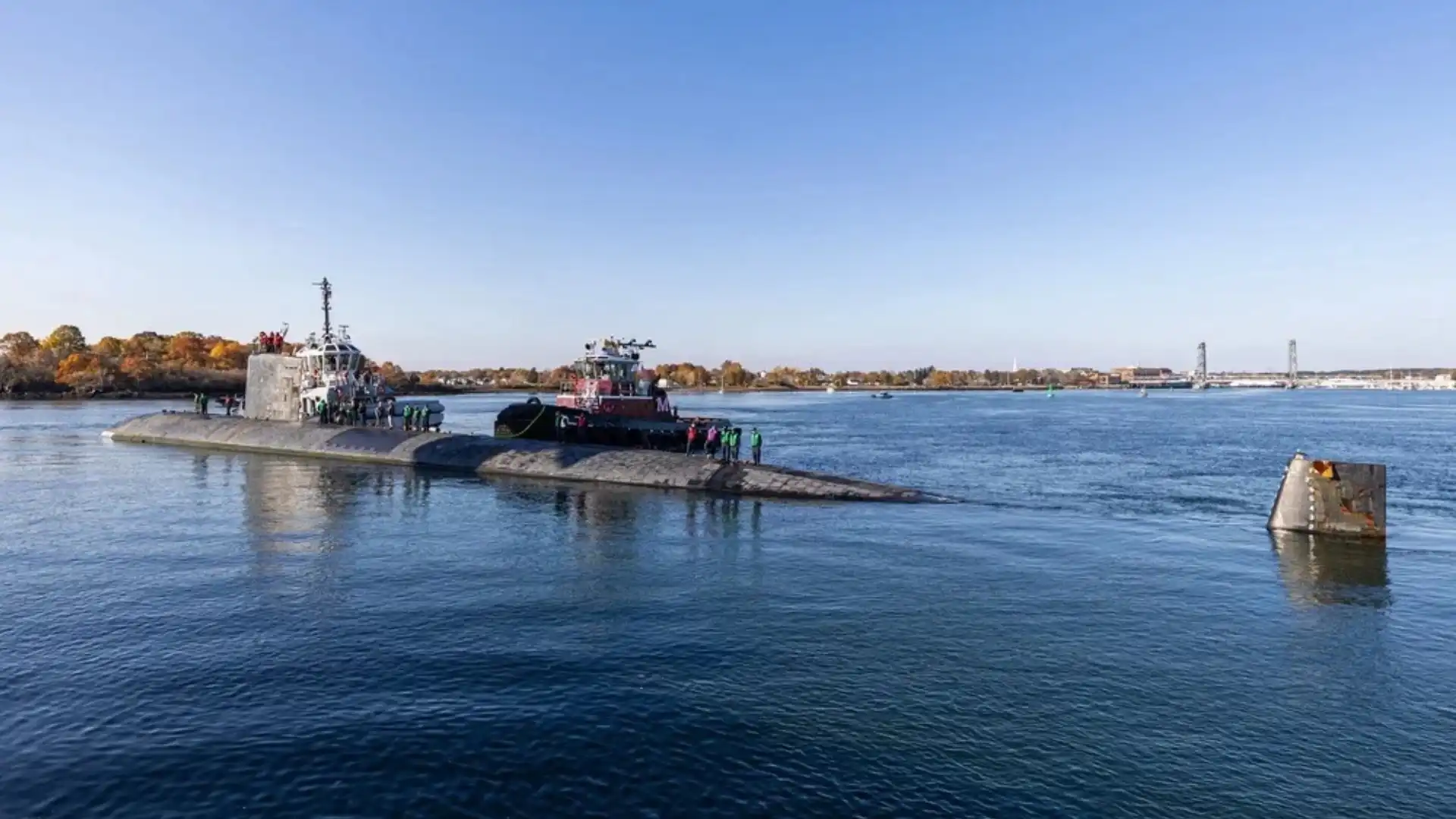
The Office of Naval Research (ONR) has awarded General Dynamics Applied Physical Sciences (APS) Corp., of Groton, Connecticut, a $19,999,957 cost-plus-fixed-fee completion contract for an effort titled “Advancements in Undersea Dominance and Naval Engineering,” according to a Pentagon contract announcement published November 9, 2026. The five-year award funds studies and new technology development aligned with what the announcement calls a new framework for naval warfare, with work in Groton expected to run through September 2031.
The award lands four months after ONR released its 2026 Science and Technology Strategy, which reorganizes the Navy’s roughly $3 billion annual research enterprise around a framework called “FEED at Speed” and 11 priority focus areas. Two of those areas, Undersea Systems and Naval Engineering, map directly onto the contract title. It also follows the July 29, 2026 award of $76.6 billion in contract modifications for five Columbia-class ballistic missile submarines and nine Virginia-class Block VI attack submarines, a package the Department of War framed explicitly around undersea dominance. APS is a General Dynamics research unit that works closely with Electric Boat, prime contractor on both classes.
Contract Terms Behind the Undersea Dominance Research Award
The contract carries a 60-month base period and no options, so its ceiling and its total value are identical. ONR obligated $5.1 million in fiscal 2026 research, development, test and evaluation (Navy) funds at award, about 25% of the total, and those funds will not expire at the end of the current fiscal year. The remaining $14.9 million depends on future appropriations.
The completion designation matters. Under federal acquisition rules, a cost-plus-fixed-fee completion contract obligates the contractor to deliver a defined end product, typically documented research findings, rather than a specified level of effort over time. ONR is paying for answers, not hours.
The Navy competed the work under its Long Range Broad Agency Announcement for Navy and Marine Corps Science and Technology (N0001425SB001). Because that solicitation accepts proposals year-round, the number of competing bids is unknown. The contract number is N0001426C1321.
The announcement is thin on technical scope. It specifies that first principles and physics-based modeling and simulation will be emphasized in all cases, that APS will perform in-house research where relevant, and that the company may draw on available domestic and foreign technologies to develop novel techniques. It does not identify the platforms, mission areas or foreign technology sources involved, and much of the work is likely to be controlled or classified.
Inside General Dynamics APS: Acoustics, Hydrodynamics and Submarine Quieting
APS was incorporated in 2002 with a focus on acoustics and hydrodynamics. General Dynamics acquired it in 2012 to reinforce Electric Boat’s ability to answer emerging submarine requirements. The company reports that about a quarter of its technical staff hold doctorates in engineering, physics or mathematics.
Its published capability areas read like an inventory of the disciplines that decide submarine survivability: maritime sensing, signal processing, ocean engineering and hydrodynamics, undersea communications, underwater signatures and platform self-noise, structural mechanics, and electromagnetic machinery. Each translates into a tactical variable. Radiated signature sets the range at which an adversary’s passive sonar can detect a boat. Flow-induced self-noise limits how fast a submarine can transit while keeping its own sensors effective. Structural acoustics governs how machinery vibration couples into the hull and the water.
The firm’s contract history confirms that orientation. Since April 2023, APS has worked on the Defense Advanced Research Projects Agency’s Advanced Propulsor, Experimental (APEX) program, examining propulsor efficiency, signature and mechanical limits for crewed and uncrewed submarines; follow-on orders lifted that contract to $52.2 million. In 2021, ONR awarded APS a $14.3 million contract, also with a five-year base and no options, to develop physics-based tools and concepts for enhanced submarine security, with completion expected in April 2026. In October 2026, Naval Sea Systems Command awarded the company a further $49.95 million for platform engineering, prototypes and demonstrations through September 2030.
How the Award Fits ONR’s FEED at Speed Strategy
Chief of Naval Research Rachel Riley’s strategy, released July 22, 2026, organizes ONR around five lines of effort: Focus, Explain, Engage, Deploy and Speed. Its central screening test is the “Only ONR” problem, a high-impact naval challenge in an area where commercial investment is unlikely. Undersea technology fits that test cleanly: the physics of quieting or detecting a nuclear submarine has no meaningful commercial market.
The Undersea Systems focus area covers undersea sensors, distributed systems, exploitation, and weapons and effects. Naval Engineering covers resilient naval systems, integrated cyber-physical systems, and complex systems and design sciences. The APS contract title straddles both. The announcement does not name the framework it references, so this alignment is an inference from title and timing rather than a stated link.
The physics-based emphasis also tracks the strategy’s goal of making physical science, not bureaucracy, the rate-limiting factor in research. High-fidelity hydroacoustic and hydrodynamic models let engineers screen concepts before costly at-sea testing.
Analysis: At $20 million over five years, this award is small next to the $76.6 billion construction package, but the two operate on different horizons. Construction contracts lock in Columbia and Virginia Block VI configurations; first-principles research of this kind feeds the acoustic and engineering margins of the boats that follow, including the next-generation attack submarine, SSN(X). Housing that knowledge base in the same corporate family as the lead submarine builder shortens the path from model to hull, directly addressing the transition gap ONR’s own strategy identifies. The explicit authorization to use foreign technology may point to allied cooperation such as AUKUS Pillar II, though the announcement does not say so.
The next visible markers will be incremental funding obligations from fiscal 2027 onward, which will show whether the Navy sustains the effort at full value. ONR has also committed to annual Innovation Industry Days across its focus areas, where undersea and naval engineering priorities will be outlined to industry. The substance of the APS work, and any transition into Electric Boat designs or fleet programs, is unlikely to surface publicly before the September 2031 completion date.