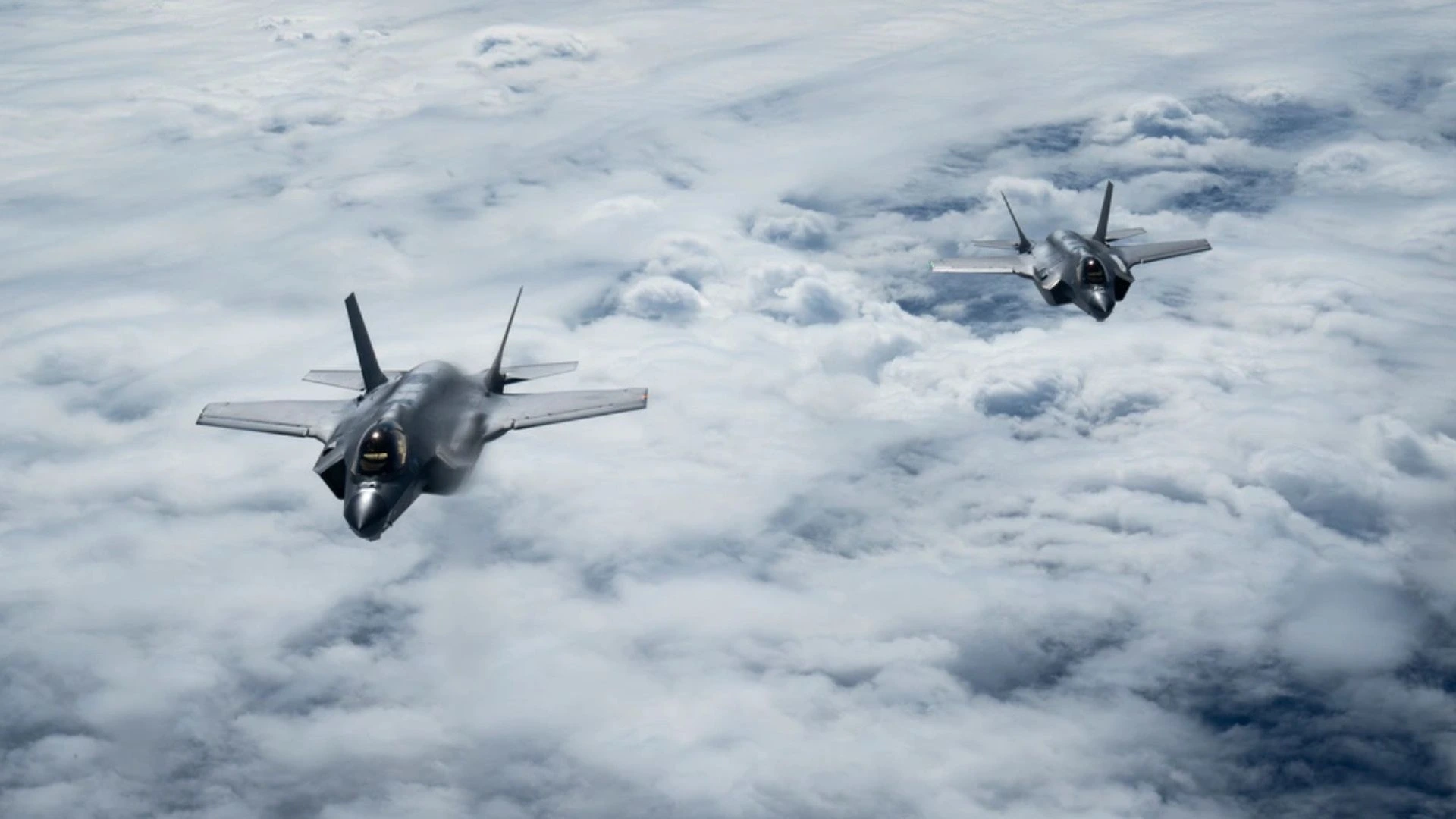
Lockheed Martin reported third-quarter 2026 earnings on October 22, 2026, with sales of $20.7 billion, up 11% from $18.6 billion a year earlier, and raised its full-year guidance for the second consecutive quarter. Net earnings rose 14% to $1.845 billion, or $7.97 per diluted share, and backlog reached a record $292 billion. The filing also disclosed that F-35 Lot 20 advance acquisition costs began exceeding U.S. government authorization and funding during the quarter.
Two multiyear interceptor awards and one unresolved fighter negotiation shaped the quarter. Backlog grew 27% from $230 billion at the end of June, and $52.5 billion of the total is tied to the seven-year PAC-3 Missile Segment Enhancement (MSE) award the Department of War issued on July 29, 2026, which raised the program’s multiyear value to $58.62 billion. It followed the $35 billion Terminal High Altitude Area Defense (THAAD) interceptor contract booked in the second quarter. The F-35 Lightning II has no definitized production contract beyond Lots 18 and 19.
Lockheed Martin Q3 Earnings: Missile Ramps Outpace Every Other Segment
Missiles and Fire Control (MFC) was the fastest-growing segment. Sales climbed 24% to $4.50 billion and operating profit rose 24% to $631 million, a 14.0% margin against 14.1% a year earlier. Production ramps on PAC-3 and THAAD added $480 million in sales, while the Guided Multiple Launch Rocket System (GMLRS) and Precision Strike Missile (PrSM) contributed another $330 million.
MFC backlog stood at $142.5 billion on September 27, 2026, against $46.7 billion at the end of 2025, and now accounts for 49% of the corporate order book. For scale, the fiscal 2024 to 2026 contract signed in September 2025 bought 1,970 PAC-3 MSE missiles for $9.8 billion. The new award is meant to triple PAC-3 MSE capacity by the end of 2030 and grow the Camden, Arkansas, final assembly workforce from 1,200 to about 1,850.
PAC-3 MSE is the hit-to-kill interceptor of the Patriot system, and Lockheed Martin cites its operational use in Ukraine and during Operation Epic Fury. GMLRS and PrSM, both fired from M142 HIMARS and M270 launchers, form the core of the Army’s surface-to-surface precision strike inventory.
F-35 Lot 20 Funding Gap Shadows Aeronautics Revenue Growth
Aeronautics sales rose 13% to $8.21 billion. The F-35 supplied $710 million of the increase on higher production and sustainment volume, and the C-130 added $270 million as pre-contract costs were liquidated after an award in the quarter, while F-16 sales fell $130 million on lower production volume and unfavorable profit adjustments. Operating profit grew 9% to $743 million, but margin slipped to 9.0% from 9.4% on $40 million in unfavorable adjustments each on the F-16 and C-130.
Deliveries diverge from revenue. Lockheed handed over 43 F-35s in the quarter against 46 a year earlier, and 94 through nine months against 143 in the same 2025 period. Sales still rose because F-35 revenue is recognized as production work progresses, not at delivery.
Lockheed said negotiations on Lots 20 and higher continue and warned that, without additional authorization and funding, its results, cash flows and financial condition will suffer in future periods. Aeronautics was the only segment whose backlog shrank in 2026, falling to $57.3 billion from $59.4 billion. The company did not disclose how much it has spent beyond the funded ceiling. The precedent is recent: Lockheed’s pre-contract costs climbed to $1.9 billion by late September 2024, driven mainly by delays in authorization and funding for F-35 Lots 18 and 19, before the $24.3 billion agreement for 296 aircraft was finalized in September 2025.
The same day, the Department of War and Lockheed Martin unveiled a framework for 850 U.S. F-35s over 10 years, with international orders across Lots 21 through 30, output held at 156 aircraft per year, and spares, modification kits and sustainment bundled in. That averages 85 U.S. jets annually. It needs multiyear procurement authority and appropriations before any contract award, and no value was disclosed.
Radar, Interceptor and Strategic Missile Work Support the Raised Guidance
Rotary and Mission Systems (RMS) sales rose 3% to $4.51 billion, with $140 million of growth from radar programs. Operating profit rose 4% to $524 million, as a $40 million favorable contract resolution offset $45 million in unfavorable adjustments on the CH-53K Heavy Lift and Seahawk helicopter programs. Space sales grew 4% to $3.49 billion as Trident II D5 Fleet Ballistic Missile and Next Generation Interceptor (NGI) work added $185 million, partly offset by a $115 million national security space decline tied to the Overhead Persistent Infrared (OPIR) program lifecycle. Space operating profit held at $331 million.
The largest guidance revision is in cash. Lockheed now expects 2026 free cash flow of about $7.8 billion to $8.0 billion, up from $7.0 billion to $7.2 billion in July and $6.5 billion to $6.8 billion in its original outlook. Sales guidance rose to about $80 billion to $82 billion and diluted earnings per share to about $30.35 to $30.75. Quarterly free cash flow still fell to $3.0 billion from $3.3 billion because customer receipts were higher in the 2025 quarter. The dividend rises to $3.60 from $3.45, the 24th consecutive annual increase, and Lockheed has repurchased no shares in 2026.
Analysis: Lockheed Martin’s order book has re-centered on munitions. MFC now holds nearly half of a $292 billion backlog, while the F-35, the company’s largest program, is the line exposed to authorization risk. The raised cash guidance and the Lot 20 warning share a release: Lockheed is again carrying fighter costs ahead of contract while interceptors drive the upside. Contract assets, which capture work performed but not yet billed, rose to $16.9 billion from $13.0 billion since December. For the Department of War, the gap is structural: Patriot and THAAD interceptors already run on multiyear contracts, while the fighter, with more than 1,375 aircraft fielded worldwide, still awaits equivalent congressional authority.
Next markers include a Lot 20 production contract, congressional action on multiyear authority and appropriations for the 850-aircraft framework, and definitization of the PAC-3 MSE award. The open question is how long the company will carry unfunded Lot 20 costs.