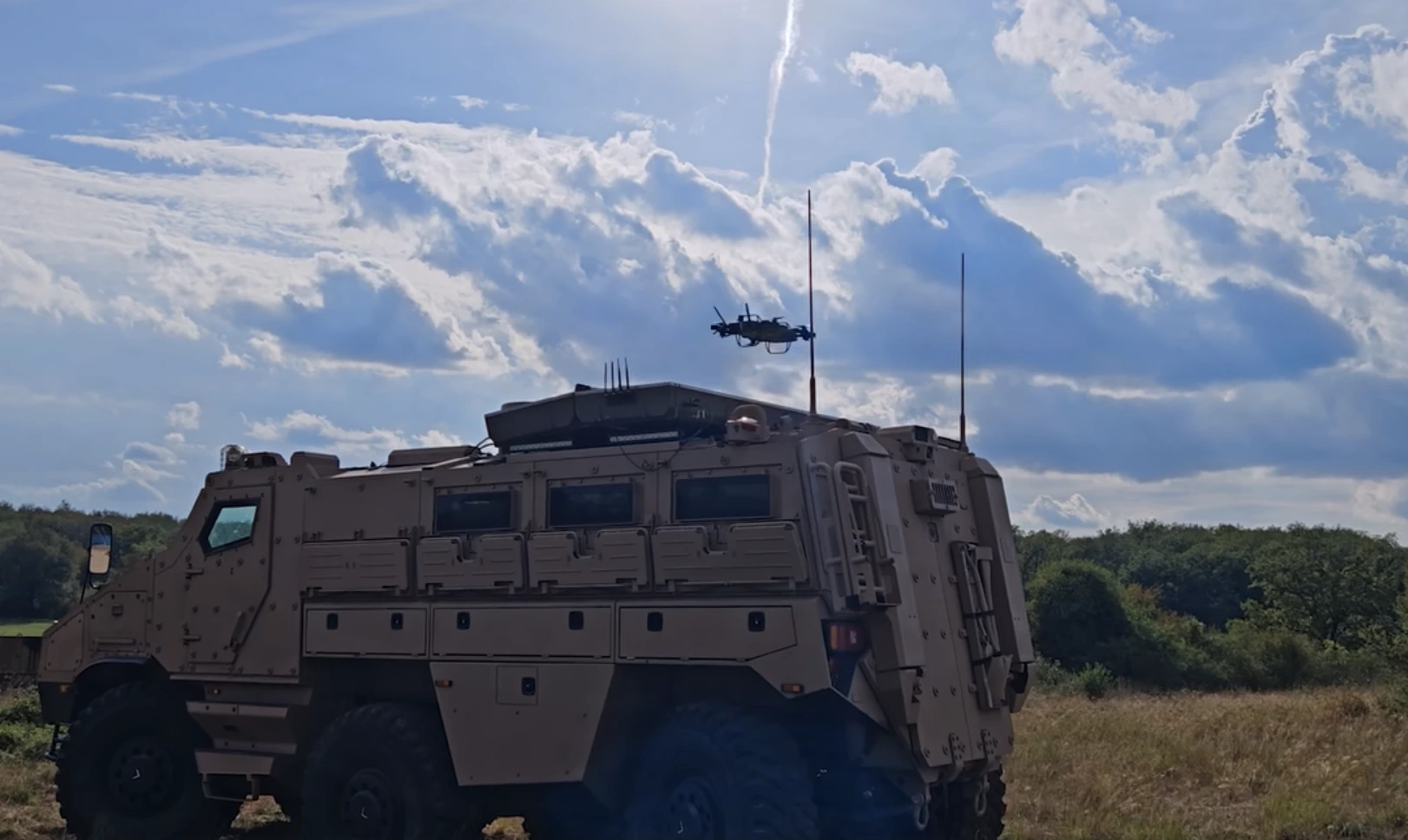
The KNDS DSP10 counter-drone kit has been tested during a counter-unmanned aircraft systems (C-UAS) Battle Lab organized by the French Army, with the RAPTOR 2 electronic warfare module seizing control of a target drone and the AERIX interceptor drone destroying its target in the first scenario tested, KNDS announced. The interceptor was also launched from a container mounted on a TITUS 6×6 armored vehicle, demonstrating vehicle integration under test conditions.
The trial follows the unveiling of KNDS’s TARGAS (Tactical Advanced Response for Ground, Air and Surface threats) ecosystem at Eurosatory in June 2026. TARGAS is the Franco-German group’s layered C-UAS and very short-range air defense architecture, spanning sensors, soft-kill effectors and gun systems such as TARGAS 30, which pairs a radar with a 30mm ARX 30 cannon on a Serval chassis firing dedicated 30x113mm counter-drone ammunition. DSP10 sits at the lighter end of that architecture, aimed at close-in protection of ground units against small drones and remotely operated munitions.
How the KNDS DSP10 Combines Electronic Takeover and Hit-to-Kill
DSP10 integrates two effectors from outside partners under KNDS system integration. The soft-kill layer is RAPTOR 2, developed by Paris-based Nuances Technologies, an electronic warfare system designed to take over and control a hostile drone rather than simply jam its links. Takeover allows an operator to redirect or land a target instead of letting it fall uncontrolled, which matters when the defended area includes friendly troops or vehicles. KNDS has not disclosed RAPTOR 2’s frequency coverage, effective range or the drone protocols it can exploit.
The hard-kill layer is the AXS-μ1 interceptor built by French startup AERIX Systems. According to the companies, it neutralizes targets through direct impact without an explosive warhead and operates fully autonomously against first-person-view (FPV) and other unmanned aerial systems. AERIX, which raised €5 million in March 2026 to industrialize its interceptors, builds the design around an omnidirectional propulsion system that lets the airframe translate laterally, vertically and rotationally without reorienting. Hugo Mayounove, AERIX’s president and co-founder, told Janes in September 2026 that the AXS-μ1 currently reaches 120 km/h when intercepting NATO Class 1 drones, flies for up to 10 minutes, weighs up to 4 kilograms and uses an electro-optical camera. KNDS has not published performance data for the DSP10 configuration.
The pairing is deliberate. Electronic takeover depends on an exploitable radio link and offers no answer to fiber-optic-guided or fully autonomous drones that emit no command signal. A kinetic interceptor covers that gap, while the electronic layer preserves interceptor stocks against less sophisticated threats.
TITUS Launch Integration and the Path to AXS-μ1 Production in 2027
The container launch from TITUS is the most operationally relevant result of the trial. TITUS is the KNDS 6×6 armored vehicle built on a Tatra chassis, according to publicly available specifications. Firing an interceptor from a vehicle-mounted container moves DSP10 closer to an organic protection kit for maneuver units rather than a fixed site defense system. KNDS presented a separate Drone Launcher Prototype Container at Eurosatory, but has not specified how many AXS-μ1 rounds the DSP10 container carries or its reload procedure.
KNDS also intends to take on industrial production of the interceptor. Under a cooperation agreement announced on September 24, 2026, KNDS will support the AXS-μ1 through its maturation phase, with production set to begin in 2027. The company frames DSP10 within its Mission Solutions approach, which bundles partner technologies into modular kits rather than selling stand-alone equipment.
Analysis: DSP10 reflects a broader shift among European land system primes toward owning the effector supply chain in counter-drone warfare, not only the platforms that carry it. Interceptor drones are consumables, and the cost-exchange problem against cheap FPV threats is decided by production volume and unit price. By planning to manufacture AXS-μ1, KNDS positions itself to compete on that metric. One successful takeover and one interception in a first scenario remain early maturity data points, not qualification results.
No French Army procurement decision has been announced. The next markers are disclosure of performance data for the DSP10 configuration, integration of DSP10 with TARGAS sensors and command and control, and whether production starts on schedule in 2027.