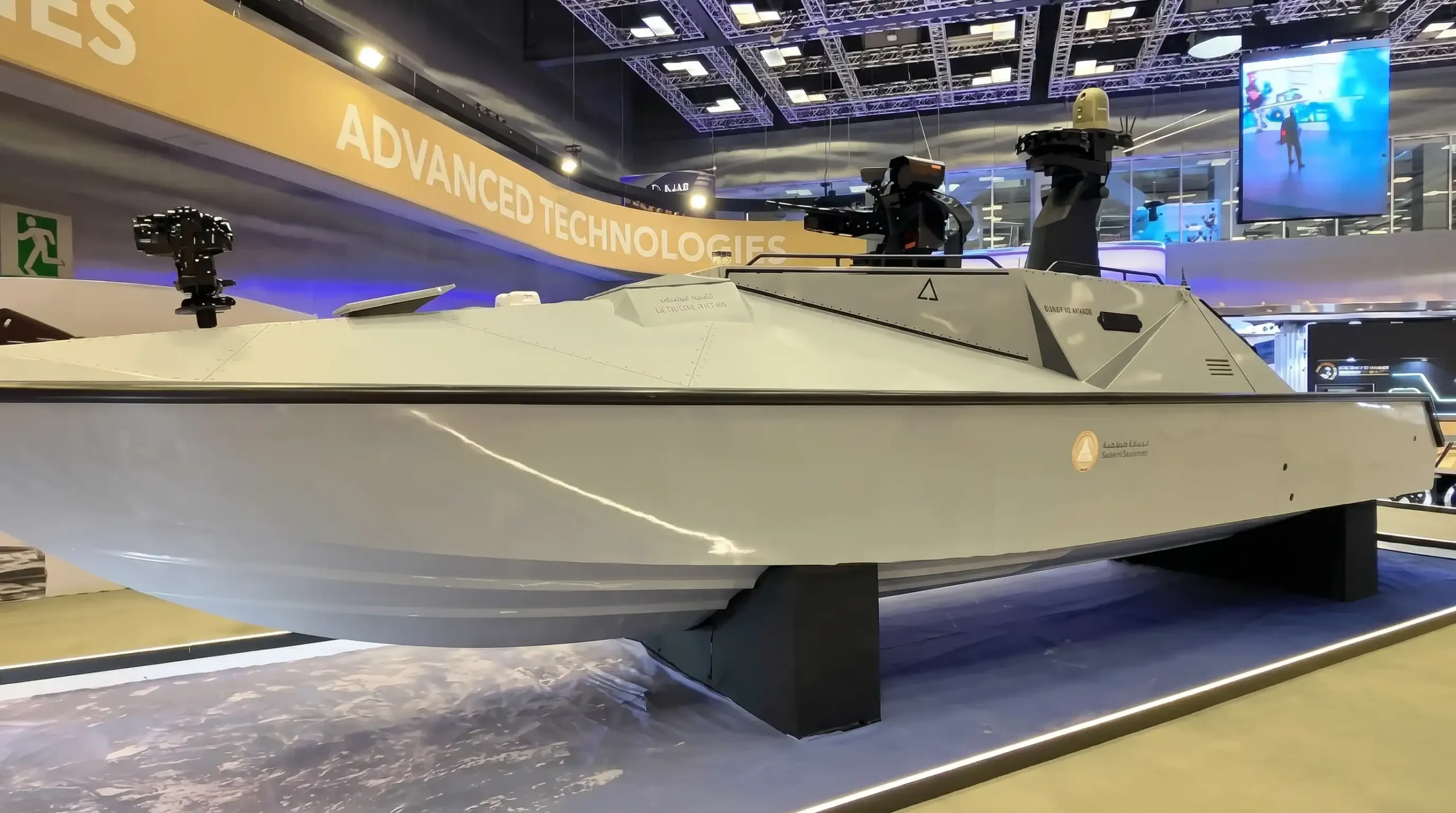
Shield AI and Rheinmetall Barzan Advanced Technologies (RBAT), the Qatari joint venture of Barzan Holdings and Rheinmetall AG, have signed a memorandum of understanding (MoU) to explore integrating Shield AI’s Hivemind autonomy software into Qatari-designed unmanned surface vessels (USVs) for intelligence, surveillance and reconnaissance (ISR). Mimi Shalash, senior director for Hivemind at Shield AI, and Dr. Sinan Al-Obaidi, RBAT’s chief executive officer, signed the agreement on the second day of Milipol Qatar 2026 in Doha; Shield AI announced it on October 28, 2026.
The agreement lands in a Gulf security environment reshaped by this year’s Iran war. An Iranian drone attack on Ras Laffan forced Qatar to halt liquefied natural gas (LNG) production in March at a complex that supplies about a fifth of global LNG, and Iranian ballistic missile strikes later that month caused extensive damage to Ras Laffan Industrial City. On October 19, 2026, Sheikh Saoud bin Abdulrahman Al Thani, Qatar’s minister of state for defense affairs, said Doha would soon announce a local defense production hub with a regional partner and other partners such as the United States, the United Kingdom and France. Uncrewed surveillance of coastal waters and offshore energy sites sits at the center of that requirement.
Hivemind Autonomy and the Shift to Coordinated USV Teams
The MoU covers exploratory integration work, not a procurement, and both signatories describe a move from single craft to autonomous teams. Shalash said the integration would “enable coordinated autonomous operations across multiple vessels,” while Al-Obaidi said it takes Qatar “from individual unmanned platforms, to coordinated teams of vessels that protect our coastal waters and critical infrastructure.”
Shield AI’s Hivemind Enterprise suite splits the autonomy stack into four elements, which company material describes as follows: EdgeOS, a C++ middleware layer; Pilot, the edge autonomy built on top of EdgeOS; Forge, the AI factory used to design, develop and test Hivemind edge systems; and Commander, the software and hardware that support human-in-the-loop and human-on-the-loop interaction, including mission planning and control. According to Shield AI, Hivemind has piloted more than 40 platforms, including F-16s, jet-powered uncrewed aircraft, helicopters, USVs, ground vehicles and a satellite in low Earth orbit.
On July 29, 2026, Thunder Tiger’s SeaShark 600 and SeaShark 800 USVs ran a Hivemind-coordinated ISR mission off Pingtung, Taiwan, using maritime radar, imagery and Automatic Identification System (AIS) data. The software split the search box into two sectors, assigned one craft to each, and routed the second vessel to intercept once the first detected the target. In a UK demonstration announced September 28, 2026, two Kraken Technology Group K3 SCOUT USVs, each 8.4 meters long with a 55-knot top speed and a 600-kilogram payload, searched a designated area off Portsmouth, classified a vessel of interest, escorted it out, then replanned and resumed the search. Shield AI said the vessels shared sensor data and adapted within operator-defined limits while humans retained decision authority.
Barzan USV Specifications and RBAT’s Multi-Domain C2 Backbone
The announcement does not name the specific vessel or vessels Hivemind would run on. The most visible candidate is the armed USV Barzan Holdings unveiled at DIMDEX 2026 in Doha in January. Publicly available specifications describe an 11.9-meter (39-foot) fiber-reinforced plastic hull with a 3.1-meter beam and a 0.76-meter draft, displacing roughly 8,200 kilograms. Twin 350-horsepower FNM 42HPE inboard diesels drive Castoldi TD284 waterjets for speeds above 30 knots, with 1,200 liters of fuel, a 940-kilogram payload capacity and a 15 kVA generator for mission equipment.
The baseline fit pairs a four-axis gyro-stabilized electro-optical/infrared (EO/IR) turret with a 12.7 mm remote weapon station and a multispectral searchlight. Optional modules include long-range acoustic devices, sonar, anti-submarine and anti-surface warfare kits, and electronic warfare payloads. The shallow draft and waterjet propulsion suit harbor approaches and nearshore energy installations, exactly the waters Qatar now has to watch continuously.
RBAT brings its own software layer. Founded in 2017, the joint venture fields indigenous command-and-control (C2) software, a family of unmanned systems and counter-unmanned aircraft systems (C-UAS). Mission Master autonomous ground vehicles shown at DIMDEX 2026 are already integrated into Barzan C2 software, with several variants employed as a pack managed from a control room. The likely division of labor is that Hivemind handles onboard sensing, decision-making and teaming at the edge, while the Qatari C2 layer keeps the fused operational picture and the operator interface. How the two layers would exchange tasking, track data and video has not been disclosed.
Analysis: The deal pulls Hivemind deeper into Rheinmetall’s unmanned maritime portfolio. Rheinmetall Kraken GmbH, Rheinmetall’s joint venture with Kraken Technology Group, began series production of the K3 SCOUT at Hamburg’s Blohm+Voss yard in April 2026 at an initial rate of about 200 hulls per year, and Hivemind has already run that hull in team trials. With RBAT now exploring the same software, one autonomy layer could span vessels built in Hamburg and Doha. For Qatar, the appeal is turning a few indigenous hulls into a coordinated sensor network without waiting for a domestic autonomy stack to mature. The cost is reliance on a US vendor for the decision-making core of sovereign platforms, a tension Doha’s localization push will have to manage.
The MoU carries no disclosed value, timeline or end user, and neither company has said whether the work will extend beyond ISR to armed configurations. The next markers are a named platform, an on-water demonstration in Qatari waters, and any follow-on contract from Qatar’s naval or internal security forces. Whether the effort folds into Doha’s promised defense production hub will show how far Qatar intends to build autonomy at home rather than import it.