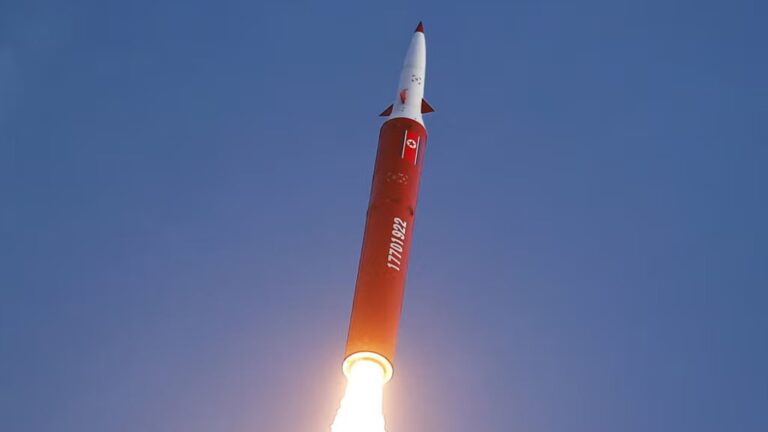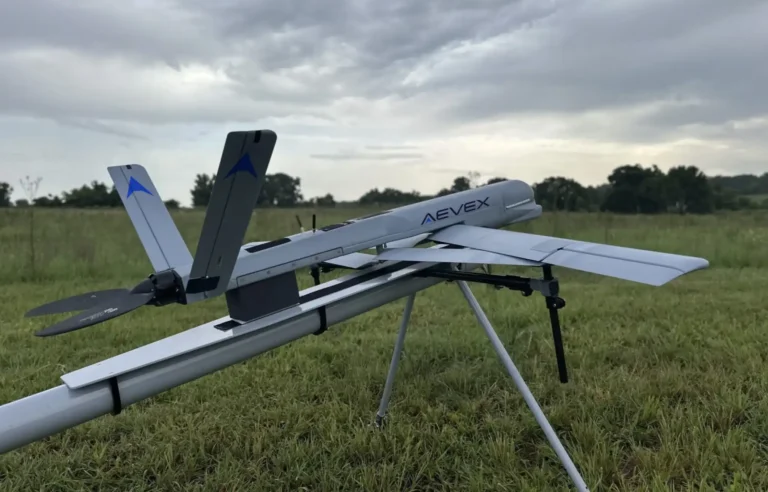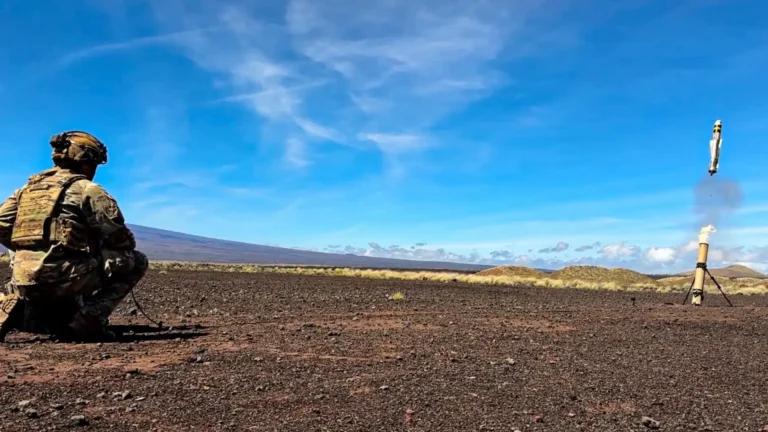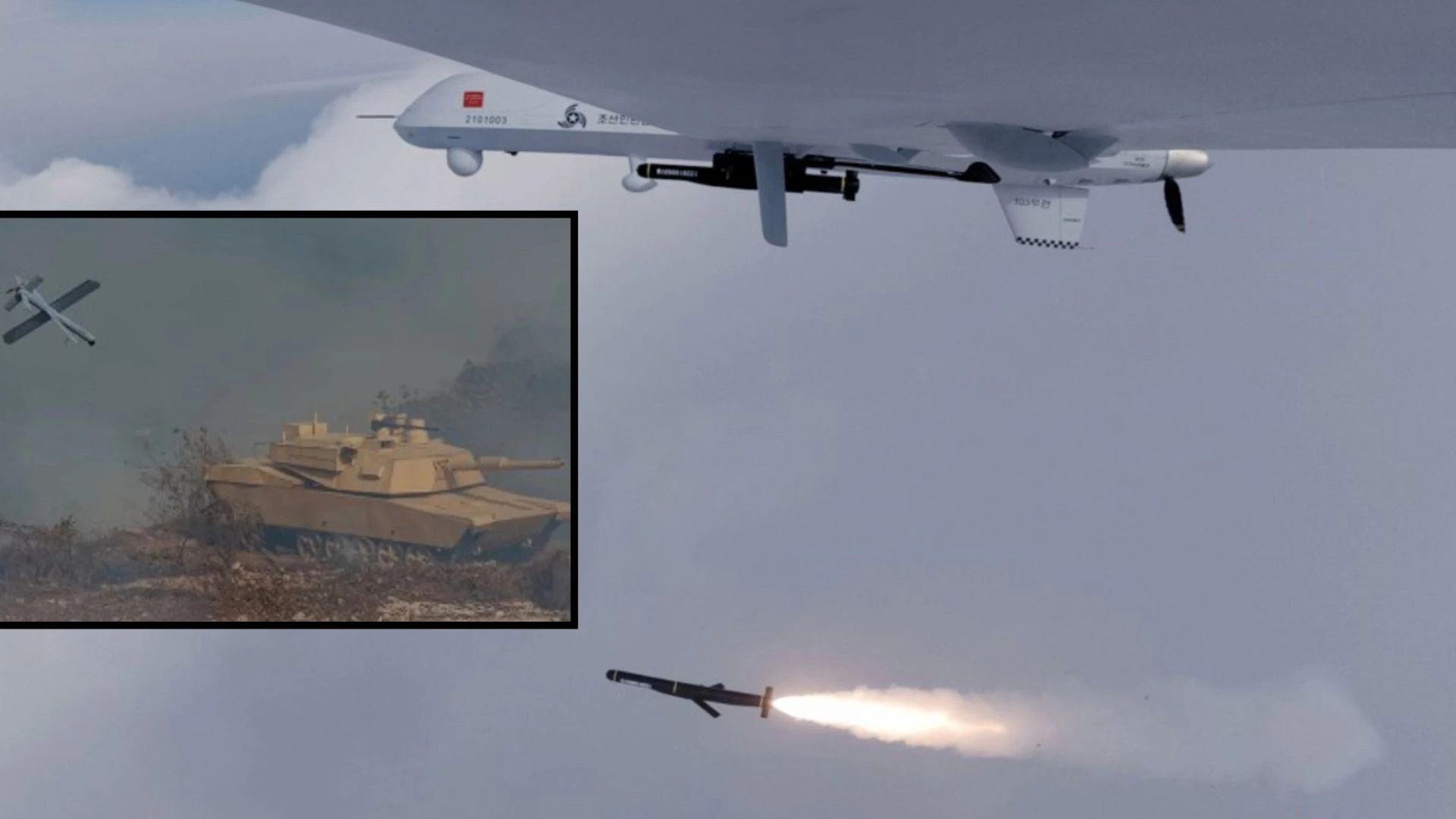
North Korea fired a new air-launched cruise missile from its Saetbyol-9 attack drone and sent loitering munitions into mock U.S. M1 Abrams tanks during a live-fire demonstration on October 29, 2026, capping an exhibition of more than 30 unmanned aircraft types attended by Kim Jong Un. The Korean Central News Agency (KCNA) released images of both events on October 30, along with the first public view of a large tailless flying-wing drone.
The exhibition, titled “Unmanned Aeronautical Technology Development-2026,” extends a drone push Kim launched in November 2024 with an order to mass-produce suicide drones. He oversaw tests of artificial intelligence (AI)-equipped attack drones in March 2025 and, between September 16 and 18, 2026, toured production lines building Saetbyol-4 and Saetbyol-9 airframes alongside a one-way attack drone. On October 29, Kim called for the country to seize “absolute superiority” in drone technology, described it as “an indispensable option” in modern warfare and named AI integration a top military priority, according to KCNA.
North Korean Drones on Display: Flying Wing Joins Saetbyol Fleet
The tailless flying-wing drone, shown publicly for the first time, invites comparison with Russia’s S-70 Okhotnik, the U.S. Navy’s X-47B demonstrator and the RQ-170 Sentinel. Removing the vertical tail reduces radar cross-section, but Pyongyang released no data on the aircraft’s engine, sensors, materials or flight status, and photos alone cannot establish whether it is a flying prototype or a mockup.
The flying wing appeared alongside the Saetbyol-4 (“Morning Star-4”), a jet-powered strategic reconnaissance drone first shown in July 2023 that mirrors the RQ-4 Global Hawk. Its wingspan is estimated at about 35 meters, against 39.9 meters for the RQ-4B, according to publicly available specifications. The propeller-driven Saetbyol-9, modeled on the MQ-9 Reaper, has an estimated 20-meter wingspan, six underwing pylons and an electro-optical sensor turret.
Tactical systems filled out the display: first-person-view (FPV) quadcopters and systems apparently fitted with fiber-optic cable dispensers. Fiber-optic control gives the operator a physical command link that conventional radio-frequency jamming cannot sever. Rows of identical loitering munitions carried serial numbers on their fuselages, an indication that at least some designs have moved beyond single prototypes.
Saetbyol-9 Cruise Missile Launch Extends Drone Standoff Range
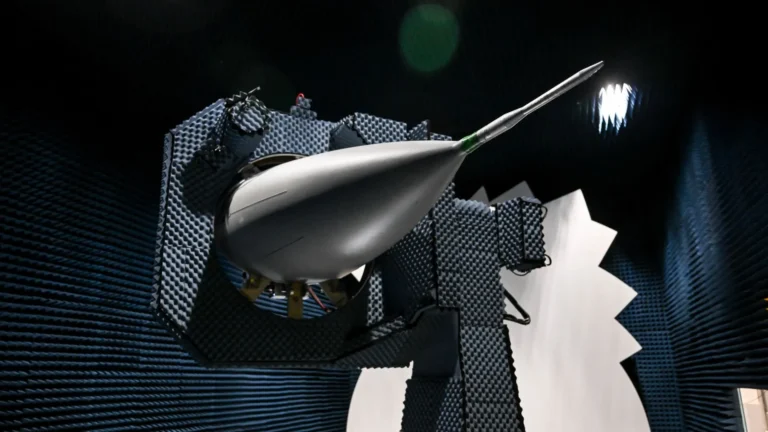
KCNA photographs show a Saetbyol-9 releasing a black cruise missile with a pointed nose and a yellow band, its motor igniting after separation. The aircraft wore Korean People’s Army Ground Force markings and the serial number 2101003, suggesting assignment to ground units. Analysts at the Korea Defense and Security Forum in Seoul assessed the weapon as a tactical air-to-ground cruise missile with a nose-mounted seeker and said it marks the first time North Korea has shown the Saetbyol-9 launching one. Pyongyang has not named the missile or released its range, warhead or guidance method.
A 2023 North Korean video appeared to show the Saetbyol-9 firing Hellfire-like missiles, and a U.S. Army general said in 2024 that North Korea was arming drones with reverse-engineered Hellfire copies. The rocket-powered AGM-114 Hellfire has a range of roughly 8 to 11 kilometers, per publicly available specifications, forcing the launcher inside short-range air defense coverage. A winged, air-breathing cruise missile typically allows release from much farther out. KCNA claimed drone-launched and ground-launched cruise missiles struck an island target with 100 percent accuracy, a claim that cannot be independently verified.
South Korea’s military said in March 2026 that the Saetbyol-9 imitates the Reaper’s appearance without matching its capabilities. The MQ-9A carries roughly 1,360 kilograms of external stores and can stay airborne for more than 24 hours, per publicly available specifications; no comparable figures exist for the North Korean copy.
Hero-Style Loitering Munitions Strike Mock Abrams and K9 Targets
KCNA images show a slender loitering munition with tandem cruciform wings and a rear pusher propeller diving onto a sand-colored Abrams mock-up. The layout closely resembles the Hero-400 family built by Israel’s UVision. The Hero-400EC weighs about 40 kilograms at launch, carries a 10-kilogram warhead and can loiter for up to two hours, according to the manufacturer; photos cannot show whether the North Korean design matches that performance or how it is guided.
Top-attack munitions hit armor where it is thinnest, a vulnerability exploited by both sides in Ukraine. Other targets replicated South Korean Army guard posts along the Demilitarized Zone (DMZ), K9 self-propelled howitzers, fortified positions and a counter-battery radar.
A battalion of 600 mm multiple rocket launchers, assessed as KN-25 systems, joined the drill. Open-source assessments credit the KN-25 with demonstrated ranges of about 380 kilometers, far beyond the 70 to 80 kilometers of standard 227 mm Guided Multiple Launch Rocket System (GMLRS) rounds. South Korea’s Joint Chiefs of Staff detected around 10 projectiles, including short-range ballistic missiles, launched from the Wonsan area the same day.
Analysis: Individually unproven, these systems collectively outline a layered strike complex aimed at the U.S. and South Korean forward posture: intelligence, surveillance and reconnaissance (ISR) from the Saetbyol-4, standoff cruise missile delivery from the Saetbyol-9, cheap top-attack munitions and jam-resistant FPVs at the tactical edge, and 600 mm rockets for depth. The demonstration did not establish whether these weapons share a common real-time targeting network, the capability that would turn a catalogue into a kill chain. Operational lessons, however, are flowing from Russia’s war in Ukraine: South Korean intelligence estimates more than 16,000 North Korean personnel have deployed to Russia since October 2024, and U.S. Eighth Army commander Lieutenant General Joseph Hilbert highlighted that combat experience on October 27, 2026.
Key unknowns remain the flying wing’s flight status, the cruise missile’s range and seeker type, and output at the Unmanned Aeronautical Technology Complex near Panghyon Airfield, where commercial satellite imagery in September 2026 showed new construction. The next indicators will be follow-on flight tests, any evidence of Russian technology transfer under the June 2024 Comprehensive Strategic Partnership Treaty, and Seoul and Washington’s counter-unmanned aircraft system response as the Freedom Flag air exercise, under way since October 26, continues.