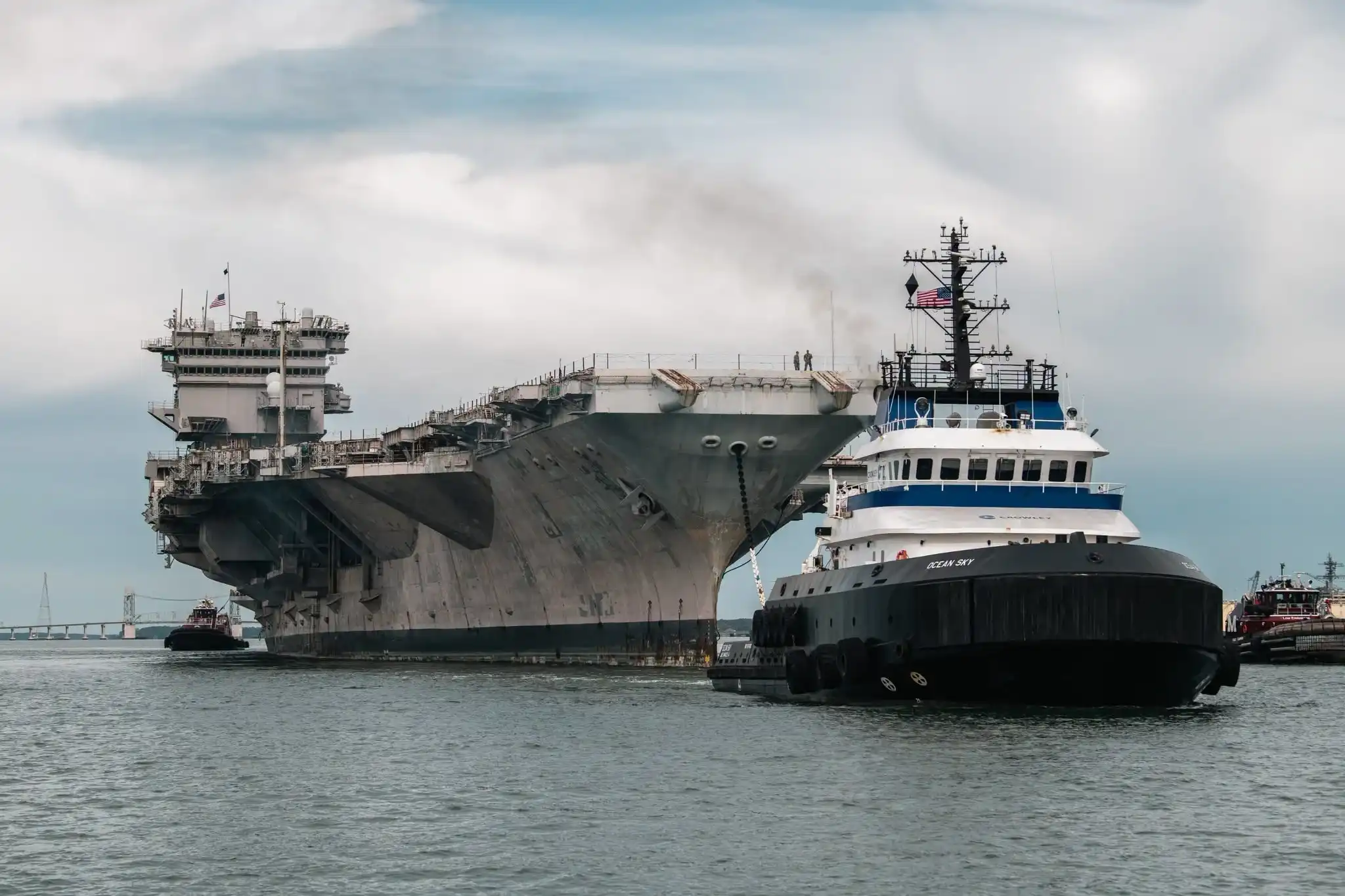
The former USS Enterprise (CVN 65), the world’s first nuclear-powered aircraft carrier, departed Newport News Shipbuilding in Virginia under tow on November 2, 2026, bound for Mobile, Alabama, where the hulk will be cut apart, recycled, and disposed of under a $418.5 million Navy contract. The transit opens the final phase of a disposal effort that began when the carrier was inactivated in December 2012.
The departure ends nearly a decade of pierside layup at Newport News, where the ship has remained since its February 3, 2017 decommissioning ceremony, the first decommissioning of a nuclear-powered carrier. The Navy completed defueling of the reactor plants in 2017, but the emptied reactor compartments remain aboard, turning the hull into a multi-year regulatory and procurement problem. In September 2023 the service published a Record of Decision selecting commercial dismantlement as the disposal method. “Enterprise will always be remembered for her proud legacy of service, a legacy made possible by the Sailors and support personnel whose dedication kept her mission-ready,” said Kevin Cormier, Deputy Portfolio Acquisition Executive Maritime for Aircraft Carriers.
Enterprise CVN 65 Design: Eight Reactors and a One-Ship Class
Built by Newport News Shipbuilding and christened on September 24, 1960, Enterprise entered service in 1961 as the eighth Navy vessel to carry the name. Publicly available specifications indicate an overall length of about 1,123 feet (342 meters), still the longest carrier hull the Navy has built, and a full-load displacement in the range of 93,000 to 95,000 tons. Propulsion came from eight Westinghouse A2W pressurized-water reactors driving four shafts, a configuration no later carrier repeated. The Nimitz class generates comparable output from two A4W reactors, and the Gerald R. Ford class from two A1B reactors.
That eight-reactor plant defined both the ship’s operational value and its disposal profile. It gave Enterprise effectively unlimited range by the standards of its era, and the Navy credits the carrier with safely steaming more than 1 million nautical miles under nuclear power. Across a career that spanned the Cold War, the Vietnam War, and post-9/11 operations including Enduring Freedom and Iraqi Freedom, Enterprise completed 25 deployments. At decommissioning, eight reactor compartments became eight separate disposal tasks, a scale no Nimitz-class hull will present.
Inside the $418.5 Million NorthStar Dismantlement Contract in Mobile
Naval Sea Systems Command awarded the current firm-fixed-price contract, valued at $418,497,668, to NorthStar Maritime Dismantlement Services of Vernon, Vermont, on July 15, 2026. About $415.5 million in fiscal 2025 Navy operations and maintenance funds was obligated at award, and work is scheduled for completion in September 2030. NorthStar will cut the hulk into sections in Mobile, route reusable steel into commercial recycling, and package radioactive and other hazardous materials for shipment to licensed disposal sites.
The award is NorthStar’s second for the same job. The company first won the work in May 2025 at $536.7 million. HII ShipCycle LLC, a Huntington Ingalls Industries subsidiary, then protested at the US Court of Federal Claims after its final proposal was excluded as late following upload problems on the government’s Procurement Integrated Enterprise Environment (PIEE) portal. In February 2026, the court sided with HII, finding that the Navy had failed to consider its pre-deadline extension request, and remanded the procurement for revised final proposals and a new source selection. NorthStar prevailed in the second round at roughly $118 million, or 22 percent, below its original price. HII challenged the re-award at the same court, then voluntarily dismissed the case in October 2026.
Fixed pricing shifts overrun risk to the contractor but does not cap the total bill: according to Navy figures, inactivating the carrier cost $902 million and storing it another $111 million, bringing the total to roughly $1.43 billion once the dismantlement contract is included.
Enterprise as the Template for Nimitz-Class Carrier Disposal
The Navy treats CVN 65 as the reference case for its 10 Nimitz-class carriers, each of which will require reactor compartment handling at the end of service life. USS Nimitz (CVN 68) is scheduled to leave active service in 2027, and HII’s Newport News Shipbuilding received a $96 million contract in March 2026 for advanced planning and long-lead materials tied to that inactivation. The Portfolio Acquisition Executive (PAE) for Maritime now oversees both ends of the carrier life cycle: construction of Ford-class hulls and disposal of retired ones.
The name carries forward. The future Enterprise (CVN 80), the third Gerald R. Ford-class carrier and the ninth Navy ship to bear the name, is under construction at Newport News. The Navy’s fiscal 2027 budget documents moved its delivery from July 2030 to March 2031, a slip that has in turn pushed Doris Miller (CVN 81) to February 2034. Steel removed from CVN 65 is already part of the new carrier: about 20,000 pounds had been built into CVN 80’s modules by its August 2022 keel laying, with more than 35,000 pounds expected in the finished ship.
Analysis: The tow matters less as a farewell than as a test of whether the Navy can industrialize nuclear carrier disposal before the Nimitz retirements arrive in sequence. A fixed-price commercial model and a single Gulf Coast site leave little margin if NorthStar encounters radiological or structural surprises in an eight-reactor ship with no sister hull to learn from. If the work holds to the September 2030 schedule and the $418.5 million price, the Navy gains a validated commercial pathway that eases demand on Puget Sound Naval Shipyard, which remains heavily committed to submarine maintenance and inactivation. If it does not, retiring 10 two-reactor Nimitz-class carriers becomes a recurring bill drawn from the same operations and maintenance accounts that fund fleet readiness.
The tow itself is the next milestone, and the Navy has not published a transit timeline or arrival date for Mobile. Once the hulk arrives, the markers to watch are the start of reactor compartment removal and any contract modifications that signal cost growth. The Navy has yet to announce how Nimitz will be disposed of after its 2027 inactivation; that decision will show how closely the service intends to follow the Enterprise model.