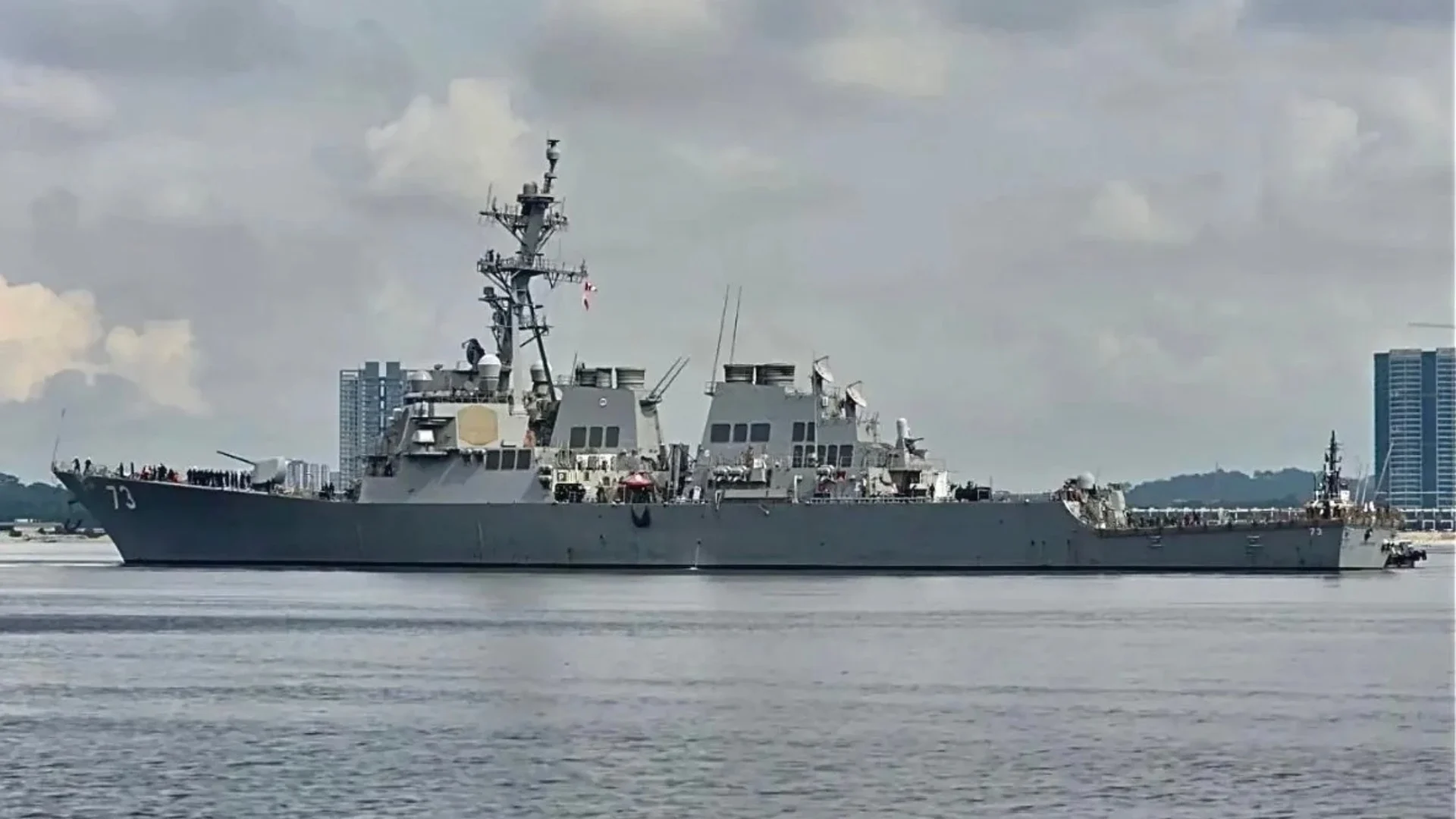
The Arleigh Burke-class guided-missile destroyer USS Decatur (DDG-73) entered Singapore on November 6, 2026, with the Theodore Roosevelt Carrier Strike Group, which stopped in the city-state before continuing to the Middle East, USNI News reported. Decatur is one of three surface combatants escorting the Nimitz-class aircraft carrier USS Theodore Roosevelt (CVN-71) on a deployment to the U.S. Central Command (CENTCOM) area of responsibility.
The stop comes as the U.S. Navy sustains a high-tempo carrier presence linked to the war with Iran, which began on February 28, 2026. Two strike groups, led by USS George Washington (CVN-73) and USS George H.W. Bush (CVN-77), are already in the region; Bush arrived in April to support the naval blockade of Iran. Theodore Roosevelt is expected to relieve the George Washington group, in the region since August 19. Whether the Pentagon will hold three carriers in theater for an extended period remains unclear; the Abraham Lincoln group overlapped with George Washington for about a month before heading home.
USS Decatur and the Carrier Strike Group 9 Escort Screen
Theodore Roosevelt is the flagship of Carrier Strike Group 9 (CSG 9), which left San Diego on September 27 with Carrier Air Wing 11 (CVW-11) embarked. The screen sailing with the carrier comprises the Ticonderoga-class guided-missile cruiser USS Chosin (CG-65) and two Arleigh Burke-class destroyers, USS Paul Hamilton (DDG-60) and Decatur.
Decatur, built by Bath Iron Works and commissioned in 1998, belongs to the Flight II subgroup of the class (DDG-72 through DDG-78). Publicly available specifications indicate a length of 505 feet, a beam of 66 feet and a full-load displacement in the 8,300 to 9,000-ton range. Four General Electric LM2500 gas turbines producing roughly 100,000 shaft horsepower drive two shafts for speeds above 30 knots.
The combat system centers on Aegis and the AN/SPY-1D radar, feeding a 90-cell Mk 41 Vertical Launching System split into 29 forward and 61 aft cells. That magazine can carry Standard Missile interceptors, Evolved Sea Sparrow Missiles, Tomahawk land-attack cruise missiles and Vertical Launch Anti-Submarine Rockets. A Mk 45 5-inch/54-caliber gun and the Phalanx close-in weapon system complete the armament. Compared with Flight I ships such as Paul Hamilton, Flight II added Link 16 datalink integration, the AN/SLQ-32(V)3 electronic warfare suite and support for extended-range Standard Missile variants.
Unlike Flight IIA ships, Flight II destroyers have a flight deck but no hangar, limiting embarked helicopter support. In the escort role, Decatur’s value lies in layered air and missile defense for the carrier, and in a region where U.S. destroyers have intercepted cruise missiles and one-way attack drones since late 2023, interceptor capacity is the screen’s critical resource.
From Keen Sword 27 to the Malacca Strait: The Route West
The group did not head directly to CENTCOM. Theodore Roosevelt first operated in the Western Pacific, where it took part in exercise Keen Sword 27. Last week, the strike group trained with Japan Maritime Self-Defense Force destroyer JS Onami (DD-111) in the Philippine Sea and the South China Sea, and on November 4 the carrier conducted a replenishment-at-sea with the Royal Australian Navy oiler HMAS Stalwart (A304).
Decatur knows those waters: on September 30, 2018, during a freedom of navigation operation near Gaven Reef in the Spratly Islands, the Chinese destroyer Lanzhou closed to within about 45 yards of the ship in a maneuver the U.S. Navy called unsafe.
Singapore sits on the Strait of Malacca, the main maritime link between the South China Sea and the Indian Ocean. U.S. forces use the city-state’s facilities under a 1990 memorandum of understanding, extended in 2019 through 2035. Decatur has called there before, including in July 2016. The Navy has not disclosed how long the current visit will last.
Analysis: The port call reflects lessons drawn from USS Abraham Lincoln (CVN-72), which was pulled from the South China Sea in January for the build-up preceding Operation Epic Fury and stayed on station until August without a port visit. Lincoln completed a 322-day deployment on October 8, and acting Navy Secretary Hung Cao confirmed that eight members of its strike group attempted suicide during the cruise. With Navy officials indicating that deployments could now run approximately 11 months, scheduled liberty and the significantly larger food stores Pacific Fleet says were loaded aboard Theodore Roosevelt are readiness measures, not amenities. Both destroyers screening CVN-71 also date from the 1990s, a sign of how heavily the commitment leans on the fleet’s oldest Aegis hulls.
The next milestone is Theodore Roosevelt’s arrival in the CENTCOM area, as the Makin Island Amphibious Ready Group and the 13th Marine Expeditionary Unit also head to the region. Open questions remain: whether George Washington departs on arrival or three carriers stay in theater, whether more escorts join the screen, and whether crews can sustain an 11-month cycle.