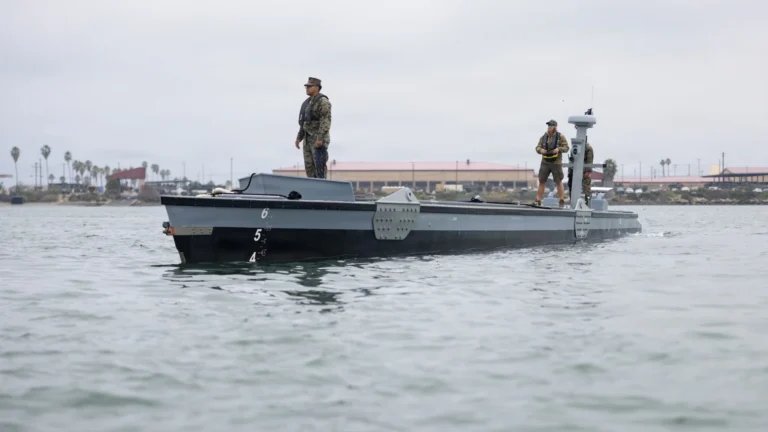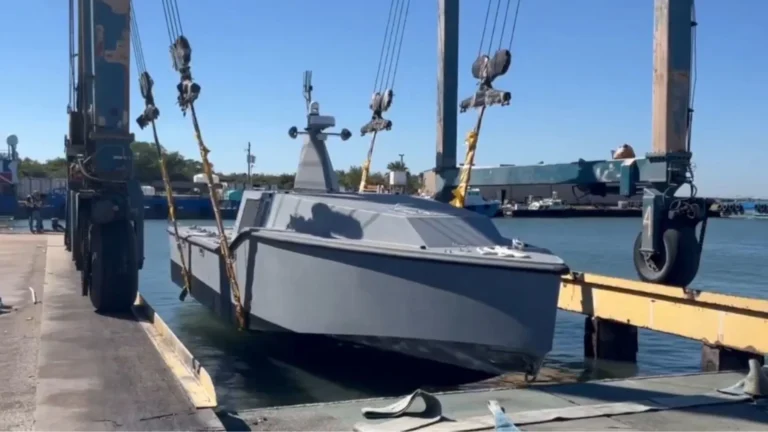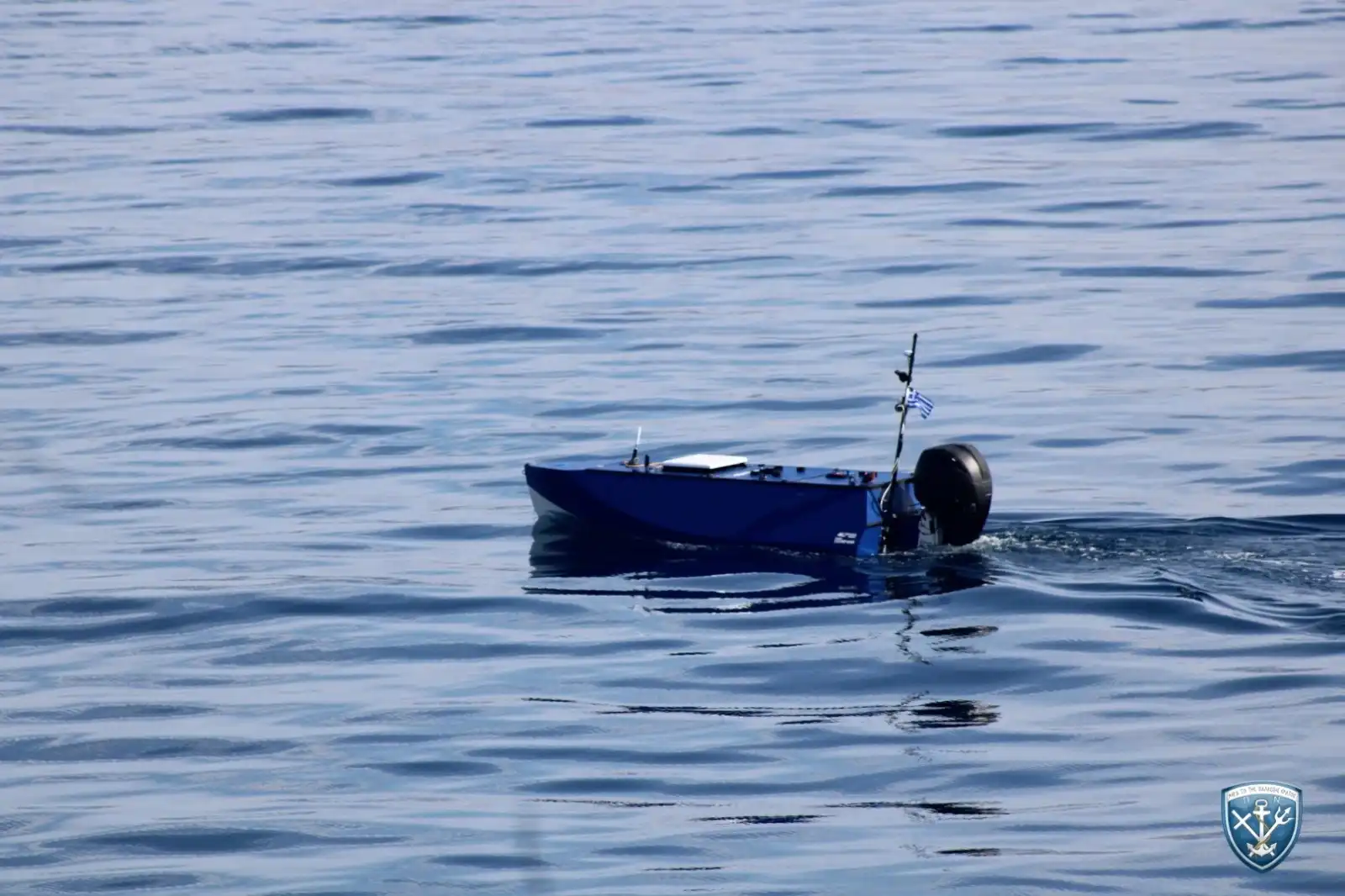
Greek firm Trygons S.A. said on November 2, 2026, that its five-meter unmanned surface vessel (USV) completed every scheduled trial it entered during UVEX 2/26, a Hellenic Navy exercise run as part of the Hellenic Centre for Defence Innovation’s (HCDI) evaluation of unmanned systems. The company said it was the only participant to complete its full trial program, a claim the organizers have not independently confirmed, and that the boat carried third-party systems Trygons integrated to Navy requirements.
UVEX 2/26 follows UVEX 1/26, the Hellenic Navy’s first small-scale technical live exercise for unmanned systems, held in the Saronic Gulf from March 9 to March 19, 2026. HCDI, created in 2024 under Defense Minister Nikos Dendias to link domestic industry to military requirements, had scheduled small-scale Navy exercises for October and November 2026 focused on fleet survivability, maritime surveillance, and offensive operations with unmanned vehicles. HCDI has not yet published the dates, location, participants or findings of UVEX 2/26.
Trygons USV Trial Scenarios and Third-Party System Integration
According to Trygons, the trial program covered autonomous navigation, remote command and control (C2), maritime surveillance, target search and continuous tracking, man-overboard detection, and real-time transmission of the operational picture. The company said the vessel exceeded the specified requirements and showed strong speed, maneuverability and responsiveness, but it published no performance figures, did not state the Navy’s threshold values, and did not name the five-meter model used.
The integration claim is the more concrete element. Trygons said it handled the technical integration and interfacing of specialized systems from other companies with the boat’s existing systems; suppliers and payload types were not disclosed. Trygons Drones describes its craft as modular platforms, and publicly available specifications for its seven-meter ER69D list sealed payload compartments of 182, 364 and 868 liters.
During UVEX 1/26, a Trygons USV reportedly launched a first-person view (FPV) drone built by Greek firm Resilience Tech, with autonomy software from Alpha Autonomy and a Starlink terminal for beyond-line-of-sight links. Whether those partners joined UVEX 2/26 is unconfirmed.
Carbon Composite Hulls and the Seven-Meter ER69D Growth Option
Trygons S.A. brings more than three decades of carbon and glass fiber composite work, and its Trygons Drones division builds unmanned craft from 1 to 14 meters long using infusion molding. Its EcoRunner hull line dates to 2012, and in 2024 the company ran 4.7-meter and 7.8-meter versions autonomously in Beaufort 7 conditions in the Aegean.
The press release also cited a larger seven-meter platform offering greater payload and endurance. The company did not name it, but the description matches the ER69D unveiled at the DEFEA exhibition in Athens in May 2025. Publicly available specifications list a 6.96-meter carbon-fiber hull, a 2.25-meter beam, a 0.34-meter draft, total payload including fuel of up to 1,500 kg, and an estimated range of 800 to 2,300 nautical miles depending on engine fit. One open-source configuration shows four internal hangars totaling 4.2 cubic meters, sized for up to 56 small FPV drones.
Analysis: The Hellenic Navy is building its USV force on two tracks: US-built craft, led by Saronic Technologies’ Corsair, for which Athens has submitted a Foreign Military Sales letter of request after Navy trials, and domestic designs such as the Navy-developed Pyrpolitis. Small Greek builders cannot match a funded US production line on volume, so Trygons is competing on architecture, owning the hull, power and control interfaces and integrating third-party sensors, communications and effectors to Navy specification. That positioning only becomes capability once HCDI publishes evaluation data or converts trials into contracts, as it did for unmanned aircraft after the PARMENION national exercise.
The next milestones are HCDI’s formal UVEX 2/26 assessment, disclosure of the integrated payloads, and any move from evaluation to development or procurement contracts for Greek-built USVs. The Navy’s Joint Unmanned and Autonomous Maritime Systems Training Centre, inaugurated at the Palaskas Training Centre on October 13, 2026, now offers a training pipeline for whichever craft it adopts.