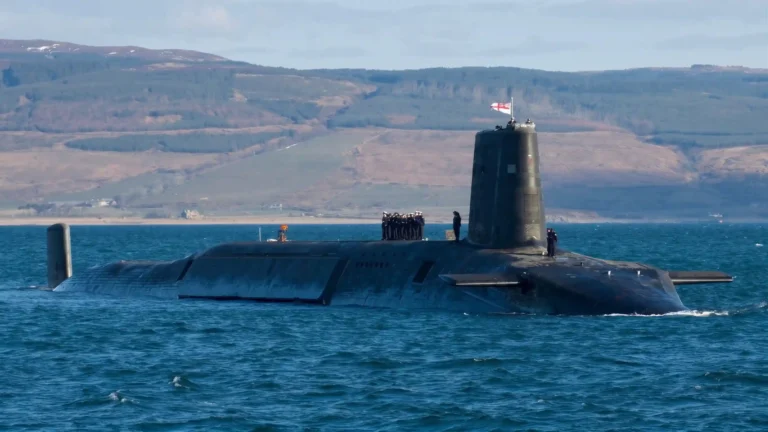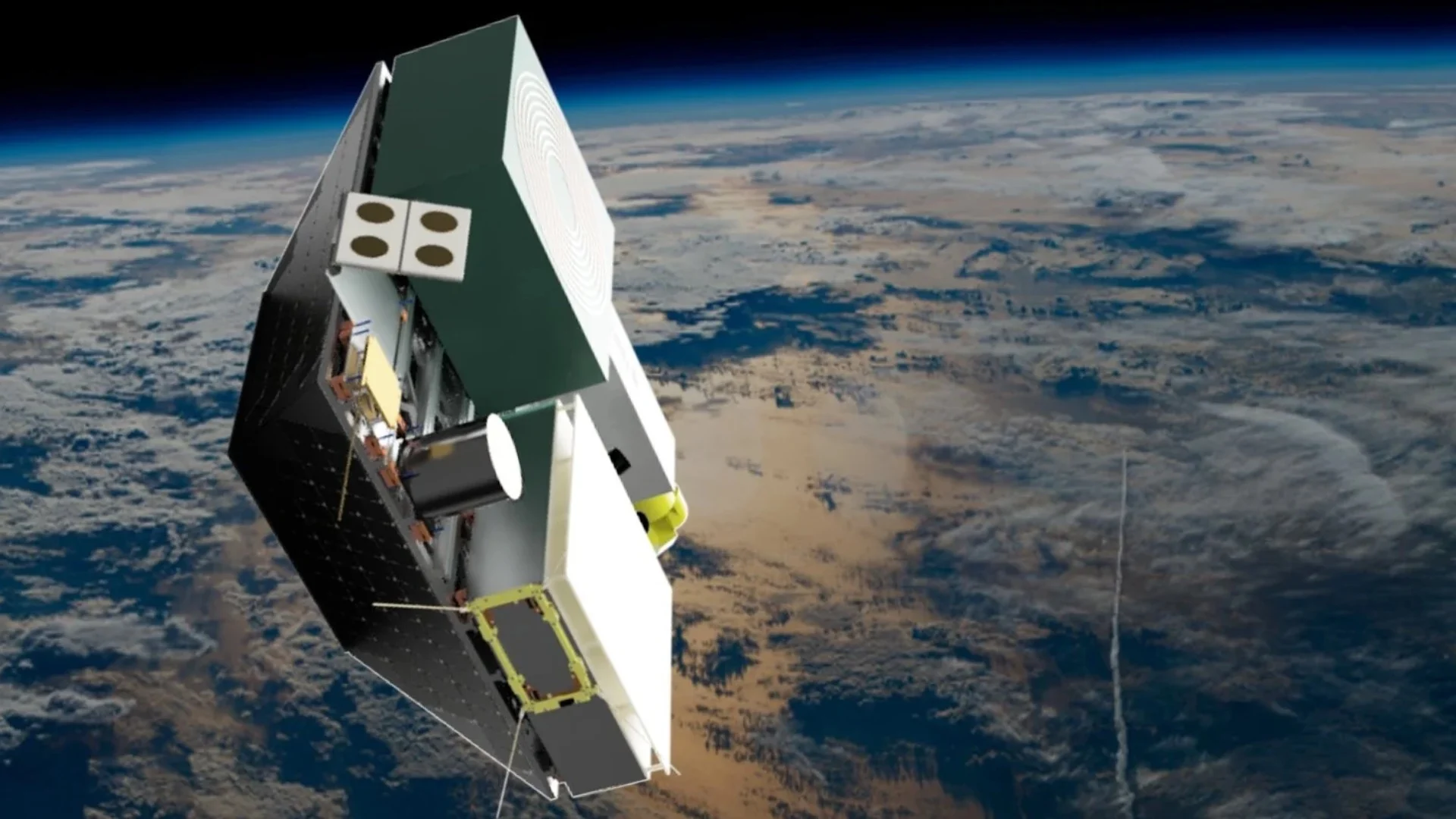
The United Kingdom has placed its Titania military satellite in orbit, the Ministry of Defence (MOD) confirmed on November 7, 2026, adding a second spacecraft to the constellation UK Space Command operates under the ISTARI program. The MOD also stood up Project Inaros, a trial network of three ground-based neuromorphic sensors designed to detect threatening activity near British satellites.
Both efforts draw on the £3 billion the Defence Investment Plan (DIP) commits to space-based capabilities over the next four years, out of £298 billion in total DIP spending over the same period. The 2025 Strategic Defence Review identified space as increasingly vital to national security, and ISTARI is the MOD’s vehicle for building sovereign space-based intelligence, surveillance and reconnaissance (ISR) together with supporting ground systems.
Titania Satellite Design, Payload and Launch Under ISTARI
Titania was designed and built in Hampshire by the Defence Science and Technology Laboratory (Dstl) and BAE Systems under a £9.5 million contract. Dstl originally awarded that contract in August 2021 to In-Space Missions, a Hampshire small-satellite firm that BAE Systems acquired later that year.
The MOD puts the spacecraft at around 100 kilograms, roughly the size of a washing machine, completing an orbit every 90 minutes at about 27,000 kilometers per hour, a profile consistent with low Earth orbit. Open-source satellite catalogs list Titania as launched in October 2026 on SpaceX’s Transporter-18 Falcon 9 rideshare mission from Vandenberg Space Force Base, California.
The ministry frames Titania as an observation asset that improves the armed forces’ ability to watch military activity on Earth. The program’s public record shows a different original mission. When Dstl awarded the contract, it described Titania as a research satellite for free-space optical communications, using laser links to Puck, Dstl’s optical ground station, with launch then targeted for 2023. The MOD has not detailed Titania’s sensor configuration or released performance figures.
Titania follows Tyche, built by Surrey Satellite Technology Ltd (SSTL) and launched in August 2024 as the first ISTARI satellite. Two further spacecraft are planned: Juno, with SSTL, and Oberon, with Airbus Defence and Space. The program has slipped against the schedule UK Space Command set out in 2023, which planned Titania and Oberon for 2025 and Juno for 2026.
Project Inaros Neuromorphic Sensors and UK Space Domain Awareness
Project Inaros will trial three ground-based neuromorphic sensors developed by Optera, a British Australian company, in partnership with the National Security Strategic Investment Fund (NSSIF). The sensors will operate from sites in the UK, Australia and British facilities in Cyprus, giving the network wide geographic spread.
Neuromorphic sensors mimic biological vision: rather than capturing full frames at fixed intervals, they register changes in light. The MOD says the technology could be developed into an early warning system to spot unusual or threatening activity near UK satellites, a space domain awareness task in which rapid detection of maneuvering objects matters more than image fidelity.
Inaros data will feed UK Space Command units including No. 1 Space Operations Squadron, No. 2 Space Warning Squadron and the newly formed No. 3 Space Effects Squadron. Those units protect satellites that guide British ships, connect mobile phones and warn of missile attacks. Defence Secretary Wes Streeting said the combination of Titania and Inaros means the UK can “see threats sooner.” The MOD has not disclosed the trial’s duration, cost or performance criteria.
Analysis: Titania matters less for the capability of a single 100-kilogram spacecraft than for what it reveals about ISTARI’s pace. A satellite contracted in 2021 as an optical communications demonstrator reached orbit years behind early schedule estimates and is now presented as an observation asset, a shift in framing the MOD has not explained. The £3 billion DIP allocation gives the program financial headroom, but its credibility now rests on fielding Juno and Oberon and on whether Inaros matures from a three-site trial into a persistent sensing layer. Pairing in-orbit ISR with ground-based monitoring of the satellites themselves reflects an assessment that British space assets are now potential targets requiring sovereign means of protection.
The next milestones are the launches of Juno and Oberon, for which the MOD has given no dates, and the start of Inaros sensor operations at the three sites. Open questions include Titania’s operational status after on-orbit commissioning, how its data will be integrated into UK Space Command’s ISR architecture, and how much of the £3 billion space allocation will fund protection against counter-space threats rather than new satellites.