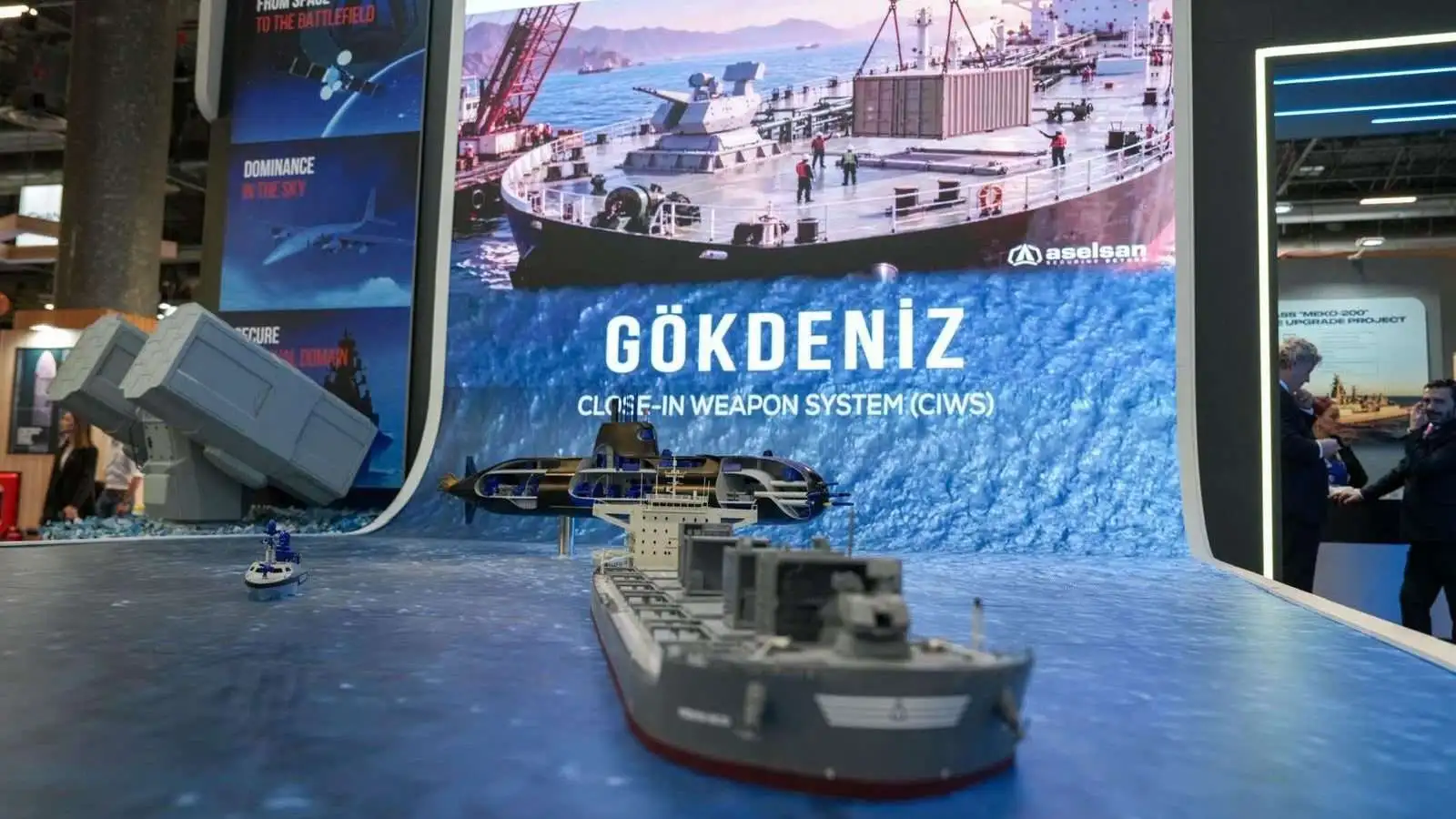
Türkiye’s Aselsan unveiled containerized versions of its Gökdeniz close-in weapon system (CIWS) and Göksur vertical-launch point defense missile system at Euronaval 2026 near Paris, offering removable air defense for tankers and cargo ships transiting contested waterways. A company representative said at the show, held November 3 to 6, that a foreign navy has signed for the system, with deliveries expected in 2027, Janes reported.
The launch coincides with the heaviest month of attacks on merchant shipping since U.S. and Israeli strikes on Iran opened the war on February 28, 2026. Maritime industry tallies recorded at least 34 commercial vessels attacked in the Strait of Hormuz and surrounding Gulf in October. The Joint Maritime Information Center (JMIC) rated the strait’s threat level SEVERE on November 1 and logged about 31 U.S.-assisted transits per day in its November 5 update. In the Red Sea, Yemen’s Houthis have enforced a declared embargo on Saudi shipping since July.
Aselsan Containerized Air Defense Packages Gun and Missile Layers
Gökdeniz is the naval derivative of Aselsan’s land-based Korkut system and already equips Türkiye’s Istanbul-class frigates. In its established form it pairs twin 35mm guns firing a combined 1,100 rounds per minute with a 3D search radar and an integrated tracking platform. Its programmable ATOM airburst round, effective to a stated 4 km, detonates ahead of the target to create a fragment cloud.
The deployable Gökdeniz 100/35 places the mount in a container with its own power supply and climate-controlled operator workspace. Aselsan markets dedicated mounting hardware that allows installation on a compatible vessel or fixed site without deck penetration or rework of shipboard electronics, followed by removal when the task ends.
The Göksur VLS version separates a fire control container from a launcher container. Aselsan says the configuration has its own sensors and built-in generators, so it does not rely on the host platform for power. The missile combines an imaging infrared seeker, encrypted two-way datalink and thrust-vector control, with a stated range of 15 km. The representative cited by Janes said a combined gun-and-missile fit needs at least four containers, including a separate power supply unit alongside Gökdeniz, the Göksur launcher and fire control.
Göksur intercepted a sea-skimming target at more than 11 km at the Sinop range in early October 2025, but that shot used the standard 100-N VLS. Public material from the show reports no firing from the containerized configuration and gives no container dimensions, mass or Gökdeniz magazine capacity.
Hormuz and Red Sea Attack Patterns Test the Engagement Envelope
JMIC counted four attacks in the strait within roughly 52 hours from November 1 to 3 off Oman’s Musandam coast, alongside Islamic Revolutionary Guard Corps drone overflights and targeted surveillance. On November 5, a suspected missile killed one seafarer aboard the products tanker Velos Sapphire in the Gulf.
Publicly available specifications put the Shahed-136 one-way drone at about 185 km/h, giving the gun about 78 seconds inside its 4 km envelope. A Mach 0.85 sea-skimmer would cross that distance in about 14 seconds, which makes Göksur’s 15 km reach the layer that buys reaction time. A gun able to handle slower drones also protects a finite missile load from early depletion.
The package does not answer every vector. On October 29, a small boat reportedly attached two explosive devices to the hull of the tanker Louise 1 northeast of Khasab, a scenario that demands close-range surface detection in dense traffic. Iranian claims of mine strikes, which the U.S. military rejects, point to a threat no air defense addresses.
The Red Sea adds a ballistic problem. The Houthis claimed a ballistic missile strike on a tanker about 63 nautical miles west of Yanbu on August 24, and a strike on the cargo ship Tihamah in the Bab el-Mandeb on August 11 left six dead. Aselsan’s published Göksur target set lists sea-skimming anti-ship missiles, cruise missiles, aircraft, helicopters and UAVs, not ballistic missiles.
Legal and Integration Hurdles Facing Armed Merchant Ships
Aselsan conditions commercial use on platform integration, operational arrangements and applicable regulations. Chief executive Ahmet Akyol said the deployable versions extend “an established air defense capability” to new platforms, and cited attacks on civilian shipping from Hormuz to the Black Sea. Integration still requires assessment of deck strength, firing arcs, sensor visibility, crew training and ammunition handling.
The San Remo Manual, the non-binding restatement of the law of naval warfare, lists being armed to an extent that could damage a warship among the activities that may render enemy merchant vessels military objectives, exempting only light individual weapons and purely deflective systems such as chaff. A 35mm gun and guided missiles fall outside that exemption. For neutral-flagged ships, the manual states that being armed alone provides no grounds for attack. Public material from the show does not say who would crew the containers, under what rules of engagement, or how flag and port states would treat them. How war risk underwriters would price an armed hull remains unknown.
BAE Systems showed the containerized Sea Tridon C, a Bofors 40mm gun with programmable 3P ammunition for military, government or commercial vessels needing temporary protection, and Rheinmetall presented a self-contained Millennium gun for platform-independent operations. Aselsan also showed its SMASH 30 remote gun, which uses programmable ATOM 30 ammunition against surface and aerial threats.
Analysis: The only disclosed order comes from a navy, not a shipowner, and that is the likely adoption path. States can assign rules of engagement, trained crews and legal responsibility to auxiliaries, chartered sealift and offshore sites in ways a private tanker operator cannot. Containerized air defense can spread scarce protection across more hulls, but it supplements escorts rather than replacing them.
The next markers are the identity of the foreign navy, the configuration it ordered and the 2027 delivery schedule. A live firing from a ship-mounted container would show whether blast, recoil and sensor performance hold on a host hull not designed for them. Turkish defense outlet TURDEF, cited by Türkiye Today, reported that new rules on protecting seaborne trade may be in preparation.