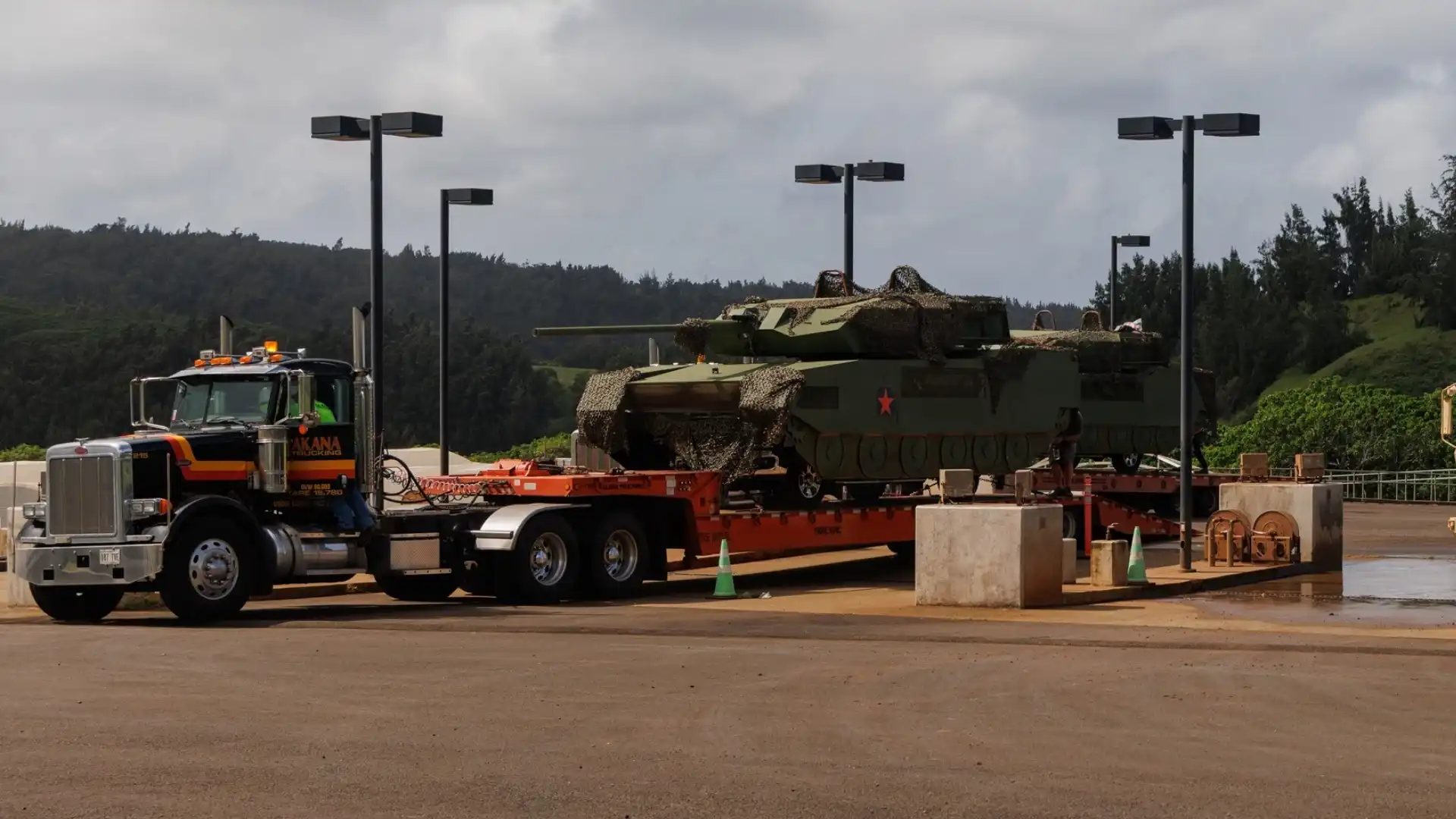
An official U.S. Army photo caption identifies a partly covered, tank-shaped vehicle trucked to Kahuku Training Area on Oahu on November 5, 2026, as an opposing force tank simulation. The description undercuts social media speculation that covered vehicles at the site were prototypes of the XM30 Mechanized Infantry Combat Vehicle, the planned replacement for the M2 Bradley.
The vehicle arrived during preparations for Joint Pacific Multinational Readiness Center (JPMRC) Rotation 27-01, which the Army says involves approximately 7,000 personnel, including troops from the Republic of Korea, Singapore, France, New Zealand, Japan, and the Maldives. The 25th Infantry Division’s 2nd Mobile Brigade is the main training audience. The sighting came as XM30 prototypes, delivered since late August, enter Army testing.
How an Opposing Force Tank Simulation Replicates Enemy Armor
Army releases do not identify the Kahuku vehicle’s base chassis, the threat type it represents, or the number assigned to the rotation. Army imagery from JPMRC 26-01 used nearly identical wording for a simulated tank in a battle position at Kahuku on November 11, 2025, which points to a recurring opposing force (OPFOR) asset.
Such vehicles typically fall under visual modification, or VISMOD, programs that fit a standard vehicle with a shell reproducing a foreign silhouette. The War Zone reported in 2019 that earlier Army fleets relied on retired M551 Sheridan light tanks dressed as T-72 tanks, BMP-2 infantry fighting vehicles, and ZSU-23-4 Shilka air defense guns. The service then moved to M113A3 armored personnel carriers configured as Opposing Forces Surrogate Vehicles.
A lighter modern option comes from WestEfx, a California special effects firm that adapted film techniques for the National Guard. Publicly available specifications indicate its T-72 kit adds about 1,700 pounds to an M1097 Humvee through lightweight framing, fabric coverings, and inflatable features, with a rotating turret assembly. The kits work with the Multiple Integrated Laser Engagement System, so crews can register simulated hits and kills, while gas-operated mock weapons and smoke generators reproduce firing cues. In 2019, an Idaho Army National Guard fleet manager put a Humvee at roughly $30,000, plus about $5,000 in annual maintenance.
Those savings carry limits. A kit-equipped Humvee does not move like a tank of more than 40 tons, and The War Zone noted in 2019 that WestEfx’s website did not say whether the kits could mimic a real vehicle’s signature under infrared or thermal sensors. That gap matters at JPMRC 27-01, where 2nd Mobile Brigade soldiers have rehearsed target identification with unmanned aircraft.
XM30 Test Plan Keeps Bradley Replacement Prototypes on the Mainland
The XM30 theory does not match the program’s published test plan. General Dynamics Land Systems delivered its first Wolf prototype to Aberdeen Proving Ground, Maryland, on August 21, 2026, and American Rheinmetall announced the delivery of its first Lynx prototype on September 1, 2026. Each company also supplied an additional hull and turret for ballistic testing. A General Dynamics Land Systems photograph of a Wolf under wraps on a trailer had already drawn attention to covered XM30 vehicles, and the firm says Wolf has fired its 50mm cannon on the live-fire range at Aberdeen.
Each contractor is now due to provide seven prototypes to the 1st Brigade Combat Team, 1st Cavalry Division, at Fort Hood, Texas, for soldier touchpoints and field evaluations that could conclude in February or March 2027, The War Zone reported in October. A previously planned rotation at Fort Irwin, California, is no longer envisaged, according to the same report. Award decisions for 19 vehicles will depend on contractor performance during testing and operational evaluations, according to the Congressional Research Service. Published test plans do not place an XM30 in Hawaii.
The design also targets a different force. The Army intends the XM30 for Armored Brigade Combat Teams, while the 2nd Mobile Brigade is moving through this rotation on Infantry Squad Vehicles, CH-47 Chinook helicopters, and Logistics Support Vessels. Both candidates pair an XM913 50mm automatic cannon with a two-soldier crew and hybrid-electric drive in a vehicle of roughly 50 tons, about 10 tons heavier than the Bradley. American Rheinmetall senior vice president of programs Jim Schirmer acknowledged, according to The War Zone, that an island campaign is a less likely setting for the vehicle, while pointing to larger landmasses such as the Korean Peninsula.
Analysis: The Kahuku vehicle matters less as hardware than as a training input. A brigade built around light vehicles, small drones, and mesh networks still has to detect and defeat armor in jungle and island terrain, and a tank-shaped target gives scouts and drone operators a recognizable silhouette to classify. Visual surrogates support that task, but they cannot fully reproduce a heavy vehicle’s mobility or sensor signature.
The Army has not said which unit will operate the simulated armor or how long it will remain in play. Imagery from the force-on-force phase may reveal its chassis and configuration. On the XM30 track, the next marker is the Fort Hood evaluation, ahead of a decision that Brig. Gen. Troy Denomy, the Army’s portfolio acquisition executive for ground maneuver, told Breaking Defense in August could end without a selection if no clear winner emerges.