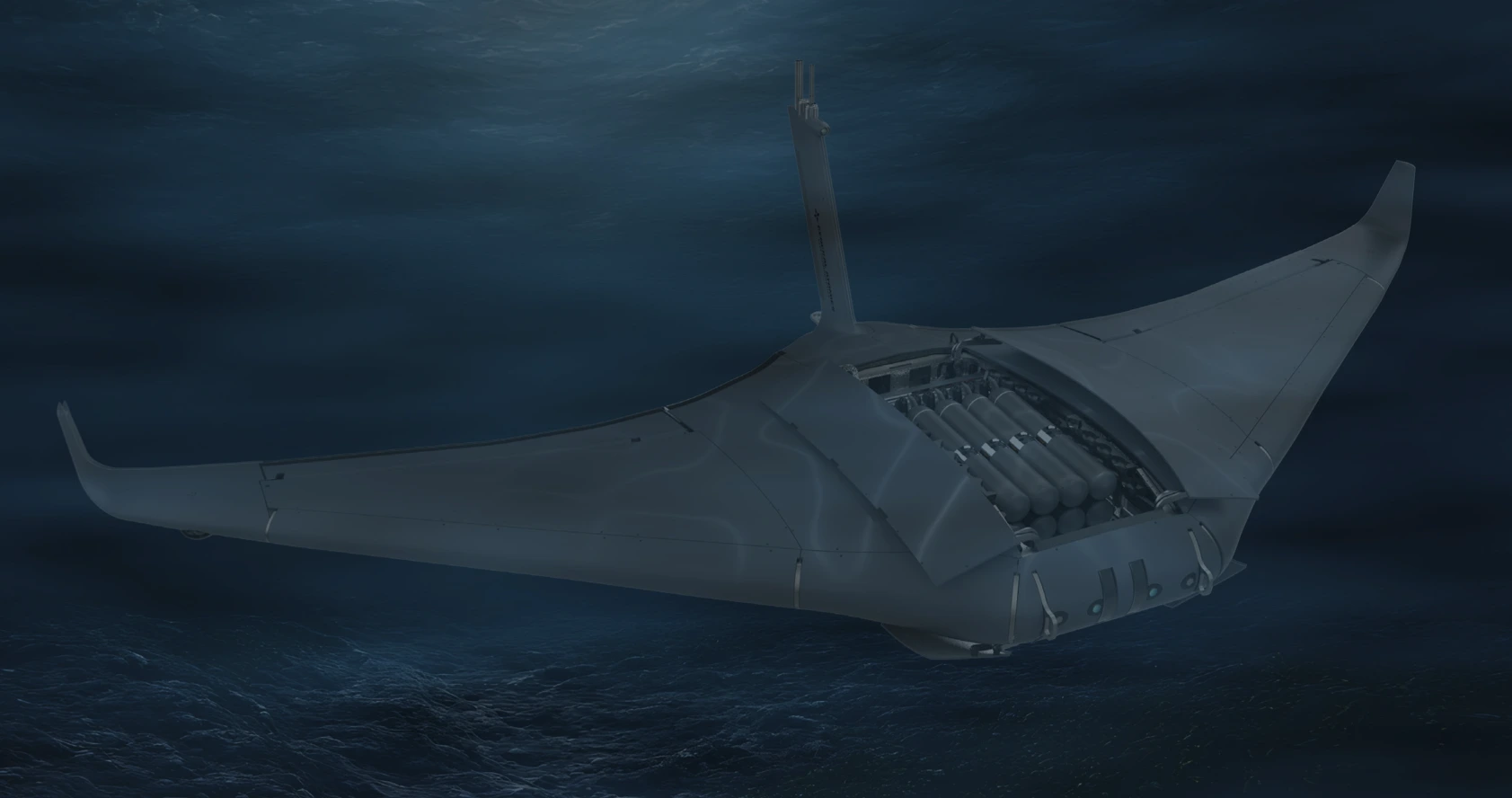
General Atomics Electromagnetic Systems (GA-EMS) unveiled its Ranger and GA-Ray (GRay) unmanned underwater vehicles (UUVs) at Euronaval 2026 in Paris, held November 3 to 6, presenting a scalable family of blended-wing underwater gliders designed to carry smaller drones, containerized payloads and strike packages on missions lasting months to years. The company positions the family as a way to take on surveillance, mining and anti-submarine tasks now assigned to nuclear-powered attack submarines (SSNs).
The unveiling lands as the U.S. Navy reshapes its undersea force structure. Chief of Naval Operations Adm. Daryl Caudle introduced the Hedge Force strategy at the Surface Navy Association symposium earlier this year, pairing unmanned systems with warships, aircraft and submarines in packages tailored to specific adversaries. The service’s May 2026 shipbuilding plan also moved Boeing’s Orca Extra-Large Unmanned Undersea Vehicle (XLUUV) into procurement, funding two vehicles in fiscal 2027 against a target of 16 through fiscal 2031.
Ranger UUV and GA-Ray: Size, Endurance, and Glider Propulsion
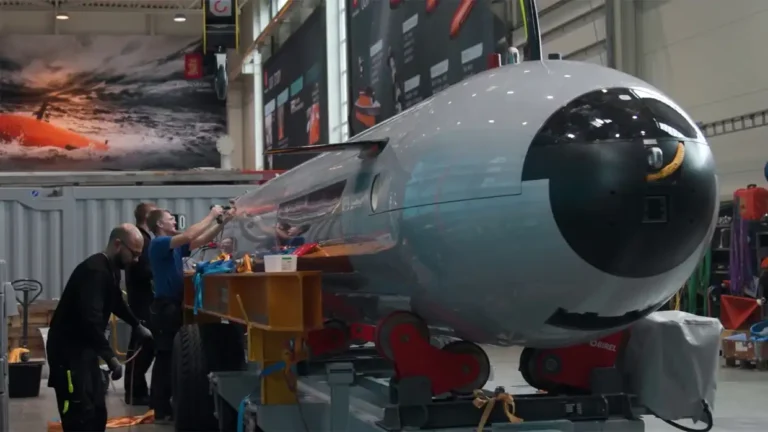
GRay is a 22-foot (6.7-meter) Large Displacement Unmanned Underwater Vehicle (LDUUV) with endurance measured in weeks to months. Ranger is a planned XLUUV of 100 to 135 feet (30 to 41 meters) with multi-year endurance and what the company calls extra-large payload capacity. In an interview with Naval News at the show, Rolf Ziesing, Vice President of Maritime Programs at GA-EMS, described one Ranger configuration with a 100-foot wingspan and a cargo bay equivalent in size to a CONEX shipping container. GA-EMS has not specified whether the 100 to 135-foot figure refers to length or span.
Program status differs sharply between the two. GRay exists and operates at sea as a dual-purpose platform for risk reduction, concept development and deployment of smaller UUVs. Ranger remains a scale-up concept. According to the company, submerged tests have lasted up to 70 days.
Propulsion is the core design choice. Rather than a conventional propeller, both vehicles rely on buoyancy-driven glider physics, supplemented by thrusters and purpose-designed directional control surfaces. GA-EMS states the blended-wing hull improves hydrodynamic efficiency and internal volume, and claims endurance of tens of thousands of nautical miles depending on configuration. GA-EMS has not disclosed transit speed, operating depth, displacement or the type of energy system Ziesing credited with enabling multi-year operations.
Signature management drives the rest of the design. The company cites near-silent propulsion, no mast or snorkel and no routine surface exposure. Navigation combines an inertial navigation system (INS), a Doppler velocity log (DVL), optical communications and emerging quantum-enabled sensors, allowing operations in GPS-denied waters.
Host Vehicle Payloads: Sub-UUVs, Containers, and Submarine-Launched UAVs
GA-EMS frames Ranger and GRay as host vehicles rather than standalone sensors. “We’re really looking at this as a system of UUVs,” Ziesing said at Euronaval 2026, noting that both the host and its payload UUV have operated at sea. A company graphic showed capacity ranging from 16 to 96 smaller UUVs depending on variant size.
Ranger can alternatively carry two large-diameter UUVs for independent missions, or a CONEX-sized container that can be released to remain on station. In a third mode, the vehicle settles on the seabed with the container and deploys payloads through a top-opening door. Listed mission payloads include intelligence, surveillance and reconnaissance (ISR) equipment, acoustic and quantum sensors, mine deployment systems and strike packages.
The family also extends into the air domain. GA-EMS displayed a quadcopter unmanned aerial vehicle (UAV) launched from a tube carried by a smaller UUV, supported by video of a physical deployment test; its specifications were not released.
Operational concept art placed launch points at Okinawa and Guam, with reach extending to First Island Chain chokepoints and Chinese littoral waters.
Ranger UUV vs Orca XLUUV: Glider Endurance and the Hedge Force Opening
Analysis: Ranger enters a segment where the Navy has just committed money to a different technical answer. Orca, roughly 85 feet long with its payload module, uses a hybrid diesel and lithium-ion power system that recharges on the surface, and completed its first patrol exceeding 1,000 nautical miles in July 2026. GA-EMS is betting that glider physics, with no snorkel exposure, can trade speed for persistence measured in years and turn the XLUUV from a mission platform into a covert logistics node for smaller drones. That pitch maps directly onto Hedge Force and the SSN shortfall, but it rests on performance the company has not yet demonstrated at Ranger scale. The undisclosed speed matters: a glider that loiters for years may still struggle to reposition quickly against time-sensitive tasking.
GA-EMS has not announced a customer, contract or timeline for building the first Ranger, and the near-term milestone is the scale-up from the 22-foot GRay to a 100-foot-class vehicle. Ziesing acknowledged additional payloads in development that the company will not discuss publicly. Whether the Navy writes a Hedge Force requirement that a glider-based XLUUV can compete for, alongside Orca procurement, will determine if Ranger moves beyond concept.