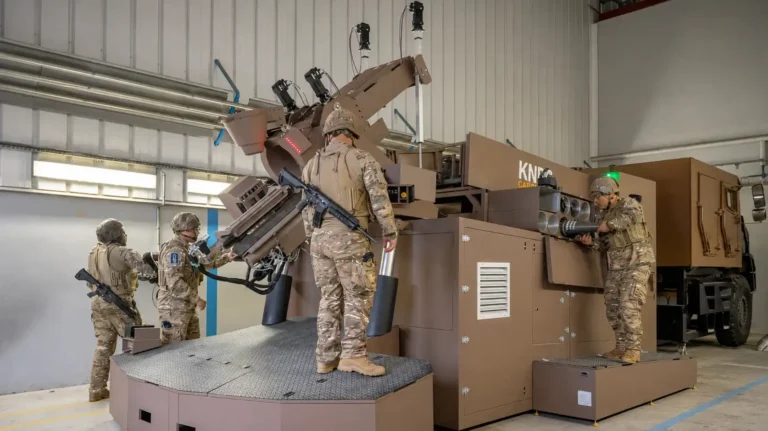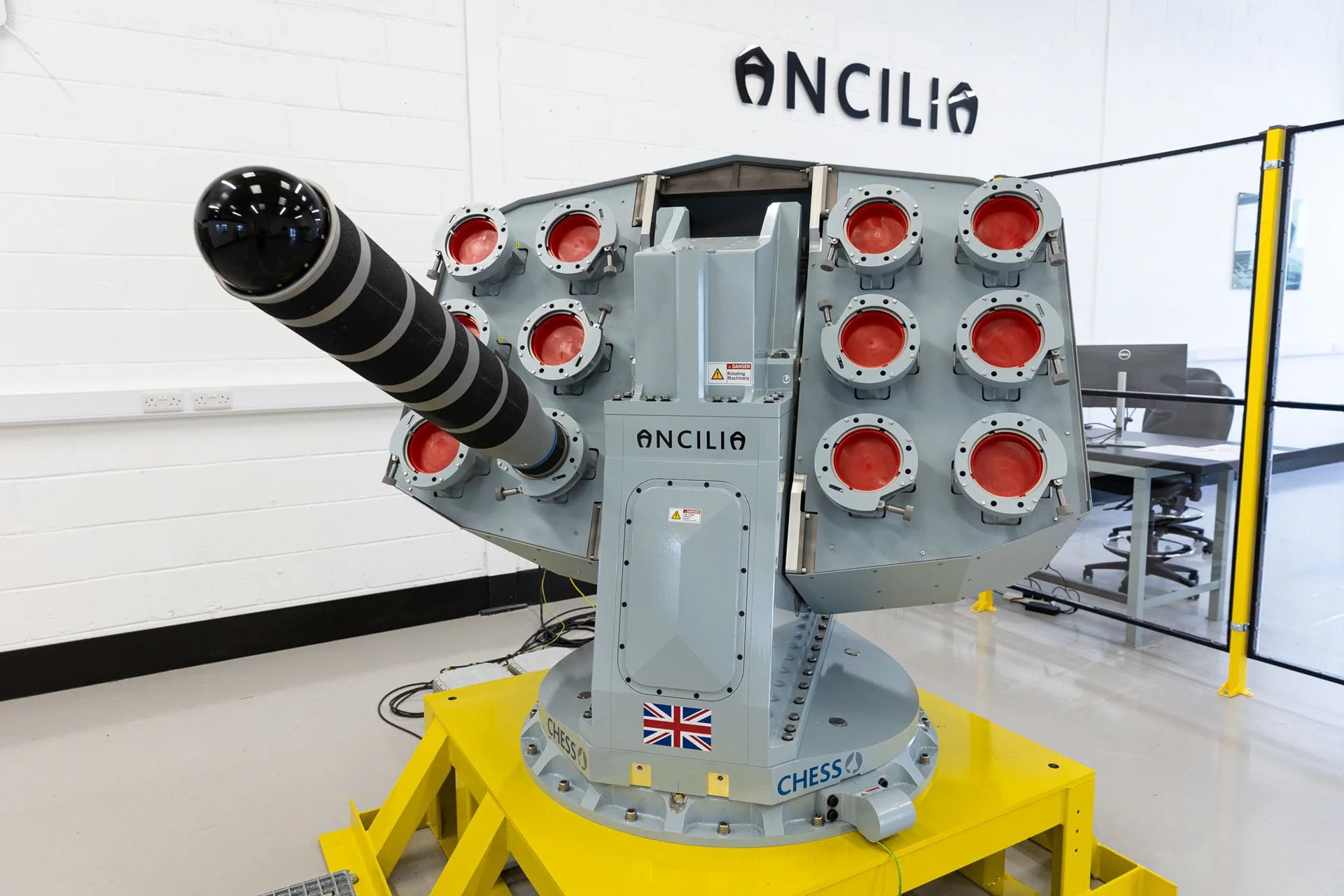
Royal Navy electromagnetic warfare operators rated the Ancilia trainable decoy launcher a marked improvement over fixed Sea Gnat tubes after two days of trials in Devon, the Royal Navy said on November 17, 2026. The four Electromagnetic Warfare Directors, drawn from Fleet Operational Sea Training (FOST), the Joint Electronic Warfare Operational Support Centre (JEWOSC) and the Electromagnetic Warfare Training Element at HMS Collingwood, tested the launcher and its control interfaces at manufacturer SEA’s site in Barnstaple and were tasked with feeding back improvements where needed.
Ancilia is being delivered under Electronic Warfare Countermeasures Increment 1a (EWCM 1a), a £135 million (about $170 million) contract that Defence Equipment and Support (DE&S) awarded to SEA, a Cohort plc company, on March 26, 2024. EWCM 1a sits within the Maritime Electronic Warfare Programme (MEWP), the Royal Navy’s long-term effort to recapitalize surface ship electronic surveillance, EW command and control, and soft-kill anti-ship missile defense. SEA won the competition ahead of Elbit Systems UK.
Ancilia Trainable Decoy Launcher Replaces Fixed Sea Gnat Tubes
The Royal Navy will install Ancilia on all Type 45 destroyers and all Type 26 and Type 31 frigates, replacing the fixed, angled launch tubes of the in-service 130mm Outfit DLH Sea Gnat system. Program details reported at contract award indicate 38 launchers for 19 ships: six Type 45s, eight Type 26s and five Type 31s. Each launcher is reported to carry two six-barrel panniers on a stabilized training and elevating mount, with Cohort sister company Chess Dynamics supplying the platform.
The operational difference is geometry. A fixed launcher fires along predetermined bearings, so the ship often has to turn to place a decoy where it will be effective. Ancilia slews toward the threat axis and fires accordingly, which the Royal Navy says allows more accurate and effective placement of current 130mm rounds. That inventory spans chaff, smoke and flares intended to distract an incoming missile, and radio frequency reflectors designed to seduce its seeker away from the ship. Its open architecture is intended to accept future rounds, and SEA says the launcher can fire any standard NATO 130mm decoy.
Testing Under CBRN Protective Equipment and Day-Night Conditions
The Barnstaple trials focused on the human-machine interface. Operators worked the system while wearing escalating levels of personal protective equipment, from standard anti-flash gear and chemical, biological, radiological and nuclear (CBRN) gloves to the General Service Respirator and protective eyewear, and under varying light levels to replicate day and night operations. They exercised both firing positions: the control panel in the operations room and a local control panel on the upper deck next to the launcher.
All four found the system a substantial step up from the current launcher when firing decoys. “It’s intuitive, responsive and easy to use, helping operators and maintainers build detailed system knowledge and make full use of its capabilities,” said Leading Seaman (EW) Lewis Rollason of JEWOSC, who described the Electronic Warfare Countermeasures interface as a glimpse of how the Royal Navy will deploy countermeasures in the future.
Analysis: Soft-kill decoys work alongside hard-kill interceptors such as Sea Viper and Sea Ceptor, and their value depends on launch timing measured in seconds. Testing the controls in full CBRN protection and darkness addresses the conditions in which an operator is most likely to lose time. A trainable launcher also frees the commanding officer from turning the ship to position decoys, preserving freedom to hold course for weapon arcs or helicopter operations. The Royal Navy’s 2024 Red Sea operations against Houthi missiles and drones, cited by the Ministry of Defence when the contract was signed, showed how compressed those decisions have become for British escorts.
The Royal Navy has not disclosed an installation schedule, a first ship to receive the system or performance figures such as slew rate and reaction time. DE&S has said launchers will be integrated in line with platform availability, which ties fielding to the Type 26 and Type 31 build programs and to Type 45 maintenance periods. The next milestone is the first ship fit and integration with the EW command and control subsystem from the companion Maritime Electronic Warfare System Integrated Capability (MEWSIC) strand of MEWP.