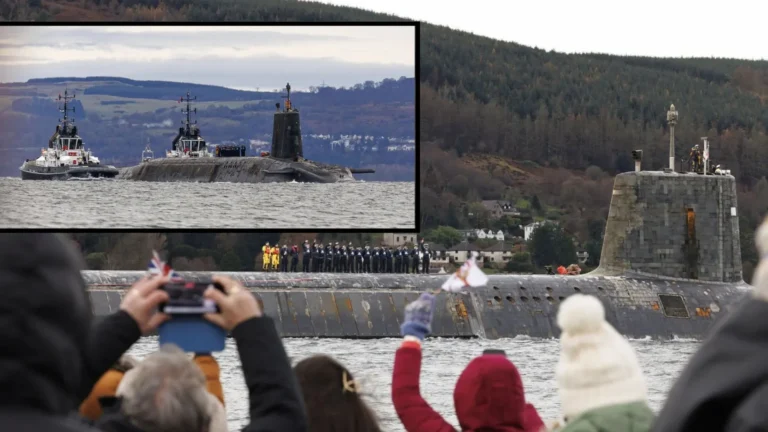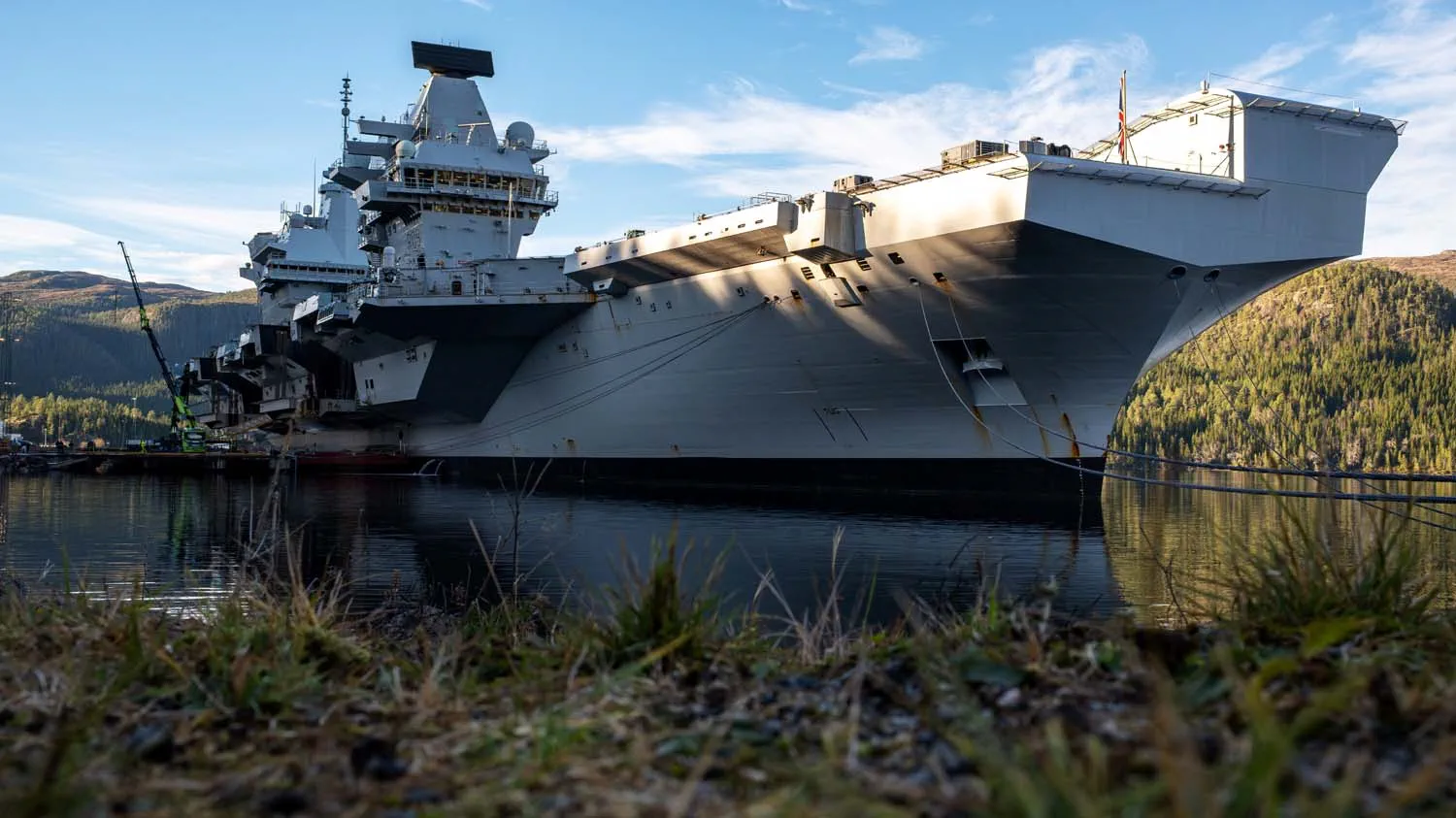
HMS Prince of Wales, the Royal Navy’s flagship, returned to Portsmouth on November 16, 2026, closing Operation Firecrest, the UK Carrier Strike Group’s two-phase North Atlantic and High North deployment. Escorted by Type 45 destroyer HMS Dauntless, the 65,000-tonne carrier spent the past month operating with NATO allies off Norway, including NATO exercise Neptune Strike 26-4.
Announced by the Ministry of Defence on February 14, 2026, Firecrest was the UK’s headline naval commitment of the year, run in two phases across six months. In the first, which ended in late July, the carrier, destroyer HMS Duncan and fleet tanker RFA Tidespring worked with 19 allies from NATO and the Joint Expeditionary Force (JEF) along the Northern Flank. After summer maintenance, the ship sailed again on October 18 for a second phase in Arctic and sub-Arctic waters, including the Greenland-Iceland-UK (GIUK) Gap, the choke point between Russia’s Northern Fleet and the open Atlantic.
HMS Prince of Wales Rearms in Norway Ahead of Neptune Strike
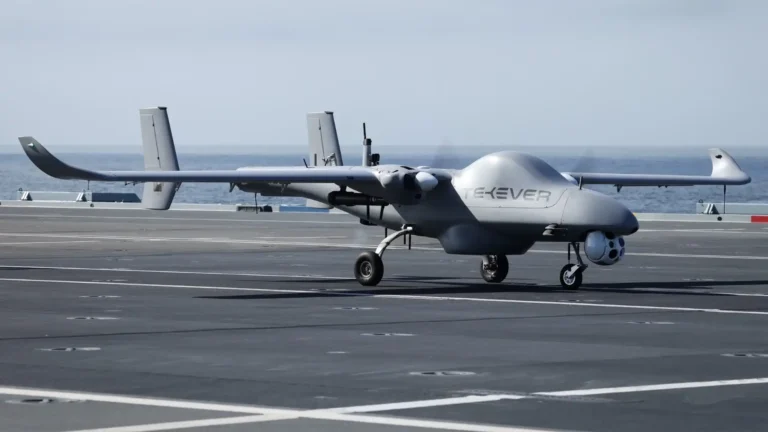
The second phase opened with combined air activity. The carrier’s F-35B Lightning jets, drawn from 617 Squadron “The Dambusters” at RAF Marham, flew alongside Royal Norwegian Air Force F-35As to escort a US Air Force B-52 bomber. The Royal Navy also reported F-35B sorties in the Baltic Sea over the past month. Royal Navy imagery from late October shows seven F-35Bs embarked for this phase, a light air wing by the standards of the Queen Elizabeth class, which the Royal Navy says can carry a maximum of 36 F-35Bs. Rotary-wing assets comprised Merlin Mk4 helicopters from Commando Helicopter Force and Merlin HM2 anti-submarine helicopters from 820 Naval Air Squadron, alongside Wildcat helicopters and Malloy uncrewed aerial systems.
The logistics milestone came at Hammernesodden, a military jetty near Namsos in central Norway, where HMS Prince of Wales loaded ammunition. According to the Royal Navy, it was the first time a Queen Elizabeth-class carrier had taken on ammunition in a non-UK port, and the first time Norway had facilitated an ammunition resupply for an ally. Until now, the two UK carriers have relied on the Northern Ammunition Jetty at Glen Mallan, on Loch Long in Scotland, where Prince of Wales loaded ammunition in early May before sailing for Nordic waters.
A carrier able to rearm inside the theater spends less time off station during a sustained air campaign, and the UK gains an alternative to a single domestic munitions node. In the High North, where every return transit to Scotland erodes presence, a host-nation magazine directly extends the strike group’s endurance.
Neptune Strike 26-4: Paveway IV Drops and a Tu-95 Intercept
After departing Hammernesodden, the carrier led one of three naval task groups in Neptune Strike 26-4, a NATO activity involving 17 nations, 20 warships and 40 aircraft. Italy and Türkiye each commanded a task group in the Mediterranean, while HMS Prince of Wales led the northern group off Norway. Her screen comprised HMS Dauntless, Type 23 frigate HMS St Albans, Norwegian frigate HNoMS Fridtjof Nansen, a French frigate and Norwegian logistics vessel HNoMS Maud.
Publicly available specifications indicate Dauntless carries the Sea Viper system, firing Aster 15 and Aster 30 missiles cued by the SAMPSON multifunction radar, while Fridtjof Nansen fields the Aegis combat system with the AN/SPY-1F radar. St Albans brings the Type 2087 low-frequency active towed sonar, built for the anti-submarine mission that defines GIUK Gap operations.
The F-35Bs flew their strike role, practicing loading and ultimately dropping live Paveway IV bombs. The Paveway IV is a 500-lb-class precision weapon combining GPS/INS and laser guidance, and the UK F-35B’s primary air-to-ground weapon. The NATO presence also drew Russian attention: the carrier scrambled F-35s to intercept a Tupolev Tu-95 Bear long-range bomber.
The carrier then sailed to Oslo, arriving November 6 to host the Atlantic Future Forum and the International Sea Power Conference on board. Captain Ben Power, the ship’s commanding officer, described the gathering as “this most significant afloat Defence diplomacy event of recent times.” Commodore Richard Hewitt, Commander of the UK Carrier Strike Group, said Firecrest had “demonstrated the strength of NATO integration and the value of a persistent maritime presence in the North Atlantic and High North.”
Analysis: Firecrest’s most durable outcome may be logistical rather than kinetic. The Hammernesodden resupply turns Norway from an exercise host into a forward support node for British carrier aviation, a model relevant to NATO’s Arctic Sentry mission. The deployment also exposed limits. Seven embarked F-35Bs and a single Type 45 destroyer amount to a modest strike and air defense package, and the Royal Navy again depended on allied hulls to complete its screen. On the Northern Flank, deterrent credibility rests less on the carrier alone than on the depth of the allied architecture around it.
HMS Queen Elizabeth, which sailed from Portsmouth in September for advanced training after her maintenance period at Rosyth, is set to take over from Prince of Wales as the UK’s flagship and high-readiness strike carrier in late 2027, according to the Royal Navy, and the Royal Navy has not yet detailed Prince of Wales’s next program. Open questions include whether Norway formalizes Hammernesodden for routine allied use and the size of the air wing the UK commits to its next High North rotation.