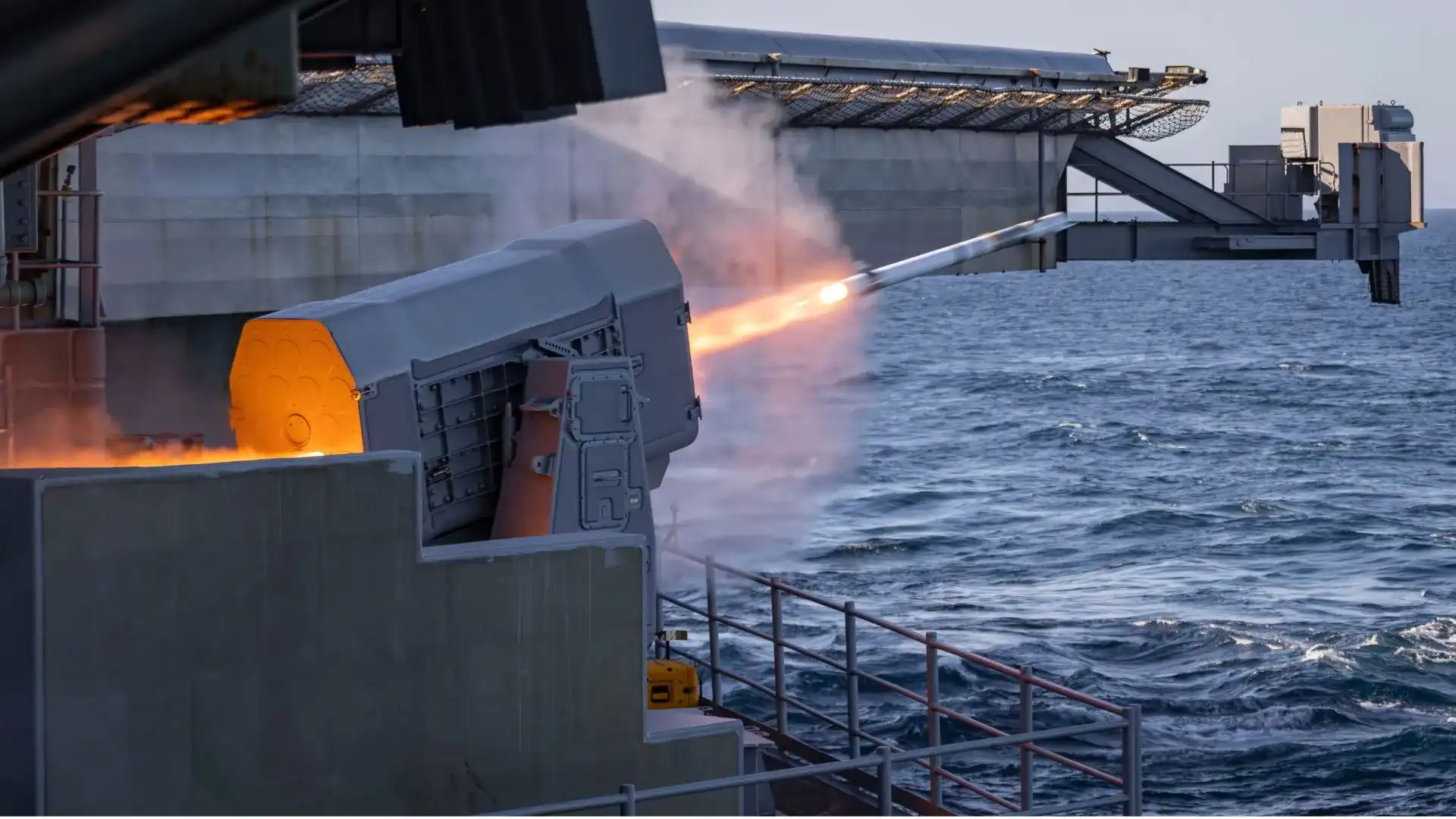
Germany is paying the full $12,337,200 for a Raytheon contract modification, announced November 17, 2026, that sustains engineering support for the Rolling Airframe Missile (RAM) weapon system. The Department of War announcement lists the cost-plus-fixed-fee award as modification P00036 to contract N00024-23-C-5401. Work will be performed in Tucson, Arizona, and is expected to be completed in September 2028.
The funding arrangement reflects how RAM has operated for more than four decades. The RIM-116 is co-developed and co-produced under a bilateral US-German government program, and Berlin routinely finances its share of design and sustainment work through US Navy contract vehicles. The award also carries an administrative signal: the contracting activity is listed as Portfolio Acquisition Executive (PAE) Munitions, an organization the Department of the Navy stood up in May 2026 as part of its acquisition overhaul. The base contract was awarded in July 2023 by Naval Sea Systems Command.
What the Rolling Airframe Missile Engineering Contract Covers
The modification exercises options for design agent and engineering support to maintain the operational capabilities of the RAM weapon system, which provides anti-ship missile defense for multiple ship platforms. The scope covers design and systems engineering, software maintenance, reliability, maintainability, quality assurance, and logistics engineering, with the stated aim of addressing technical issues and sustaining weapon system capabilities. The specific technical issues were not disclosed. Germany’s funds are obligated in full at the time of award. The contract was not competitively procured; the original July 2023 award, with a ceiling of roughly $282.6 million, went sole-source to Raytheon under the requirements of an international agreement.
The RIM-116 is a supersonic, quick-reaction, fire-and-forget point-defense missile designed to destroy anti-ship cruise missiles, and it can also engage aircraft, helicopters, drones, and small surface craft. US Navy figures give the Block 1A a length of 2.83 meters, a diameter of 127 mm, and a weight of 74.4 kg, while the Block 2 grows to 2.88 meters, 159 mm, and 88.2 kg, with a larger rocket motor and a four-canard control section built to defeat high-maneuver threats. Guidance combines passive radio-frequency homing on the threat’s own emissions with infrared terminal guidance. The Mk 49 launcher carries 21 rounds, while the autonomous SeaRAM variant mounts an 11-round launcher on a modified Phalanx close-in weapon system.
Germany’s RAM Block 2B Buy and the Transatlantic Work Split
Germany’s stake has grown with the Block 2B, the sixth-generation round designated RIM-116E in US service. It introduces a new infrared seeker, an improved radar seeker, and a missile-to-missile datalink that lets rounds fired in a salvo share information, a feature aimed at saturation and swarm attacks. Berlin ordered 600 Block 2B rounds through RAM-System GmbH (RAMSYS) in October 2022 and another 400 in October 2024, bringing its total to 1,000 missiles. Deliveries from the second batch are scheduled to begin in 2027.
RAMSYS, a 50/50 joint venture of Diehl Defence and MBDA Deutschland, manages the European side of the program. Diehl produces the infrared seeker, guidance unit, and launch canister, while MBDA Deutschland builds the radar seeker, control unit, and warhead. Raytheon holds the design agent role in Tucson, which explains why German sustainment money flows through a US Navy contract to an Arizona facility. In the German Navy, RAM arms all frigates and the K130 corvettes; beyond the two partner nations, operators include Egypt, Greece, Japan, Mexico, Qatar, South Korea, Türkiye, and the United Arab Emirates.
Analysis: The more consequential detail is the contracting office. The Navy presents PAEs as a significant shift from the Program Executive Officer structure, giving each executive direct authority over an entire portfolio of like programs and the associated technical, contracting, and sustainment functions. PAE Munitions absorbed several offices of the former Program Executive Office Integrated Warfare Systems, including the Terminal Defense System program (IWS 11.0), the office code under which the Navy lists its next RAM design agent requirement, and was created with a mandate to drive faster production of high-quantity munitions. Its appearance on a routine, foreign-funded sustainment action shows the reform moving from organization charts into contract execution. For Berlin, that places Block 2B sustainment inside the same portfolio that arbitrates US munitions ramp-up priorities, which could simplify coordination but also puts German requirements in competition for engineering capacity in Tucson as US demand for interceptors rises.
Work under this option runs through September 2028. The next markers to watch are further option exercises on contract N00024-23-C-5401, the start of deliveries from Germany’s second Block 2B batch in 2027, and whether other cooperative and Foreign Military Sales munitions actions migrate to PAE Munitions as the Navy completes its transition away from the legacy acquisition structure.