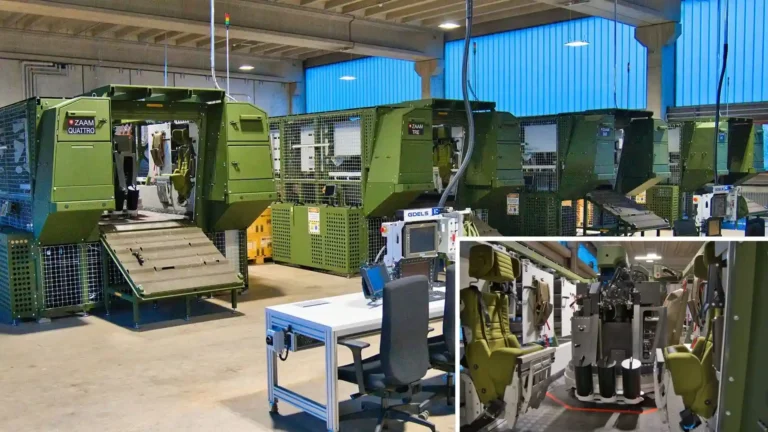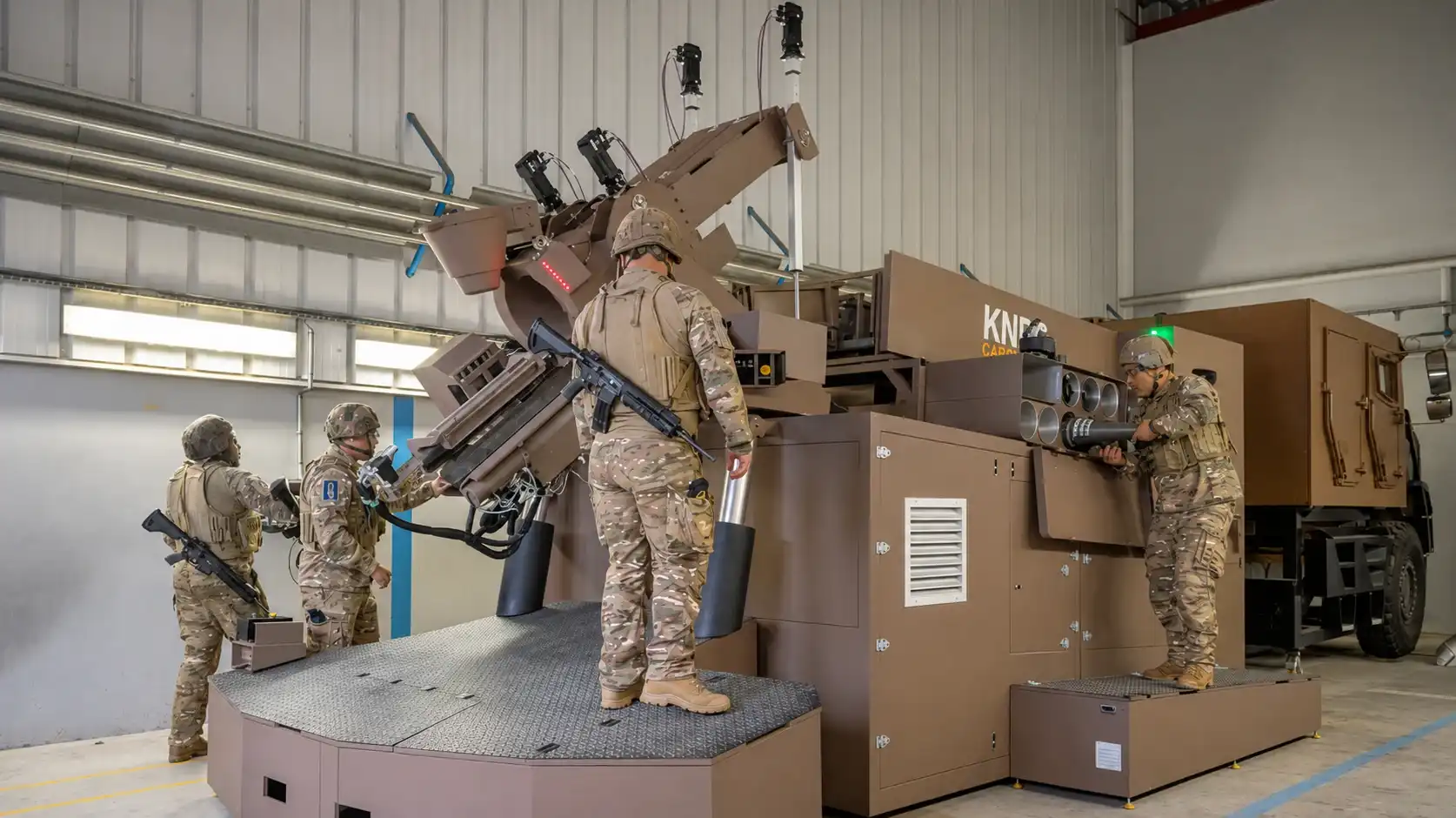
The French Army’s artillery school has become the first unit in the service to receive the CAESAR loading training bench (banc d’instruction au chargement, BIC), a full-scale KNDS simulator of the CAESAR 6×6 MkII gun section. The École d’artillerie (EA) in Draguignan took delivery in summer 2026, trained its instructors in September and has since run its first simulator sessions for non-commissioned officers, the French Army announced on November 12, 2026.
The bench arrives as the French Army prepares to field the CAESAR MkII, the new-generation 155mm truck-mounted howitzer ordered from Nexter, a KNDS company, by the Direction générale de l’armement (DGA) in a contract announced in February 2024. That contract covers 109 newbuild systems, with first deliveries scheduled for 2026 and the full batch due in the artillery regiments by 2031, according to KNDS. The MkII keeps the CAESAR artillery module on a new Arquus chassis with a 460 hp engine, up from 215 hp, an automatic gearbox and integration into the SCORPION combat information system.
How the CAESAR MkII Loading Simulator Replicates the Gun Section
The BIC is a 1:1 scale mockup of the rear section of the CAESAR 6×6 MkII, where the gun crew works. It is fitted with real interfaces and ballasted dummy rounds, allowing a complete crew of five to train in conditions close to those encountered in the field.
Trainees rehearse loading and unloading, safety procedures and crew coordination, repeating each technical gesture until it becomes automatic. Instructors can also inject degraded scenarios, including a hang fire, a recoil malfunction or a casualty requiring evacuation from the gun position. These scenarios target future section chiefs, who must diagnose and resolve such incidents under pressure.
The bench is connected to ATLAS (Automatisation des tirs et liaisons de l’artillerie sol-sol), the Thales-built digital fire-support command and control system used across French ground-to-ground artillery. It carries the same interfaces as the howitzer and reproduces the synchronization of the loading sequence.
“The different interfaces allow trainees to find themselves in conditions close to reality and to reproduce identically the gestures they learned in theory,” said Staff Sergeant Olivier, an artillery fire-support instructor at the EA.
Simulation Cuts Live Ammunition and Logistics Costs in CAESAR Training
Beyond individual drills, the Army presents the BIC as a tool for building collective skills and decision-making. By exposing trainees to simulated incidents, instructors can assess how well they apply procedures, react under stress and work as a team. “We can study their behavior in degraded situations, and therefore best guide young artillerymen according to their reactions,” the instructor said.
The second gain is availability. Sequences can be repeated as often as needed without immobilizing an operational CAESAR or firing live rounds, cutting logistics constraints, costs and risk. Publicly available ministry specifications credit the CAESAR with a 40 km range and a rate of six rounds per minute, with a five-gunner crew able to fire six rounds and displace within two minutes. The Army has not disclosed the cost of the BIC, the number of units ordered or the contract under which KNDS supplied it.
Analysis: The BIC targets the drill that keeps a truck-mounted gun alive. A wheeled howitzer survives counter-battery fire by shooting and moving within minutes, and that depends on a loading sequence executed without hesitation. Moving repetition off the vehicle preserves the first MkII guns for unit conversion and reserves 155mm stocks for live firing and war reserves, as European artillery ammunition remains a constrained resource.
The French Army says all artillery regiments of its combined arms brigades will receive the BIC in the coming years, without giving a timeline. The rollout is likely to track MkII deliveries; Army Chief of Staff General Pierre Schill told lawmakers in October 2025 that the first 10 systems would arrive in 2026. Whether KNDS will offer the bench to export MkII customers such as Belgium, which has ordered 28 systems, remains unconfirmed.