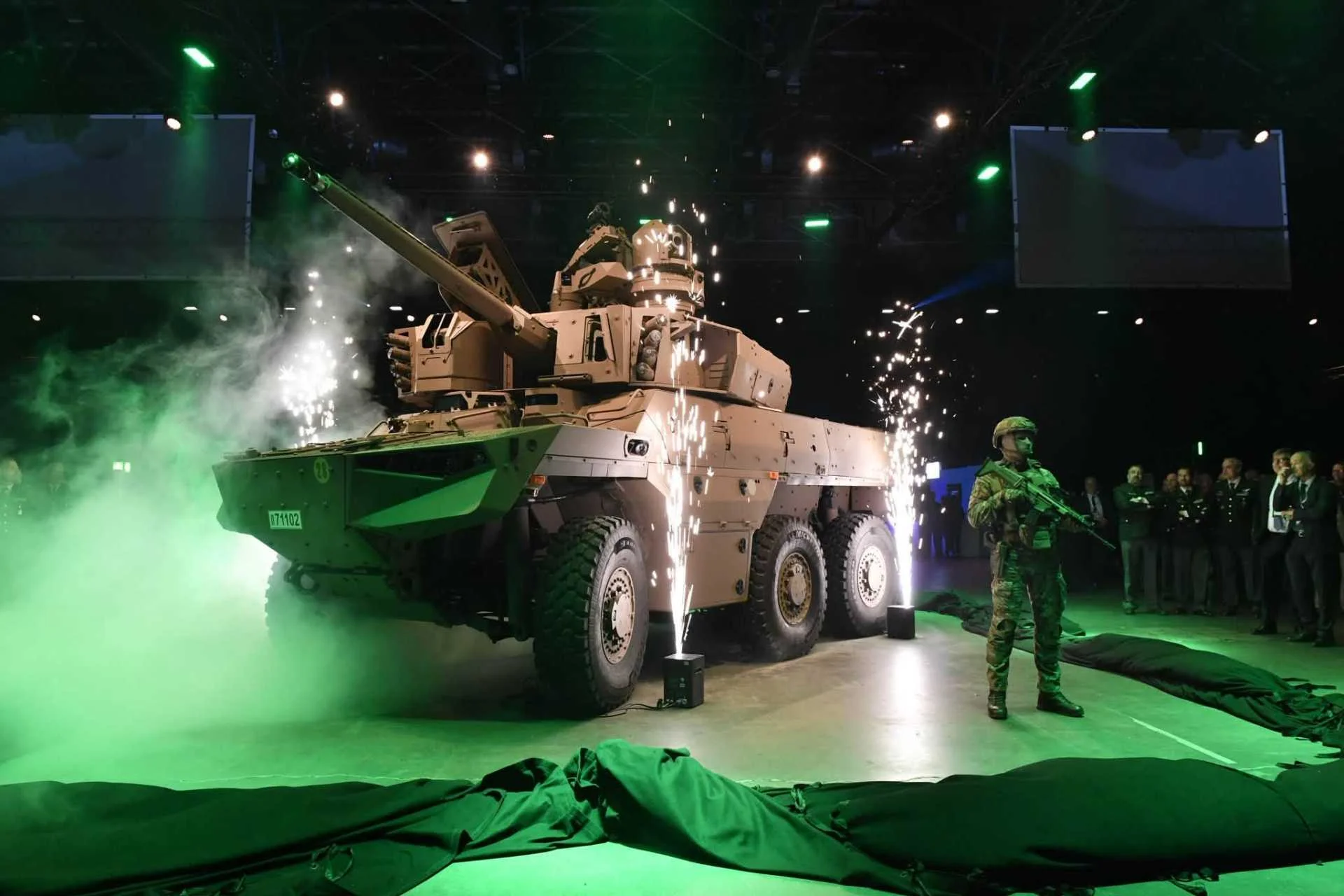
The first Belgian Army Jaguar was presented on November 18, 2026, during Army Day in Leuven, the lead vehicle of 60 Jaguar 6×6 armored reconnaissance and combat vehicles ordered from France. Defense Minister Theo Francken and Land Component commander Maj. Gen. Gert Van Goethem attended the event at the Brabanthal exhibition center. Belgium is acquiring the Jaguars under the Capacité Motorisée (CaMo) program, with operational entry expected in 2027.
The arrival marks the return of a dedicated medium cavalry capability to the Belgian Army. Signed in October 2018 and initially valued at €1.5 billion, the CaMo agreement covered 60 Jaguars and 382 Griffon multirole armored vehicles, aligning Belgian land forces with the French Army’s SCORPION modernization effort and its SCORPION Information and Combat System (SICS). Follow-on orders added Serval light armored vehicles, CAESAR NG 155 mm self-propelled howitzers and Griffon MEPAC mortar carriers. The new fleet replaces the Piranha IIIC and Dingo vehicles that have formed the backbone of Belgium’s motorized forces.
Belgian Army Jaguar Rollout: Units, Timeline, and Infrastructure
The Jaguars will equip the cavalry of the 1st and 7th Motorized Brigades, both reactivated on February 3, 2026. The first vehicle goes to the 1st/3rd Lancers Battalion at Marche-en-Famenne, part of the predominantly French-speaking 7th Brigade. The 2nd/4th Lancers Battalion at Leopoldsburg, within the predominantly Dutch-speaking 1st Brigade, will follow. An even split would give each battalion 30 vehicles before training and reserve requirements are deducted.
Operational introduction is expected in 2027, once final certification is complete. Belgian crews have already trained on French Army Jaguars, including live-fire exercises in April 2025. Construction of a maintenance complex covering more than 22,000 square meters began at Marche-en-Famenne in August 2026. The site will include 40 servicing bays, a simulation center and covered storage for 101 Griffons, 12 Jaguars and 10 CAESARs, with completion scheduled for late 2027. Leopoldsburg is receiving comparable infrastructure.
The final allocation must also account for Luxembourg. On December 17, 2025, the Luxembourg Army confirmed an order for 38 Jaguars and 16 Griffons, procured through Belgian Defence, to form a binational medium reconnaissance battalion with Belgium. Luxembourg expects its first vehicles in 2028.
Jaguar Firepower and Protection Compared to the Piranha DF90
The Jaguar weighs 25 tonnes in combat configuration and carries a crew of three. A militarized Volvo D11 six-cylinder turbodiesel rated at 500 hp drives a seven-speed ZF automatic transmission, giving 20 hp per tonne, a road speed of 90 km/h and a range of 800 km. Rear-wheel steering and central tire inflation support off-road mobility, and the vehicle is sized for carriage by the Airbus A400M. Protection meets STANAG 4569 Level 4, with an underbody mine and blast package and optional add-on armor.
The main armament is the CTA International 40CTAS cannon firing 40×255 mm cased telescoped ammunition at up to 200 rounds per minute, with 180 rounds aboard, 65 of them ready to fire. Publicly available specifications indicate the APFSDS-T round penetrates more than 140 mm of rolled homogeneous armor at 1,500 m, while the GPR-AB-T airburst round reaches 2,500 m against dismounted infantry and slow aerial targets. Elevation runs to +45 degrees.
Anti-armor capability comes from four MBDA Akeron MP missiles, two on a retractable launcher and two stowed inside. The fire-and-forget missile uses an imaging infrared seeker, a fiber-optic datalink and a tandem warhead, with a range of up to 5,000 m according to publicly available specifications. Belgium has ordered 761 of these missiles. An Arquus T3 Hornet S remote weapon station with a 7.62 mm FN MAG completes the armament.
Against the Piranha DF90 and its 90 mm medium-pressure gun, the Jaguar trades bore diameter for automatic fire, programmable munitions and a guided anti-tank missile. Roughly 70 percent of selected components are common with the Griffon, cutting spare parts and training costs. The standard vehicle carries no hard-kill active protection system. A 105 mm Jaguar variant is under Franco-Belgian study, but Belgium’s order retains the 40 mm cannon.
Analysis: Belgium retired its last Leopard 1 main battle tanks in 2014, so the Jaguar becomes the Land Component’s principal anti-armor maneuver platform. That role rests on a thin fleet: 60 vehicles shared between two battalions, training and reserve leaves little depth for attrition in a high-intensity fight. CaMo also binds Belgian cavalry to French doctrine, French logistics and the SICS network, which strengthens interoperability on NATO’s western flank but leaves Brussels dependent on French production lines for 40 mm ammunition, spares and software standards. The absence of a hard-kill active protection system is a vulnerability against loitering munitions that will need addressing.
The next milestones are final certification and operational entry in 2027, completion of the Marche-en-Famenne complex by late 2027 and the first Luxembourg deliveries in 2028. The outcome of the 105 mm study, the final split of vehicles between the two Lancers battalions and the future equipment of the brigades’ reconnaissance squadrons remain open questions.