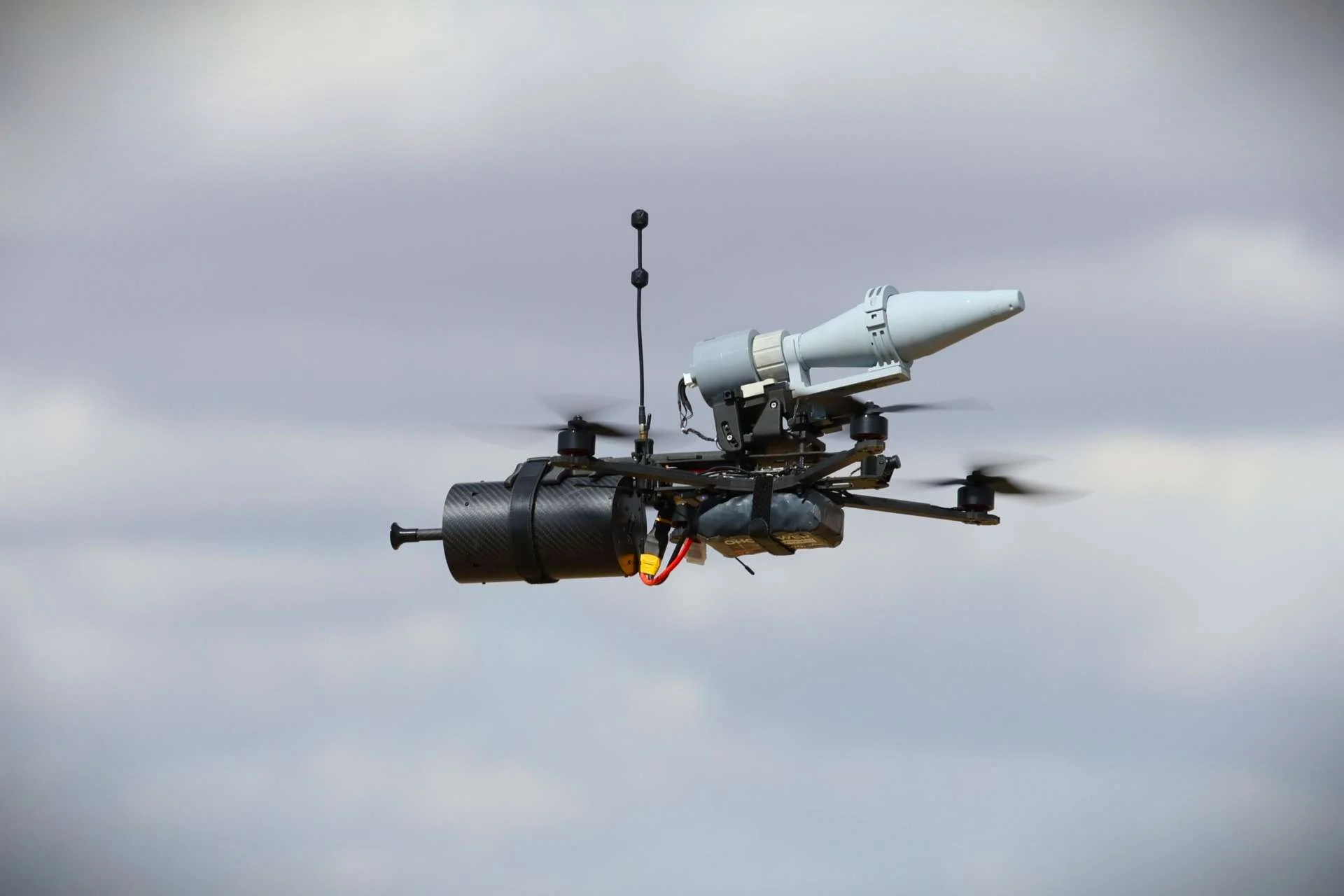
STM’s ALKAN FPV kamikaze drone has completed acceptance testing and entered the inventory of Turkish security forces, the Ankara-based company announced on November 23, 2026. Multiple systems have been delivered in a first batch. STM has not disclosed the receiving units, the quantity delivered, or the contract value.
The ALKAN FPV is the new name of the system STM unveiled in May 2025 as KARGU FPV, when the drone hit its target in its first test firing with an anti-personnel warhead. STM then integrated an armor-piercing warhead and a fiber-optic control option in July 2025, and the drone scored a direct hit on an armored vehicle in its first live detonation test with the armor-piercing warhead in October 2025. STM notes that first-person view (FPV) drones have shown their worth, particularly in the Russia-Ukraine war, as cheap and effective precision attack tools.
ALKAN FPV Drone Specifications, Warheads, and MIL-STD-331 Fuze
According to STM, the ALKAN FPV offers a mission range of 10 km and a maximum speed of 140 km/h. Mission altitude is 500 m, with a ceiling of 5,500 m above mean sea level. Endurance exceeds 20 minutes in kamikaze configuration and reaches 44 minutes in observation configuration, flown without munition and fuze. The 140 km/h figure is lower than the 160 km/h STM published for the KARGU FPV in 2025; the company has not explained the change.
STM’s 2025 data for the KARGU FPV listed a 1,300 g anti-personnel warhead containing 820 balls and a take-off weight of 3,650 g with munition. Updated figures for the ALKAN FPV production standard, including the armor-piercing variant, have not been released.
According to STM, a key differentiator is the safety and arming architecture. The ALKAN FPV uses a military safety fuze compliant with MIL-STD-331, the US standard for fuze environmental and performance testing, which STM says ensures a high level of safety during transport and mission execution and sets the drone apart from conventional FPV systems. A distance fuze sensor triggers detonation at an adjustable standoff. Once the operator designates a target, image processing enables an autonomous terminal dive. STM General Manager Özgür Güleryüz said this “reduces operator dependency while enhancing strike accuracy and mission effectiveness.”
Fiber-Optic Control and KARGU Munition Commonality Against Jamming
In addition to its radio-frequency (RF) datalink, the ALKAN FPV can be flown via fiber-optic cable, which lets it continue its mission without being affected by electromagnetic jamming and without reliance on GPS or RF signals. STM has not disclosed the length of the fiber-optic cable.
The ALKAN FPV also shares its munitions and fuzes with KARGU, STM’s rotary-wing loitering munition and the first indigenous system of its type in Türkiye. STM’s anti-personnel and armor-piercing warheads can be swapped between the two platforms without modification, allowing KARGU munitions already in service to be used in the FPV role. The ALKAN FPV joins KARGU, BOYGA, TOGAN and ALPAGU in STM’s tactical UAV portfolio, which Güleryüz said has been exported to more than 15 countries on four continents.
Analysis: The ALKAN FPV matters less for its airframe than for the military-standard package STM has built around it. A MIL-STD-331 fuze, a warhead family shared with KARGU, and an optional fiber-optic link address three issues STM itself puts forward: safety during transport and missions, munition commonality, and resilience to electronic warfare. Pricing, which will weigh on how the ALKAN FPV compares with FPV designs valued mainly for their low cost, remains undisclosed.
STM says further ALKAN FPV deliveries will follow, but it has given no schedule, production rate, or end-user breakdown. Key unknowns include the fiber-optic cable length, production-standard weight and warhead data, and whether the ALKAN FPV will follow KARGU, which STM has already exported to Europe, onto the export market.