Boeing’s Load Adaptable Modular (LAM) pylon for the B-1B Lancer has completed critical design review (CDR), the company announced on November 17, 2026, clearing the bomber’s new external carriage design to move into the manufacturing, integration, and test phases. At the close of the review, the U.S. Air Force B-1 program office accepted the design and established the system product baseline, the formal configuration reference against which all follow-on hardware and software work will be measured.
The milestone follows the preliminary design review that Boeing’s Oklahoma City engineers completed in spring 2026, and it arrives as the Air Force reverses its plan to retire the B-1 in the early 2030s. The service’s latest budget submission programs $342 million in B-1 modernization from 2027 through 2031 to keep the fleet relevant through at least 2037, while B-21 Raider production ramps up. Roughly 45 B-1Bs remain in service with the 7th Bomb Wing at Dyess Air Force Base, Texas, and the 28th Bomb Wing at Ellsworth Air Force Base, South Dakota. Boeing goes further, stating that the added flexibility could help keep the B-1 relevant through 2040 and beyond.
How the LAM Pylon Reactivates the B-1’s Dormant Hardpoints
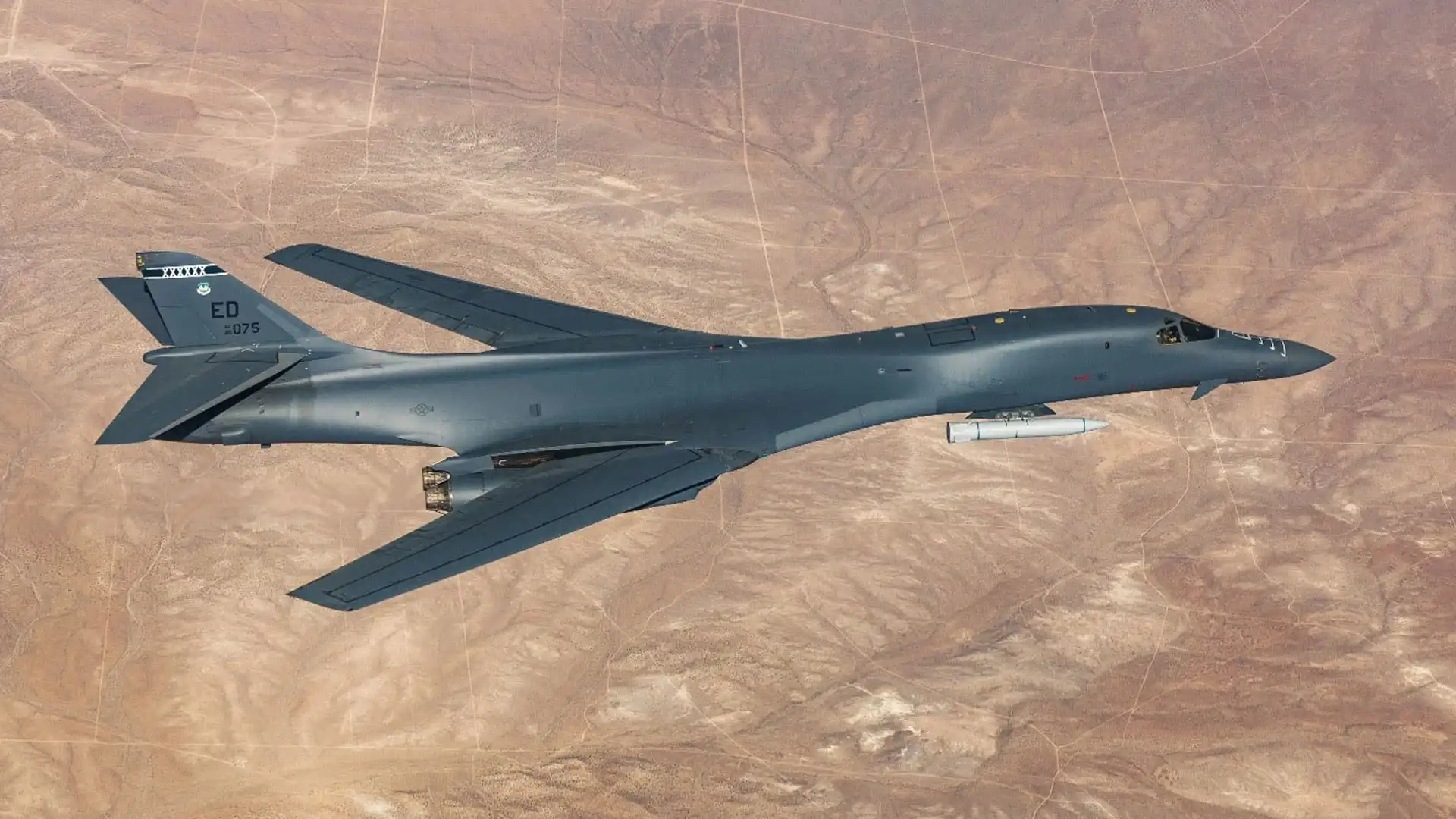
The LAM pylon mounts on six existing external hardpoints along the B-1B fuselage that were originally intended for the AGM-86 Air-Launched Cruise Missile (ALCM). Those stations have gone largely unused since the United States converted the B-1B to conventional-only missions in the 1990s under the Strategic Arms Reduction Treaty (START I). Repurposing them gives the bomber an external payload path for stores that cannot be accommodated in its three internal weapons bays, including future hypersonic weapons.
The design philosophy centers on modularity. Rather than requiring a dedicated pylon for each weapon, the LAM uses repositionable attach points that can be reconfigured to accept different stores. Boeing has publicly stated a maximum load of 7,500 lb per pylon, a figure first disclosed in 2023.
The concept has already flown. The 419th Flight Test Squadron at Edwards Air Force Base, California, began LAM flight testing in early 2024, testing a 2,000 lb GBU-31 Joint Direct Attack Munition in February 2024 and conducting multiple flights to qualify the 5,000 lb GBU-72 Advanced 5K Penetrator. A separate flight behind a tanker assessed the bomber’s handling qualities with a large external store. At the time, only a single hardpoint was qualified, and the pylon could be moved between the two Edwards test aircraft. The Air Force’s B-1 program lead told reporters in 2024 that the service had met the intent of Congress and now had a B-1 hypersonic testbed, a role Boeing designed the pylon to take over from B-52 test aircraft already committed to the B-52J upgrade.
From Hypersonic Testbed to Operational External Carriage
The CDR marks the shift from a test-only installation to a configuration intended for the operational fleet. Boeing says the capability could double the B-1’s payload capacity. Earlier Boeing data framed the gain differently: 24 Hypersonic Attack Cruise Missiles (HACM) internally plus 12 externally on LAM pylons, for 36 weapons, a 50 percent increase in weapon count, with the same 36-round loadout cited for Joint Air-to-Surface Standoff Missiles (JASSM). Boeing has not reconciled the two figures publicly, and the doubling claim may refer to specific store mixes or carriage weight rather than total missile count. The B-1B already carries a maximum payload of 75,000 lb, the largest conventional load in the Air Force inventory.
“The LAM pylon gives commanders more options,” said Dan Ruder, Boeing’s Bombers Advanced Programs manager. “It supports future advanced weapons and additional payload types, helping the aircraft adapt to changing mission needs.”
The program’s origin is also unusual. An Oklahoma City B-1 team led by engineer Tristin Lam, for whom the pylon is named, developed the concept under Boeing independent research and development funding. That allowed the company to retain the intellectual property and start work before the Air Force formally requested the capability. “This is the moment when we shift from designing the solution to preparing to produce and test it,” said Lynsay Brannock, Boeing’s B-1 program manager.
Analysis: The LAM pylon addresses the Air Force’s most pressing bomber problem in a Pacific contingency, which is standoff weapon volume per sortie rather than penetration. With the B-21 fleet still small and the B-1 now funded through 2037, converting dormant hardpoints into external stations is a relatively low-cost way to add magazine depth for JASSM-class and hypersonic weapons that the internal bays cannot hold. External carriage will increase drag and radar cross section and erode the B-1’s speed and range margins, which reinforces its role as a standoff missile carrier rather than a penetrating bomber. Boeing’s ownership of the intellectual property will also shape sustainment costs and data-rights negotiations as the capability moves toward fleet-wide installation.
Next steps include preparing hardware and software for manufacturing, aircraft modification, and ground and flight testing. Key details remain undisclosed: the production contract value, the number of aircraft to be modified, the first weapons to be certified for operational external carriage, and a fielding date. Those answers will likely surface in the FY2028 budget cycle and in the integration schedules of the Air Force’s hypersonic weapon programs.