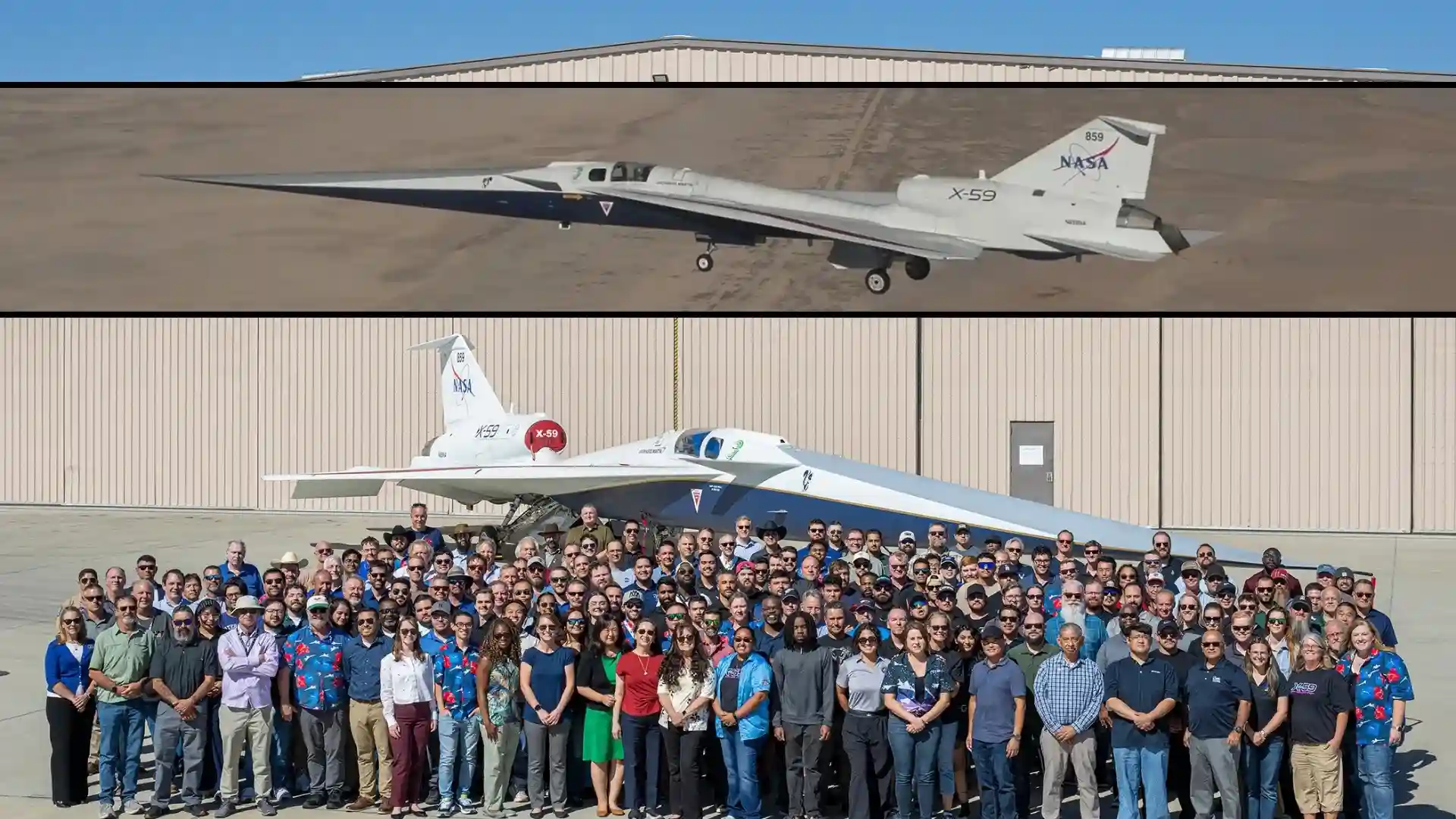
NASA formally took ownership of the X-59 quiet supersonic research aircraft from Lockheed Martin Skunk Works on November 18, 2026, following completion of an aircraft acceptance review, a key step in closing out the build contract. The X-59 now continues flight testing as a government-owned asset at NASA’s Armstrong Flight Research Center in Edwards, California, with Lockheed Martin shifting to supplemental support on an as-needed basis.
The transfer comes nearly 13 months after the aircraft’s first flight on October 28, 2025, when it departed Skunk Works in Palmdale, California, for Armstrong, its home base since. Lockheed Martin had retained official ownership as flight testing continued there. The timing matters: the X-59 is moving out of envelope expansion and toward acoustic validation, the phase in which NASA must prove the aircraft produces the quieter “sonic thump” it was built to generate. That data feeds a regulatory process already in motion, after the Federal Aviation Administration (FAA) proposed on July 2, 2026, to repeal its 1973 ban on civil supersonic flight over land and replace it with a noise-based standard.
NASA X-59 Acceptance Closes Out the Lockheed Martin Build Phase
NASA selected Lockheed Martin to collaborate on the X-59 design and to lead vehicle construction and testing for the agency’s Quiet SuperSonic Technology (Quesst) mission. NASA awarded the original $247.5 million contract on April 2, 2018, to design, build, and deliver the aircraft. NASA has not disclosed the final cost at closeout.
The aircraft has already cleared most of its performance envelope. The X-59 first exceeded the speed of sound on June 5, 2026, reaching Mach 1.1 at 43,400 feet. On June 12, it hit its mission design point of Mach 1.4, roughly 925 mph, at 55,000 feet, the conditions planned for community overflights. During the week of September 21, the team flew six sorties, a program record, and pushed the aircraft to Mach 1.53, its fastest speed to date. By the first-flight anniversary, the X-59 had logged 41 flights and exceeded 56,000 feet. It then made its first cross-country trip, with stops in Texas and Alabama, to appear at NASA’s MAX POWER airshow at Kennedy Space Center on November 7 and 8.
“To someone outside the flight test, this might seem like a subtle change,” said Cathy Bahm, Low Boom Flight Demonstrator project manager, in a NASA announcement, calling it “another big moment for the X-59” that brings NASA closer to providing data to make commercial supersonic flight over land a reality.
Low-Boom Shaping and the Path to Acoustic Validation
Publicly available specifications indicate the X-59 measures about 99 feet long with a 29.5-foot wingspan and is powered by a single General Electric F414-GE-100 turbofan rated at roughly 22,000 pounds of thrust, from the engine family that powers the F/A-18E/F Super Hornet. Its design is driven entirely by shock management. A long, tapered nose shapes the forward shock, the engine sits atop the fuselage, and a T-tail limits the aft shock, preventing the waves from merging into a conventional boom. The cockpit has no forward window; pilots rely on the eXternal Vision System (XVS), a camera and display suite that feeds a forward view to a cockpit monitor. To contain cost and schedule, the airframe reuses proven parts, including a T-38 aft canopy and ejection seat and F-16 landing gear. Program figures target a ground signature of about 75 perceived level decibels (PLdB), well below a conventional sonic boom.
None of that signature has been measured yet in a clean acoustic environment. On every flight so far, the supersonic chase aircraft’s own booms masked any sound from the X-59. Acoustic validation will use an F-15 fitted with a near-field shock-sensing probe and semi-autonomous ground recording systems to confirm that the design and prediction tools match reality. Only then will NASA fly the X-59 over several U.S. communities at Mach 1.4 and 55,000 feet, survey residents, and deliver the response data to national and international regulators.
Analysis: The ownership change is administrative on paper, but it shifts operational risk. NASA now carries full responsibility for maintenance, scheduling, and airworthiness decisions on a one-of-a-kind demonstrator with no backup airframe, at the point when the program enters its most data-critical phase. The stakes extend beyond the agency. The FAA’s proposed interim rule is designed to be followed by a permanent noise-certification standard, and X-59 community data is the dataset positioned to inform it. Any slip in acoustic validation therefore moves the regulatory timeline that U.S. supersonic manufacturers are planning around. For Lockheed Martin, reduced involvement does not erase the low-boom shaping expertise Skunk Works built into the aircraft.
NASA has not announced a start date for acoustic validation. In May 2026, NASA said it aimed to complete envelope expansion and acoustic validation by the end of 2026, a target now weeks away. The X-59 will also share the agency’s expanding X-plane portfolio with the X-70 Fractal, a crewed, reconfigurable flight-control testbed NASA unveiled on November 4, 2026, with first flight expected within two years.