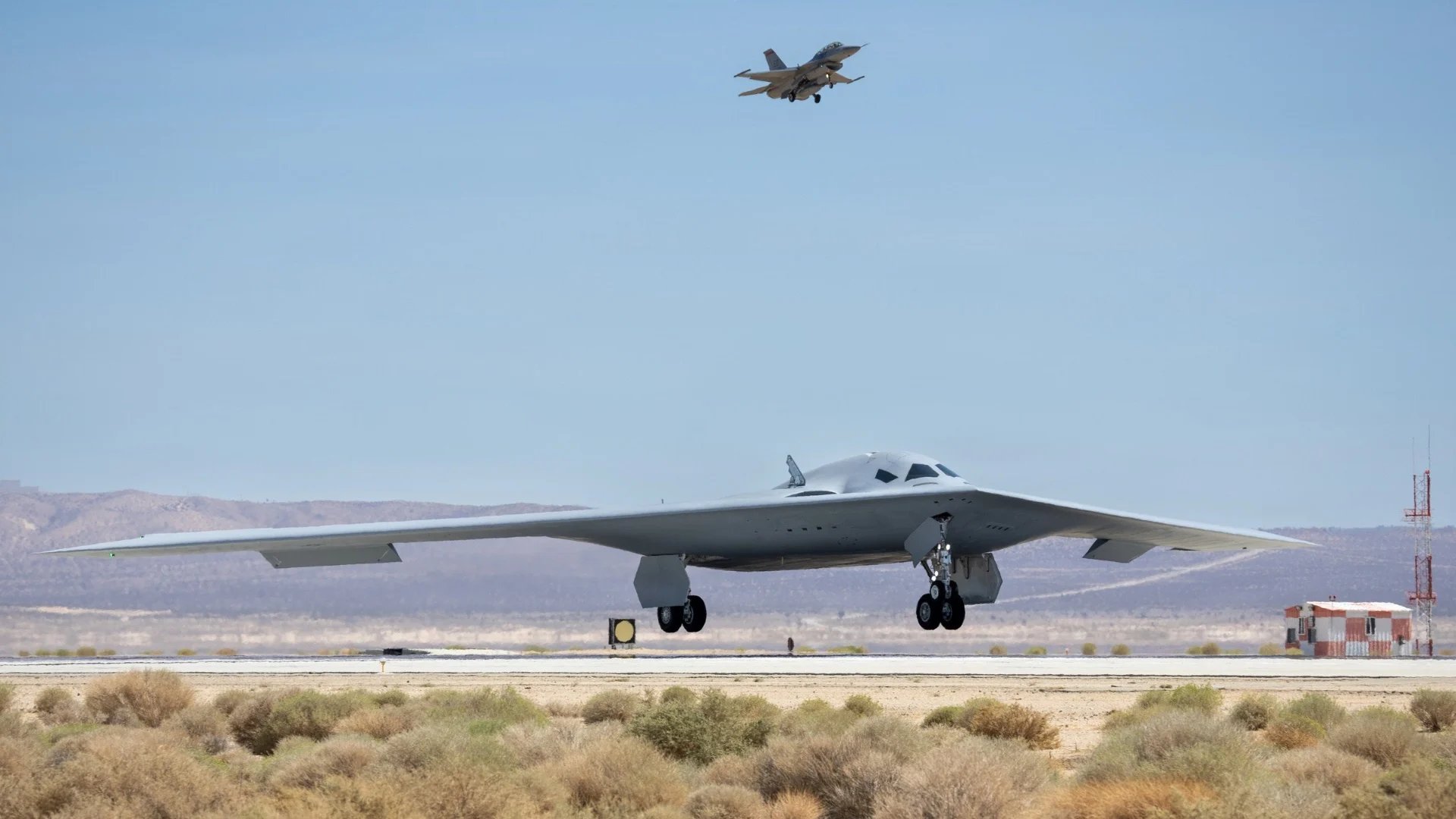
A B-21 Raider test aircraft flying from Edwards Air Force Base, California, released a conventional weapon in flight, the Department of the Air Force announced on November 13, 2026. Northrop Grumman said the demonstration shows the next-generation penetrating bomber can carry and employ combat power. Neither the Air Force nor prime contractor Northrop Grumman identified the munition, the exact test date, or which test aircraft performed the release.
The milestone lands as the program pushes toward its first operational aircraft arriving at Ellsworth Air Force Base, South Dakota, in 2027. The B-21 is the Air Force’s top acquisition priority for both nuclear modernization and conventional long-range strike, with a program of record of at least 100 aircraft that will incrementally replace the B-1B Lancer and B-2A Spirit. The first Raider flew on November 10, 2023, from Air Force Plant 42 in Palmdale, California. A second test aircraft reached Edwards on September 11, 2025, to open weapons and mission-systems testing.
What the B-21 Raider Weapons Testing Milestone Confirms
According to the Air Force, the test validated the B-21’s digital models and the maturity of its open systems architecture, and demonstrated the aircraft’s ability to rapidly onboard new weapons. The B-21 Combined Test Force prepared it through thousands of hours of virtual modeling in the bomber’s digital twin environment, predicting and refining the weapon’s trajectory before the aircraft left the ground. “This successful test demonstrates our ability to adapt rapidly and hold any target at risk if deterrence fails,” said Secretary of the Air Force Troy Meink. Air Force Chief of Staff Gen. Ken Wilsbach said: “We are building an impressive fleet that will give our joint force credible, penetrating strike options for decades to come.”
For a low-observable bomber that carries weapons internally, an early release event typically validates the full chain: weapons bay door actuation, store ejection, separation aerodynamics in the bay’s disturbed airflow, and the command path from mission computer to rack. Correlating the real trajectory with the digital twin’s prediction is the key output; if the models hold, later weapons can be cleared with fewer live separation sorties. The Air Force has not said whether the weapon was guided.
The test builds on a change in the test model itself. On June 11, 2026, the 412th Test Wing announced that a pilot from the Air Force Operational Test and Evaluation Center’s Detachment 5 had flown the B-21 alongside a developmental test pilot from the 420th Flight Test Squadron, allowing weapons employment to be assessed against combat tactics from the outset.
Payload, Range, and Stealth: The Raider’s Design Trade Space
The Air Force has never published B-21 performance figures. Publicly available information indicates a flying-wing design smaller than the B-2, whose wingspan is 172 feet, powered by two engines supplied by Pratt & Whitney. The aircraft is dual-capable, and open-source program documentation indicates its planned nuclear loadout includes the B61-12 gravity bomb and the AGM-181 Long Range Standoff cruise missile, alongside conventional standoff and direct-attack weapons. The Air Force has not disclosed the integration sequence or which weapon will be certified first.
Northrop Grumman stresses payload flexibility, saying commanders will be able to tailor loadouts from long-range strike to operations in heavily defended airspace, and that the open-systems architecture allows new weapons to be added over time. Range rests on aerial refueling, which the Air Force confirmed on April 14, 2026, with a KC-135 Stratotanker. Northrop says refueling has unlocked longer test sorties and accelerated the overall campaign.
The company also claims the B-21 behaves more like a modern fighter than a legacy bomber in maintenance turnaround and cost per flying hour, and that it has completed multiple lifetimes of fatigue testing months ahead of schedule. No supporting figures have been released, and these claims remain contractor assessments until confirmed by operational testers.
How Northrop Grumman Is Scaling B-21 Production for 2027
On February 23, 2026, the Department of the Air Force and Northrop Grumman agreed to apply $4.5 billion in funding from fiscal year 2025 reconciliation legislation to raise annual B-21 production capacity by 25 percent, without changing the 100-aircraft program of record. In September 2026, Northrop opened its East Gate 3 facility in Layton, Utah, which the company says adds 265,000 square feet of manufacturing space. On September 29, 2026, the service and the company broke ground on a final assembly line of more than one million square feet at Plant 42.
The ramp carries financial weight for the contractor. In April 2025, Northrop recorded a $477 million pre-tax charge tied to a manufacturing process change intended to enable higher production rates, bringing projected losses on the first five low-rate initial production lots above $2 billion. On the operational side, the Air Force activated B-21 Integration Detachment 1 at Ellsworth on September 9, 2026, to coordinate the aircraft’s arrival.
Analysis: The weapons release closes the most consequential gap between a flying test article and a strike platform, but its strategic value lies in the concurrency around it. The Air Force is overlapping developmental and operational test, expanding production capacity, and standing up its first base before weapons integration is complete. That approach compresses the timeline for fielding a penetrating bomber able to hold targets at risk inside dense integrated air defense networks, the core requirement in any Indo-Pacific contingency. It also concentrates risk: discoveries in weapons integration or low-observable maintenance would now ripple through a production line built for higher rates. So far the bet is paying off, but a single demonstration is not certification, and nuclear certification in particular is a separate, longer process.
Next milestones include expanded separation testing across the flight envelope, the first publicly confirmed guided weapon employment, and delivery of the first aircraft to Ellsworth in 2027, followed by Whiteman Air Force Base, Missouri, and Dyess Air Force Base, Texas. Key unknowns remain the specific munition used in this test, the date of initial operational capability, and whether the Pentagon will formally raise the buy beyond 100 aircraft.