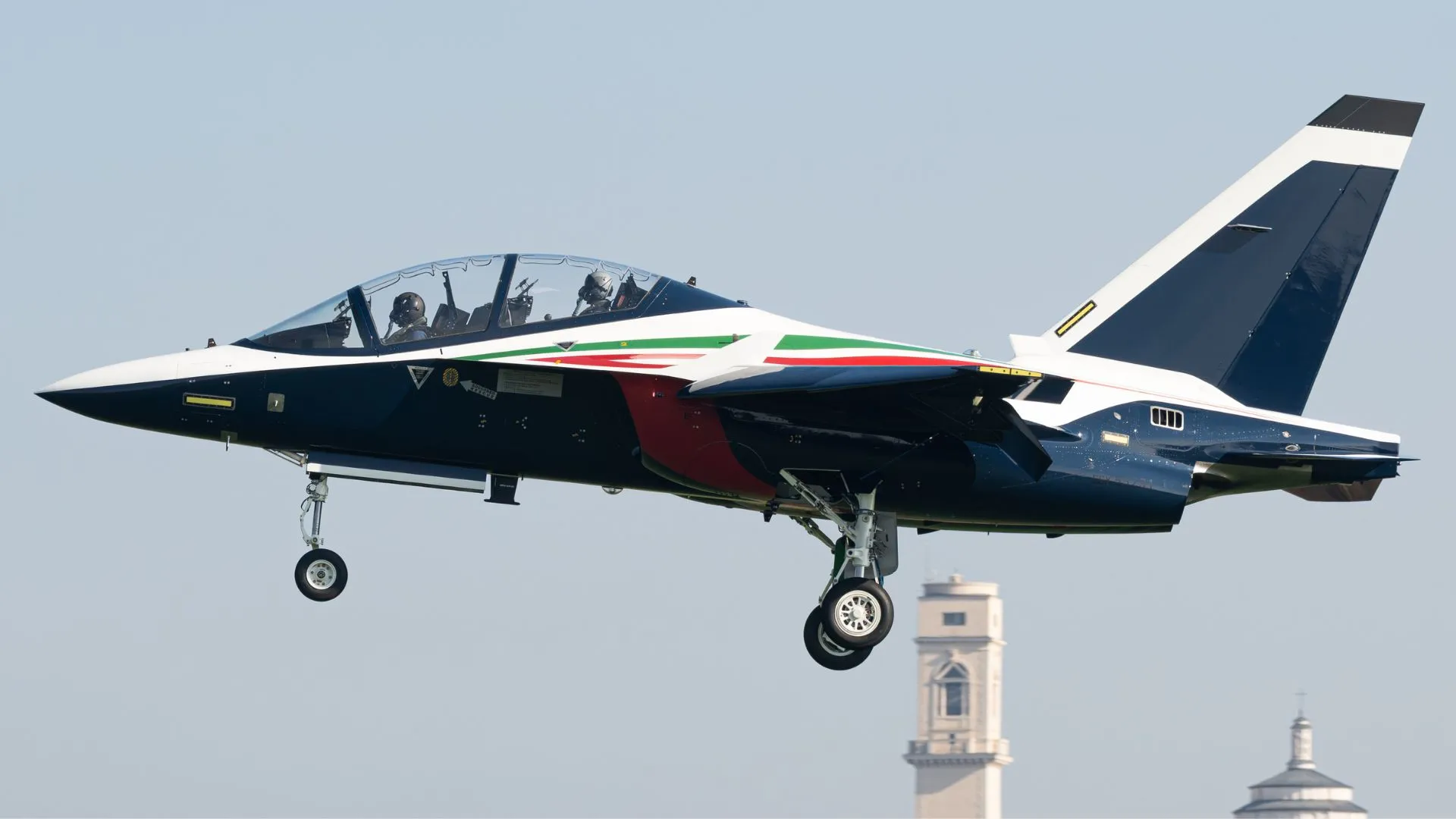
Leonardo rolled out the first M-346 PAN for the Italian Air Force’s Frecce Tricolori national aerobatic team on November 26, 2026, and aircraft testing is now underway. The jet is the first of 15 M-346s in a dedicated aerobatic configuration that will replace the team’s MB-339 PAN fleet, with production and deliveries from Leonardo’s Venegono Superiore plant in the province of Varese scheduled between 2027 and 2028. According to Leonardo, the program is running on schedule, with pilot and technician training and the development of a revised aerobatic flight program starting in parallel.
The roll-out follows the Italian Air Force’s decision, announced at Istrana Air Base on September 12, 2024, to equip the Pattuglia Acrobatica Nazionale (PAN) with the twin-engine M-346 rather than the single-engine M-345, which had long been positioned as the team’s next aircraft. The MB-339 has flown with the Frecce Tricolori since 1982. The M-346 PAN program covers more than airframes: it includes a technical and logistics support package, training and simulation systems for pilots and maintainers, and infrastructure upgrades at Rivolto Air Base in the province of Udine, home of the 313th Aerobatic Training Squadron.
Frecce Tricolori M-346 Configuration and Aerobatic Equipment
The M-346 PAN designation is the Italian Air Force’s name for the Frecce Tricolori variant. Leonardo says the configuration retains the performance, avionics and digital flight control systems of the M-346 advanced trainer and multirole light fighter, while adding equipment specific to display flying: a smoke generation system, video streaming capability, avionics modifications to the flight controls and cockpit, auxiliary fuel tanks, and an onboard access ladder. According to Leonardo, the ladder and tanks are intended to facilitate ferry flights for operational requirements and travel to venues on the team’s display calendar in Italy and abroad. The aircraft wears a livery styled by Pininfarina.
Publicly available specifications for the baseline M-346 indicate two Honeywell F124-GA-200 non-afterburning turbofans with FADEC, each rated at 6,280 lb (2,850 kg) of thrust, a maximum level speed of 590 knots true airspeed (1,090 km/h), a 45,000 ft service ceiling and limit load factors of +8/-3 g. The aircraft uses a quadruple-redundant fly-by-wire flight control system, has a length of 11.49 m and a wingspan of 9.72 m, and has been credited in a published flight test evaluation with a maximum angle of attack of 40 degrees and a maximum roll rate of 230 degrees per second. Internal fuel capacity is listed at 2,500 liters. Leonardo has not disclosed the number or capacity of the auxiliary tanks on the PAN variant, nor details of the smoke system or any changes to flight control laws for close formation work.
From MB-339 to M-346: Performance Gap and Fleet Roadmap
The step up in performance is substantial. Publicly available data indicate the MB-339 PAN is powered by a single Rolls-Royce Viper Mk 632-43 turbojet producing about 4,000 lb of thrust, roughly a third of the M-346’s combined output. Leonardo says the M-346 PAN brings enhanced performance and maneuverability, and the renewed aerobatic flight program is being developed alongside the test campaign to exploit those capabilities.
The 15-aircraft fleet compares with the team’s standard ten-aircraft display, nine in formation plus a solo, leaving five airframes beyond the display line-up. Italy already flies the M-346 as the T-346A with the 61st Wing at the International Flight Training School at Decimomannu, Sardinia, so the Frecce Tricolori will join an established national support chain and a pilot training pipeline that already runs on the type. Leonardo did not disclose the contract value in its announcement.
Lieutenant General Antonio Conserva, Chief of Staff of the Italian Air Force, said the transition “from the illustrious MB-339 to the M-346 marks another step forward” for the team.
Stefano Bortoli, managing director of Leonardo’s Aircraft Division, said the M-346 is “well positioned” to pursue new opportunities “as a platform for aerobatic teams,” as well as in its trainer and multirole roles.
Analysis: The M-346 PAN gives the Italian Air Force a single twin-engine family spanning lead-in fighter training and the national display team, consolidating logistics, simulation and maintainer skills around one type. For Leonardo, the Frecce Tricolori become the most visible showcase for an aircraft now in a new export cycle, after Austria ordered 12 M-346 F Block 20 light fighters in December 2025 and Canada’s International Test Pilots School ordered six M-346 T Block 20 trainers in May 2026. The open question is cost: the twin-engine M-346 replaces a single-engine jet, and neither the Italian Air Force nor Leonardo has published operating cost figures for the PAN fleet.
The next milestones are completion of the flight test campaign, conversion of the team’s pilots and technicians, and validation of the new display program ahead of series deliveries from Venegono Superiore in 2027 and 2028. Still unconfirmed are the date of the first public display with the M-346, the final MB-339 PAN display season, and the overall value of the program.