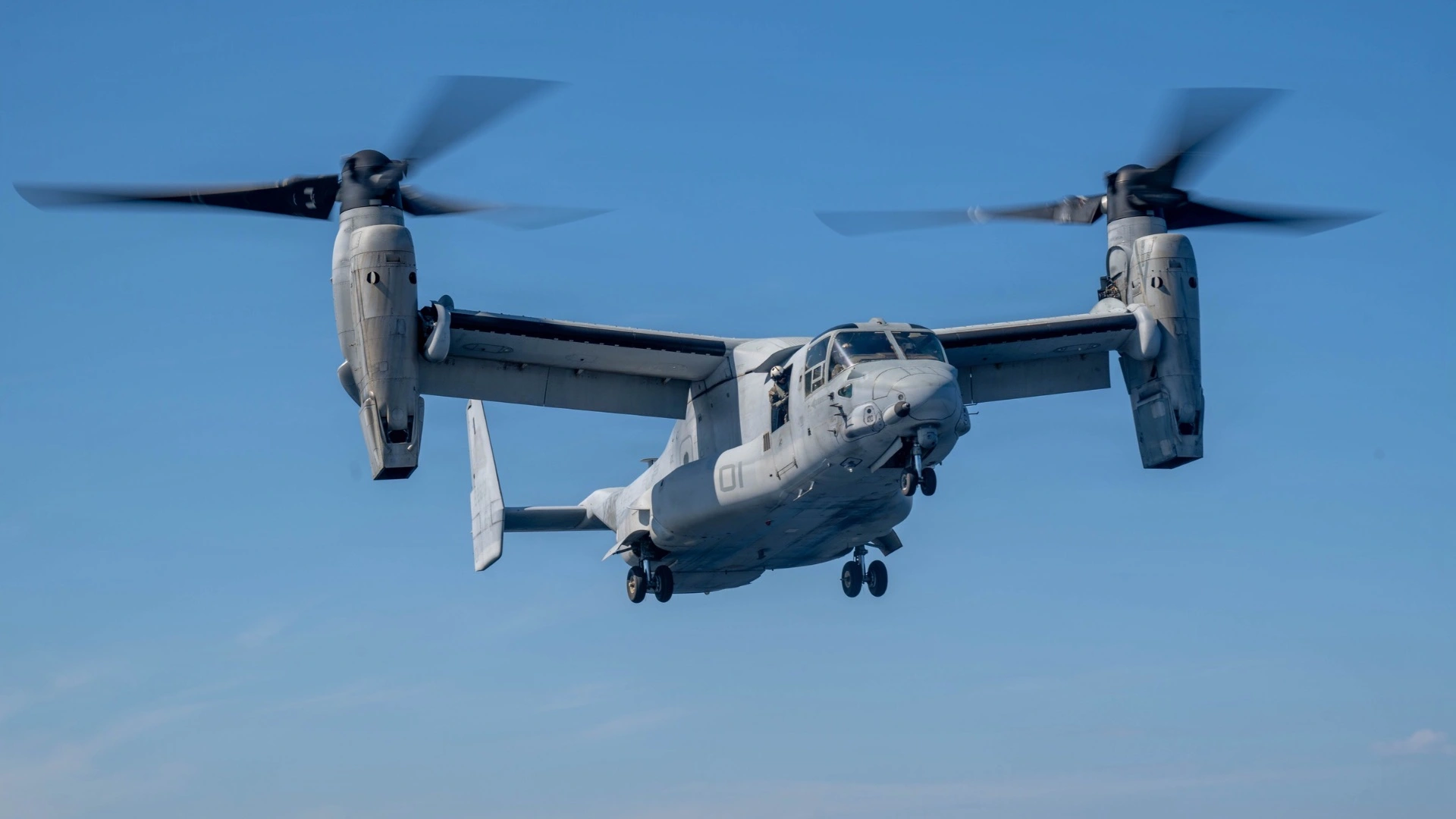
The U.S. Navy has awarded Rolls-Royce Corp. an $88 million option to extend V-22 engine sustainment for the AE 1107C engines powering the Osprey fleet through January 2027. The $88,005,612 modification, P00007, was listed in a Department of War contract announcement on November 27, 2026, and exercises an option on a firm-fixed-price, indefinite-delivery/indefinite-quantity contract covering MissionCare support at 14 sites.
The award comes as the Osprey shifts from production to long-term sustainment. The Marine Corps accepted its 359th and final MV-22B on July 28, 2026, closing the program of record, and the joint fleet is planned to fly into the 2050s. The tiltrotor has operated under flight restrictions since the November 2023 crash of an Air Force Special Operations Command (AFSOC) CV-22B off Yakushima, Japan, which killed eight airmen after a gearbox failure. The V-22 Joint Program Office had targeted a return to unrestricted operations by the end of 2026; no public confirmation that this milestone has been met is available.
Scope of the V-22 Engine Sustainment Extension Across 14 Sites
The modification covers field service representatives, logistics, engineering, and organizational- and depot-level maintenance. Work spans 14 locations. New River, North Carolina, carries the largest share at 20%, followed by Miramar, California, at 13%. Japan accounts for 24% of the effort, split evenly among Okinawa, Yokota, and Iwakuni at 8% each, while Kaneohe Bay, Hawaii, adds 5% and Mildenhall, United Kingdom, takes 8%.
Although the notice describes the engines as powering Navy and Marine Corps aircraft, the site list includes Hurlburt Field, Florida, Cannon and Kirtland Air Force Bases in New Mexico, Yokota, and Mildenhall, all Air Force CV-22 locations. The parent contract, N0001925D0002, was awarded in November 2024 at $695.3 million and covers MV-22, CV-22, and CMV-22 engine support, per federal contracting records. No funds were obligated at award; money will flow through individual orders. The modification was not competitively procured, and Naval Air Systems Command (NAVAIR), Patuxent River, Maryland, is the contracting activity.
AE 1107C Turboshaft Architecture and the MissionCare Model
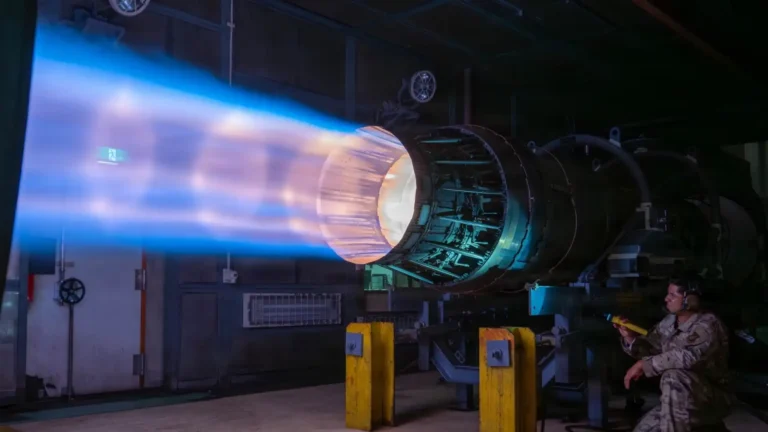
The AE 1107C-Liberty, designated T406 in military service, is rated at 6,150 shaft horsepower, according to manufacturer data. It uses a two-shaft axial layout with a 14-stage compressor, an effusion-cooled annular combustor, a two-stage gas generator turbine, and a two-stage power turbine. Dual full authority digital engine controls (FADEC) manage each engine, and a self-contained oil system allows it to keep running when the nacelles rotate to vertical for hover. The engine weighs 971 pounds dry, measures 78.1 inches long and 34.2 inches in diameter, and shares its core with the AE 2100 turboprop and AE 3007 turbofan.
MissionCare is a performance-based logistics arrangement priced per flying hour, under which Rolls-Royce is responsible for all aspects of propulsion system support. Before the current vehicle, the company held a five-year, $1.2 billion MissionCare contract awarded in 2019.
Analysis: The timing points to a bridge. The parent contract’s two-year ordering period ended on November 30, 2026, per federal contracting records, so an option running to January 2027 appears to buy roughly two months of coverage ahead of a follow-on. With MV-22B production complete, propulsion support becomes a recurring cost line for decades. Engine availability also weighs more heavily as the services work to restore readiness rates that lawmakers described as declining at a February 2026 House Armed Services hearing.
No follow-on MissionCare award has been announced ahead of the January 2027 end date; its length, value, and pricing structure are not public. The program office is also studying a mid-life upgrade and technology refresh for the V-22, decisions that will shape engine support requirements through the 2050s.