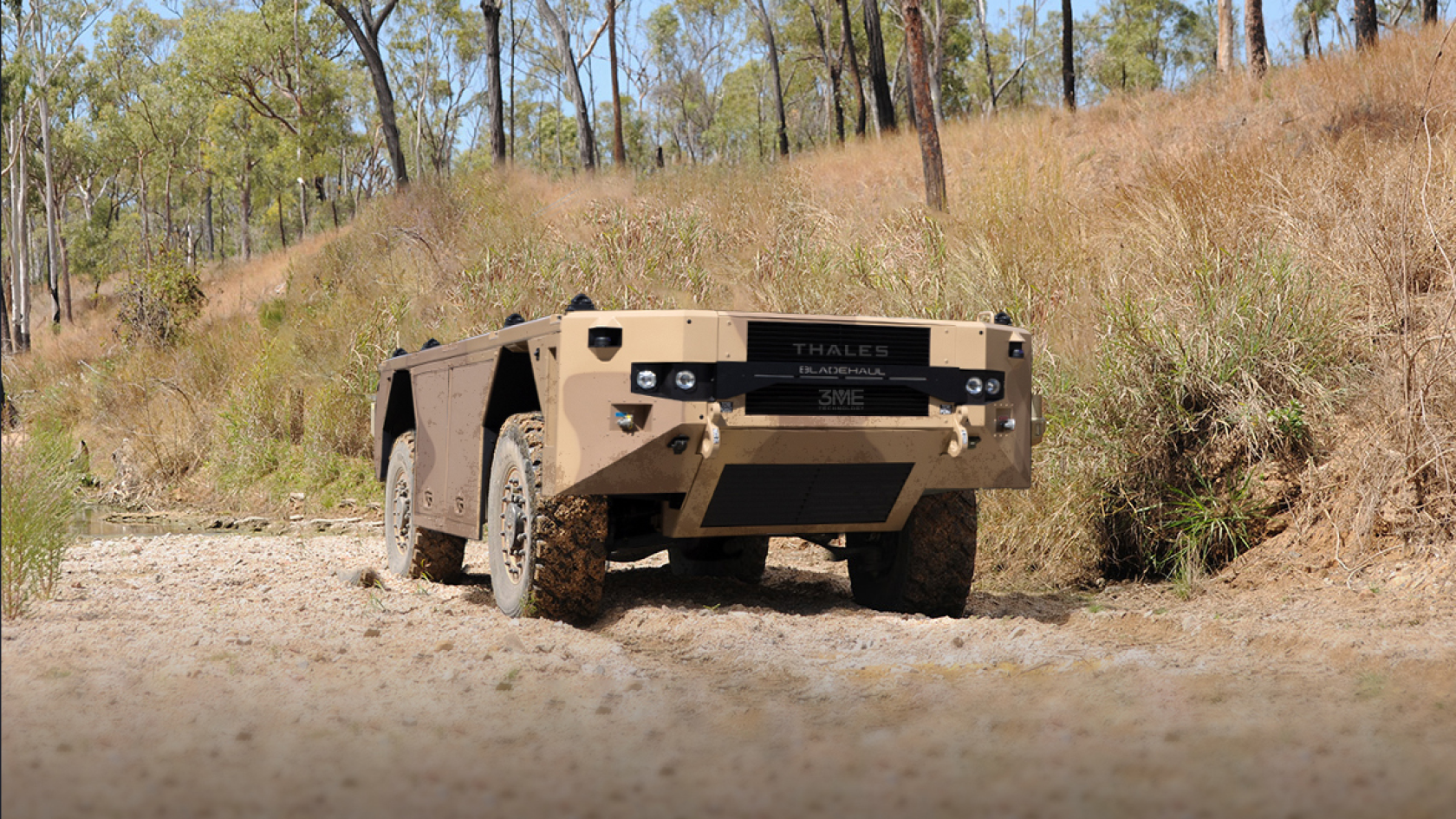
Thales Australia and Newcastle-based electrification specialist 3ME Technology on October 6, 2026, unveiled BladeHAUL, a hybrid-electric extra-large uncrewed ground vehicle (XL-UGV) inspired by the Bushmaster Protected Mobility Vehicle (PMV) and built to carry a 20-foot container or up to 10 tonnes under remote or autonomous control. The companies say no existing or planned Australian uncrewed vehicle matches that capacity. The announcement coincided with the opening of Land Forces 2026, which runs in Perth, Western Australia, through October 8.
The launch targets the problem the Australian Army has faced since the 2023 Defence Strategic Review reoriented land forces toward littoral operations in northern Australia: sustaining small, dispersed units along long supply lines exposed to drones and precision fires. It is also Thales Australia’s second uncrewed ground vehicle (UGV) reveal in two months. In August 2026, the company showed Guardian Angel, an armed prototype designed, built and live-fired in six weeks with Chaos 1 and W&E Platt, and has since pitched the Bushmaster as a control node for autonomous ground systems. BladeHAUL moves that effort from tactical teaming to heavy sustainment.
BladeHAUL UGV Design: Bushmaster Heritage Meets 3ME Hybrid Drive
Thales describes BladeHAUL as a self-propelled, hybrid, heavy-duty off-road vehicle that leverages key features of the Bushmaster. Production splits between the Bushmaster line at Thales Australia’s Bendigo facility in Victoria and 3ME Technology in Newcastle, New South Wales, which supplies the power, hybrid drive and vehicle control systems. According to 3ME chief executive Justin Bain, the vehicle integrates the company’s BladeVOLT energy storage, BladeDRIVE hybrid-electric propulsion and BladeNET control architecture in a single platform.
Jeff Connolly, chief executive of Thales Australia and New Zealand, framed the program around local supply: “By leveraging the trusted Bushmaster platform and integrating advanced autonomous and power systems developed locally, together we are delivering a highly capable uncrewed ground vehicle to meet the diverse and evolving needs of our Defence Force.”
The donor vehicle sets the baseline. Publicly available specifications indicate the in-service Bushmaster troop carrier has a gross vehicle mass of 15,400 kg, a Caterpillar 3126E 7.2-liter turbocharged diesel rated at 224 kW (300 hp), a governed top speed of 100 km/h and a range of about 800 km. More than 1,200 Bushmasters had been built in Bendigo by 2023, and the type has operated in Afghanistan, Iraq and Ukraine.
Neither company has released BladeHAUL’s power output, battery capacity, axle configuration, gross mass, range, speed or protection level. Thales’s billing of BladeHAUL as Australia’s most “powerful” uncrewed ground vehicle is therefore unquantified, and it is unclear how much of the Bushmaster’s blast-deflecting V-hull survives on a vehicle with no crew to protect.
Payload, Mobile Power and Mission Systems on the XL-UGV
Thales outlines three roles. The first is logistics: a 20-foot ISO container or 10 tonnes moved without a driver. That puts BladeHAUL in a different weight class from most UGVs Western armies are testing at the tactical edge; the U.S. Army’s Hunter WOLF, now in evaluation with the 82nd Airborne Division, is rated at up to 2,800 lb, roughly 1.3 tonnes. Container compatibility also lets pre-packed loads move through handling equipment the Australian Defence Force (ADF) already operates.
The second role is power. BladeHAUL can act as a hybrid mobile power source, supplying field hospitals and communications systems remotely or running as a standalone generator. Thales has not published an exportable power rating. The function draws on 3ME’s deployable power work, including its EdgeVOLT system, which Polaris has integrated into its MRZR Alpha light tactical vehicle for U.S. special operations forces.
The third role is carrying sensors and effectors for reconnaissance and surveillance. The partners have not named specific payloads, but the launch material lists counter-unmanned aerial systems (C-UAS) and maritime strike among intended missions, alongside deployable command posts. Guardian Angel has already demonstrated Thales Australia’s integration of a W&E Platt remote weapon station on an uncrewed chassis. The launch material cites human-machine teaming but does not identify the autonomy software or datalink.
From Stealthmaster to BladeHAUL: 3ME’s Hybrid Bushmaster Lineage
BladeHAUL is not 3ME’s first work on the Bushmaster. In 2022, the company delivered an all-electric Bushmaster, branded Stealthmaster, developed with the Australian Army and the Defence Science and Technology Group (DSTG) and shown at that year’s Chief of Army Symposium in Adelaide. It promised a lower thermal signature, silent loitering and easy power export, but it could travel only about a third as far as a standard Bushmaster and depended on deployable generators to recharge.
The Army then moved to convert the prototype into a diesel-electric hybrid with range comparable to the baseline vehicle, with the 1st Armoured Regiment, the Army’s experimental unit, slated to field-test it. Bain linked BladeHAUL to demand for contested logistics and remote power solutions in littoral environments, which he described as present and growing. A hybrid architecture suits that role: an engine for range, batteries for silent movement and torque, and one electrical backbone that becomes a power plant at the destination.
Analysis: BladeHAUL’s main asset is its production logic. Drawing on the Bushmaster production line and a supply chain behind more than 1,200 vehicles, Thales can offer the ADF a heavy UGV that could share spares, training and maintenance with a fleet it already sustains. That fits the contested-logistics problem in northern Australia, where each crewed resupply run puts soldiers within reach of drones and long-range fires. The constraint is demand. Land autonomy sits outside the ADF’s current investment priorities, according to industry analysts, and the Army’s most visible UGV effort, the Modular Robotic Vehicle program, centers on converting aging M113AS4 armored personnel carriers. Without a funded requirement, BladeHAUL risks joining the list of capable Australian UGV demonstrators that stall short of procurement.
Thales and 3ME have not announced a customer, contract, unit cost or production schedule. The next indicators are whether the Army’s Robotic and Autonomous Systems Implementation and Coordination Office (RICO) takes BladeHAUL into experimentation, as it did with Stealthmaster, and whether the partners publish verified power, range and autonomy data. The U.S. Army’s Project Sustainment, which selected five industry teams in July 2026 to automate resupply in contested environments, offers both a benchmark and a potential allied market for heavy autonomous logistics.