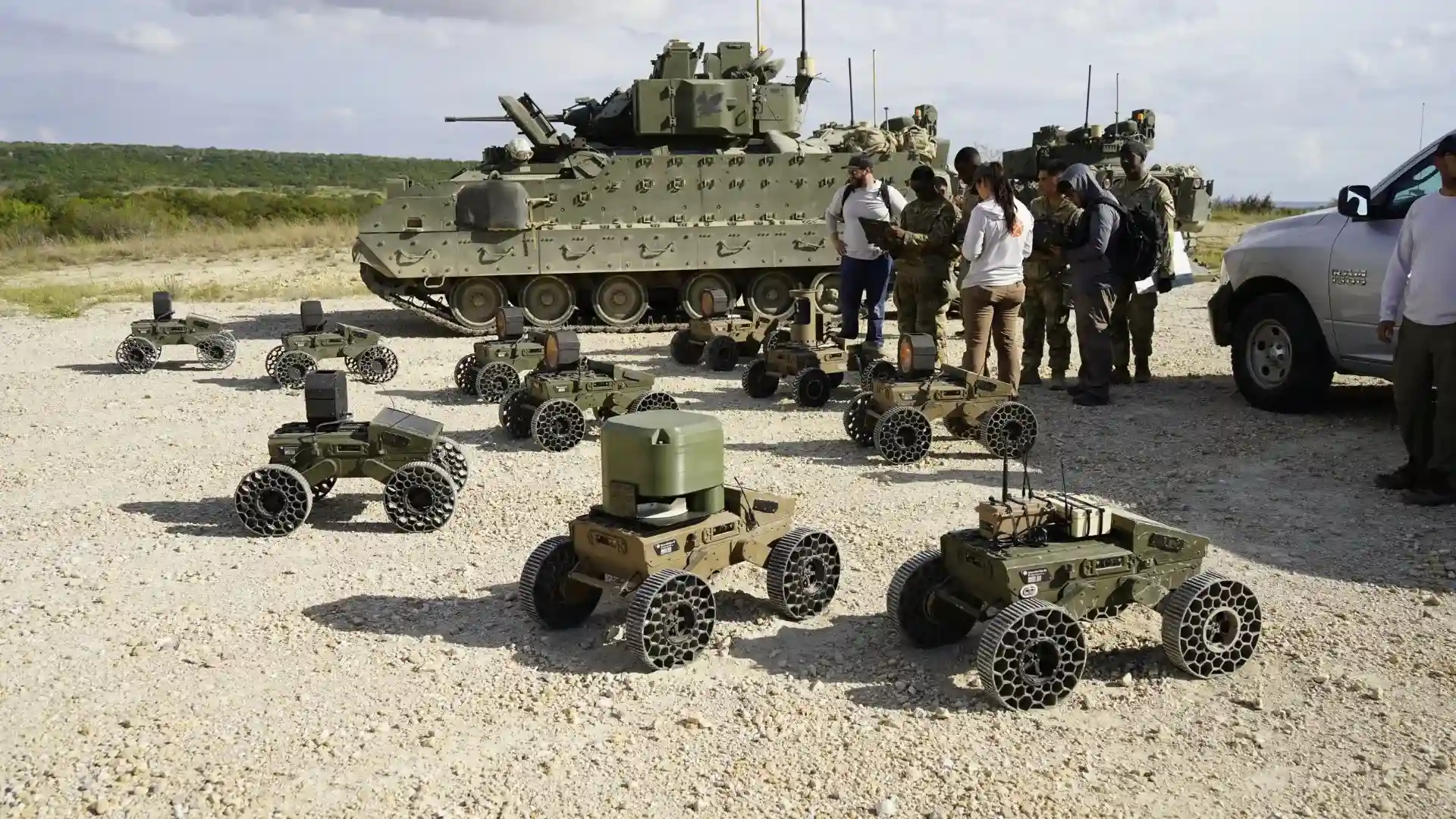
Soldiers of the U.S. Army’s 25th Division Sustainment Brigade put Swarmbotics AI’s FireAnt small uncrewed ground vehicles (UGVs) through a long-distance movement test at Marine Corps Training Area Bellows on Oahu, Hawaii, on November 8, 2026, according to an Army photo release, as the service assesses autonomous systems that could carry supplies and evacuate casualties across the Pacific. The trial came days after Swarmbotics AI said FireAnt swarms had operated alongside 1st Cavalry Division soldiers during Pegasus Charge 4, the division’s latest maneuver experiment.
The two events place the same platform on separate tracks. FireAnt entered Army experimentation through the xTechOverwatch competition in October 2025, and Swarmbotics AI announced on February 5, 2026, that the Army had selected it to develop swarming, attritable small UGVs for the 1st Cavalry Division under Transforming in Contact, the service’s initiative to push new technology directly into operational units. In August 2026, company footage from Pegasus Charge 3 showed five FireAnts mounted on the side of an M2A4 Bradley infantry fighting vehicle. Hawaii now moves the system into a sustainment evaluation built around the Pacific theater.
G-TEAD USARPAC ACE 27-01 Puts FireAnt UGV to the Resupply Test
The Hawaii trial is part of an Accelerated Capability Event, designated G-TEAD USARPAC ACE 27-01, run by the Army’s Global Tactical Edge Acquisition Directorate (G-TEAD) with U.S. Army Pacific (USARPAC). Vendors’ systems are assessed head to head in lanes covering casualty evacuation across several mission types, a contested 4,700-meter (2.9-mile) resupply route, and navigation without GPS under electronic warfare jamming.
Distance drives the requirement. USARPAC must keep small units supplied as they disperse across island chains, and every long logistics route over sea or land offers the enemy a target. The Army’s call for vendors, published on August 5, 2026, covered three categories: attritable autonomous air delivery systems, attritable uncrewed surface vessels able to carry one to four twenty-foot equivalent units (TEUs), and autonomous ground delivery systems for logistics and resupply.
The solicitation allows for up to 15 finalists, each paid $25,000, plus a further $25,000 for attending the live exercise and integrating its technology. Up to five winners receive an additional $150,000 each, and systems retained for further testing could draw on an other transaction authority (OTA) funding pool of up to $2 million.
The model reverses the usual acquisition order: soldiers use the equipment before the Army commits to buying it. Promising systems may be left with G-TEAD and the unit for additional testing ahead of an operational assessment in an active combat zone, and the Army aims to field a capability within 90 days of the evaluation. The GPS-denied and jamming lanes reflect Ukraine, where dense electronic warfare degrades UGV navigation and datalinks on resupply and casualty evacuation runs.
Fifth-Generation FireAnt Hardware and Its Pegasus Charge 4 Role
FireAnt is a small, low-cost wheeled vehicle built for group operation, with a single operator directing several vehicles. Swarmbotics AI unveiled a fifth-generation version in October 2026 that adds suspension for rough terrain, sealed hardware meant to sit in rain, dust, and heat for weeks, and more onboard computing for its in-house camera-based navigation and swarming software. The company puts the vehicle at under 100 pounds and roughly 30 inches long.
According to the company, its flatbed payload area can carry a small quadcopter drone, radars, intelligence, surveillance and reconnaissance (ISR) sensors, or kinetic payloads, including interceptors. Swarmbotics AI first presented the vehicle as an anti-armor weapon: at the xTechOverwatch field test in October 2025, FireAnt was shown with payload options that included explosively formed penetrator (EFP) devices, with a projected unit cost below $50,000.
The company’s statement on Pegasus Charge 4 is brief: FireAnt swarms worked with 1st Cavalry Division soldiers to integrate multi-agent ground autonomy into maneuver operations. It did not disclose the number of vehicles, payloads, level of autonomy, or the dates of the iteration, and the Army has not published its own account. FireAnt’s cargo capacity, endurance, and speed, and the number of vehicles that ran the Hawaii lanes, also remain undisclosed.
Analysis: The Army is testing whether one attritable chassis can serve both the armored brigade’s forward edge and the Pacific sustainment problem. That breadth strengthens the case for volume production. It also exposes a physical limit: a vehicle under 100 pounds and 30 inches long carries little cargo per trip, so its resupply value depends on numbers, swarm coordination under jamming, and operator workload rather than individual capacity. Strong results in the GPS-denied lanes would show that camera-based navigation holds where satellite positioning fails, a requirement both missions share.
G-TEAD has not announced results from ACE 27-01 or named winners. The next decision points are whether FireAnt ranks among the up to five awardees, whether it stays with USARPAC units for stress-testing, and whether the 90-day fielding goal puts equipment in soldiers’ hands in early 2027. Pegasus Charge will separately test whether ground swarms enter armored formation tactics.