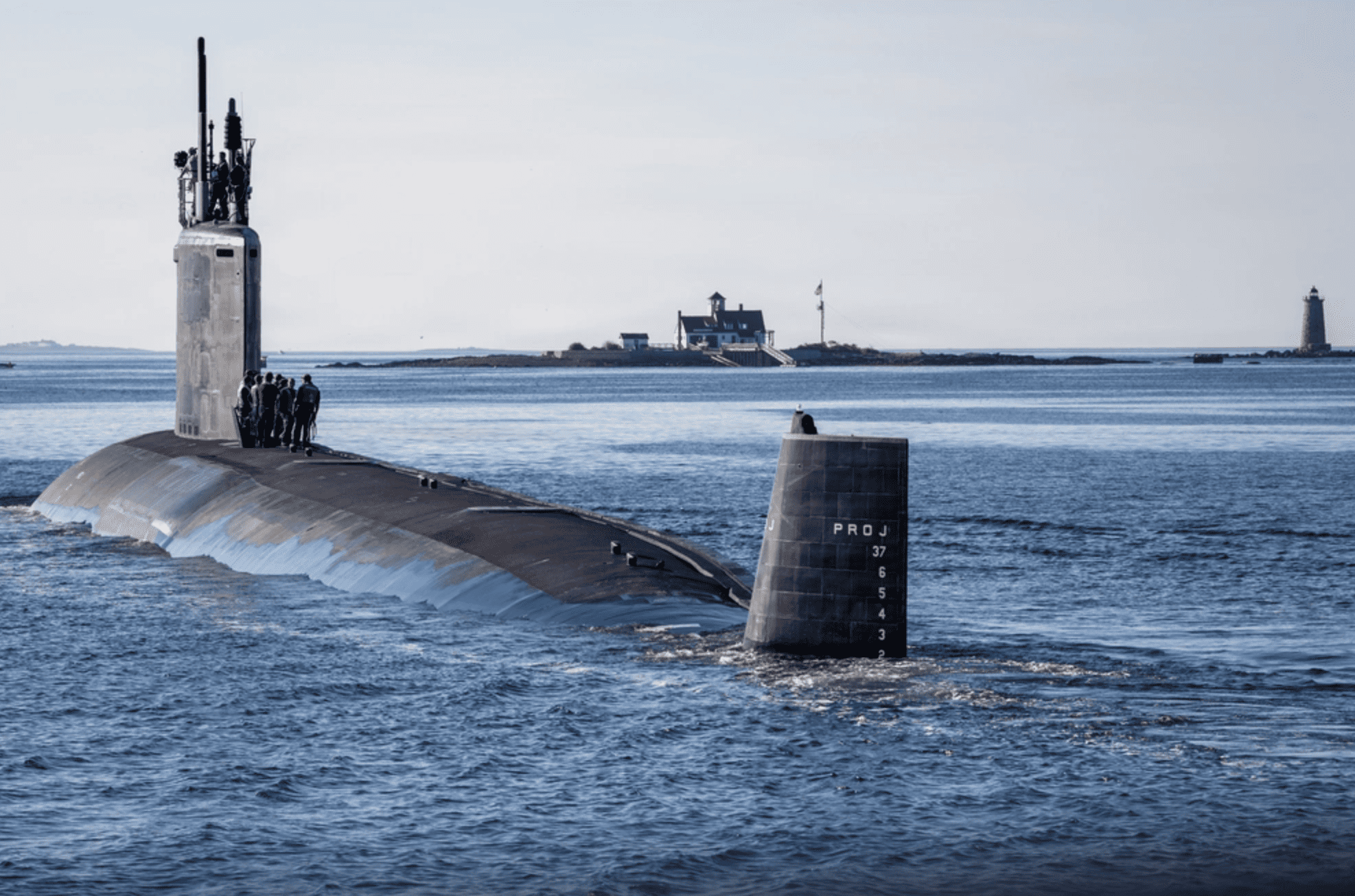
The U.S. Navy has awarded five Other Transaction Authority (OTA) agreements worth a combined $743,567,499.68 to prototype the Nuclear-Armed Sea-Launched Cruise Missile (SLCM-N) and its canister, Strategic Systems Programs (SSP) announced on October 6, 2026. Signed on September 23, 2026, the agreements send Leidos subsidiary Dynetics, Raytheon and Northrop Grumman into missile prototyping, with all work due by December 31, 2027.
The awards push into hardware a weapon that Congress kept alive over executive branch objections. Proposed in the 2018 Nuclear Posture Review, SLCM-N was dropped from the Navy’s FY2023 budget request as cost prohibitive and late to need, then restored by lawmakers. Section 1640 of the FY2024 National Defense Authorization Act (NDAA) requires initial operational capability (IOC) no later than September 30, 2034, and Section 1633 of the FY2026 NDAA demands a limited operational deployment by September 2032.
Inside the SLCM-N Prototype Awards: Five Agreements, Two Task Areas
The September 23 package covers two task areas. Flight system integration and missile development agreements went to Leidos (Dynetics Inc.) under N00164-25-9-G083, Raytheon Company under N00164-25-9-G089 and Northrop Grumman Systems Corporation Defense Sector under N00164-25-9-G091. Canister development agreements went to Northrop Grumman Mission Systems under N00164-25-9-G093 and Pacific Engineering Inc. under N00164-25-9-G094. SSP published a single value for the package and did not break it down by awardee or say whether the figure is obligated funding or a ceiling.
The agreement numbers signal continuity rather than a fresh competition. They carry a fiscal 2025 designation, and Northrop Grumman Mission Systems held the same G093 number on the launcher and canister agreement SSP signed on September 26, 2025, a $26.24 million effort according to the Navy. That first phase, opened with missile task area awards on August 22, 2025, focused on trade studies and concept design. The consortium manager said at the time that a follow-on phase would target technology maturation, risk reduction and manufacturing development.
The roster has also narrowed. Lockheed Martin, one of four flight system primes selected in August 2025, does not appear among the new awardees, and neither does Florida Turbine Technologies, the Kratos company picked for missile technology development. The Navy has not said whether either firm competed. All five agreements were solicited through the Strategic and Spectrum Missions Advanced Resilient Trusted Systems (S2MARTS) OTA, created by Naval Surface Warfare Center Crane Division and managed by the National Security Technology Accelerator (NSTXL).
Virginia Payload Tube Integration and the W80-5 Warhead Path
SSP has released no performance data for the missile. Range, speed, propulsion, guidance architecture, dimensions and weight remain undisclosed, and none of the three teams has described its design publicly. The launch platform is on record: the launcher subsystem is being built to sit inside a Virginia Payload Tube (VPT) and connect the missile to shipboard systems, with integration on Virginia-class attack submarines planned for the 2030s.
Publicly available specifications indicate each 87-inch VPT on Block III and later Virginia-class boats carries six Tomahawk Land Attack Missiles in a multiple all-up-round canister, while Block V hulls add the Virginia Payload Module with four more large-diameter tubes. That architecture explains why the canister is its own task area: it is the physical interface between a new missile and tubes designed around Tomahawk. It also defines the operational tradeoff critics have raised, since every cell loaded with a nuclear round is unavailable for conventional strike.
On the warhead, the FY2024 NDAA directed an alteration of the W80-4 that the National Nuclear Security Administration (NNSA) is life-extending for the Air Force’s Long Range Standoff (LRSO) cruise missile. In January 2026, officials from Sandia and Lawrence Livermore national laboratories said a new W80-5 variant, on an accelerated schedule, will arm SLCM-N. Its predecessor at sea, the W80-0 on the Tomahawk Land Attack Missile-Nuclear (TLAM-N), left routine shipboard deployment in the early 1990s, and the TLAM-N was fully retired by 2013.
Reconciliation Funding and the 2032 Limited Deployment Deadline
Funding has arrived in uneven tranches. The FY2025 reconciliation law provided $2 billion to accelerate missile development and $400 million for the warhead. For FY2026, the NDAA authorized $210 million for the missile and $50 million for the warhead, while the administration requested no discretionary missile funding and instead counted on $1.92 billion in mandatory reconciliation money. Congress had already used the FY2025 NDAA to require a dedicated SLCM-N program element in the budget.
The FY2027 request again left SLCM-N out. At a Senate Armed Services Committee hearing on May 19, 2026, Sen. Deb Fischer (R-Neb.) warned that the omission put the 2032 deadline at risk. Acting Navy Secretary Hung Cao answered that SSP Director Vice Adm. Johnny Wolfe judged the roughly $2 billion already provided to be what the program could execute responsibly, and left the door open to a future request.
The prototype package equals about 37 percent of the $2 billion reconciliation tranche for the missile, although the Navy has not identified which appropriation funds it. Support work is scaling in parallel: on September 29, 2026, BAE Systems received a $94.6 million Navy contract for engineering, technical and programmatic services supporting SLCM-N, running through September 2028.
Analysis: The structure of the award says more than its value. By carrying three flight system teams into prototyping instead of choosing one, SSP is buying competition and schedule insurance, but it is splitting roughly $744 million across parallel efforts in a program financed mostly by one-time reconciliation money. Once this phase closes at the end of 2027, the Navy will have less than five years to qualify a missile, integrate it into the VPT, certify it for nuclear surety and mate it with a W80-5 still early in development. Without base budget funding, the program’s pace now rests on Congress.
Prototype work runs through December 31, 2027. The next markers are any down-select among the three flight system teams, the W80-5 schedule in NNSA’s next Stockpile Stewardship and Management Plan, and whether the FY2028 budget funds SLCM-N directly. The Navy has not disclosed when prototype flight testing will begin.