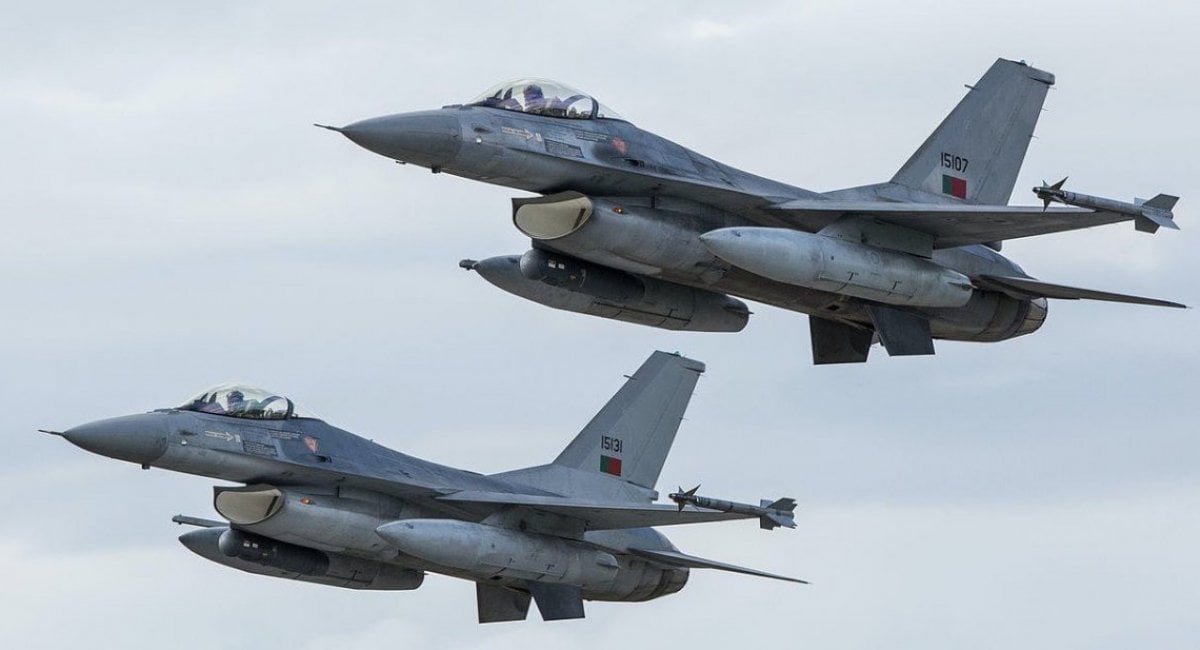
Portugal is “seriously considering” Lockheed Martin’s F-35A Lightning II to replace its aging F-16 fleet, Foreign Minister Paulo Rangel said in Lisbon on October 8, 2026, after US Secretary of State Marco Rubio pledged a “very competitive” American offer. The Eurofighter Typhoon, Dassault Aviation’s Rafale and Saab’s Gripen E remain in contention.
“The Portuguese state will always decide in accordance with the national interest,” Rangel said. The remarks soften the line taken in March 2025, when Defense Minister Nuno Melo warned that Washington could limit the F-35’s use, maintenance and components. No tender has been launched, and fighters were left out of Portugal’s €5.8 billion allocation under the European Union’s Security Action for Europe (SAFE) loan instrument.
Portugal F-16 Replacement: Aging Vipers and a Post-2030 Timeline
The Portuguese Air Force, or Força Aérea Portuguesa (FAP), flies its F-16AM/BM fighters from Monte Real Air Base with Esquadras 201 and 301; open-source tallies put the fleet at 25 to 28 aircraft. Lisbon acquired 45 F-16A/B Block 15 airframes under the Peace Atlantis I and II programs between 1994 and 1999, upgraded them through the Mid-Life Update (MLU) to a standard broadly comparable with the F-16C/D Block 50/52, and later sold 12 to Romania.
The jets carry Joint Helmet-Mounted Cueing Systems (JHMCS) and Litening II pods, employ GBU-12, GBU-31 Joint Direct Attack Munition (JDAM) and GBU-49 weapons, and have flown NATO air policing over the Baltic states, Iceland, Romania and Poland. The weak link is the mechanically scanned AN/APG-66(V)2 radar. The airframes could structurally serve into the mid-2040s, but an active electronically scanned array (AESA) retrofit such as the AN/APG-83 would be costly on jets more than 30 years old.
FAP Chief of Staff Gen. João Cartaxo Alves named the F-35A the preferred replacement in November 2023 and has warned that first deliveries would come roughly seven years after a decision. An internal FAP study reported this year ranked the F-35A first across 20 technical criteria, ahead of the Gripen E, sizing the requirement at 14 to 28 aircraft and €3 billion to €5 billion; it has not yet reached political decision-makers.
F-35A vs Typhoon and Rafale: Stealth, Sensors and Kinematics
Publicly available specifications indicate the F-35A pairs a Pratt & Whitney F135-PW-100 rated at about 43,000 lb (191 kN) in afterburner with a Mach 1.6 top speed and a combat radius of roughly 590 nautical miles (1,093 km) on internal fuel. Its edge is not kinematic. Low observability, internal carriage of four AIM-120 Advanced Medium-Range Air-to-Air Missiles (AMRAAM), and fusion of the AN/APG-81 AESA radar, AN/AAQ-37 Distributed Aperture System and AN/AAQ-40 Electro-Optical Targeting System let it operate inside integrated air defenses that fourth-generation fighters must engage from stand-off range. US officials count more than 900 F-35s in service or on order across Europe, a ready-made community of tactics, training and data.
The price is dependence: software blocks, mission data and spares run through US-managed channels, the exposure Melo flagged in 2025, while the Technology Refresh 3 (TR-3) and Block 4 upgrade path has slipped repeatedly.
The Typhoon trades stealth for performance. Twin Eurojet EJ200 engines of about 20,250 lb (90 kN) each in reheat deliver Mach 2 class speed and supercruise, and the Captor-E AESA radar paired with the MBDA Meteor ramjet missile suits the Quick Reaction Alert (QRA) and air policing missions Portuguese F-16s fly today. The Rafale’s two Safran M88-2 engines of about 16,860 lb (75 kN) each power a jet built around the Thales RBE2-AA AESA, the SPECTRA electronic warfare suite and Meteor, MICA NG and SCALP-EG weapons, with the F4 standard now in delivery. Both keep software and spares inside European supply chains; neither approaches the F-35A’s radar cross-section.
Gripen E and Industrial Offsets: How Europe Is Courting Lisbon
Saab’s Gripen E is the cost-driven option. Publicly available specifications indicate a single General Electric F414G of about 22,000 lb (98 kN), a Leonardo ES-05 Raven AESA on a repositioner that widens its field of regard, the Skyward-G infrared search and track (IRST) sensor and the Arexis electronic warfare suite. Ten hardpoints carry Meteor and IRIS-T. The jet is built for dispersed road-base operations with small ground crews, but has only recently entered Swedish service and flies with Brazil as the F-39E.
Industrial return is now the main battleground. Saab signed memorandums of understanding (MoU) with OGMA, the Embraer-controlled aerospace firm, and Critical Software, offering a Brazil-style technology-transfer model and possible final assembly in Portugal. Dassault filed a formal Rafale bid in July 2026 and signed an MoU with the AED Cluster Portugal on September 23, 2026. Airbus, citing more than 30 Portuguese suppliers and nearly 1,600 local jobs, will submit an unsolicited Eurofighter offer with financing and military cooperation by early November. Lockheed Martin counters that Portuguese F-35s would be maintained, repaired and upgraded in Portugal.
Analysis: The €3 billion to €5 billion envelope may weigh more than any specification. At 14 aircraft, Portugal would field one squadron instead of two, thinning the force that sustains national QRA and NATO rotations simultaneously. That arithmetic keeps the cheaper Gripen E competitive despite its lack of low observability, and Rubio’s “very competitive” pledge targets price rather than capability, where the F-35A already leads the FAP’s own evaluation. Lisbon is choosing between integration into Europe’s largest fighter community and a European package that converts defense spending into domestic industrial work.
The Eurofighter submission is the next marker. The Ministry of National Defense must still launch a formal procurement with requirements, quantities and a schedule. Unknowns include whether Washington adds Foreign Military Sales (FMS) financing or industrial work beyond sustainment, and how the program fits a budget that reached 2 percent of gross domestic product (GDP) in 2025 under pressure from NATO’s 2035 targets. With roughly seven years from decision to delivery, every month without a tender narrows the margin before F-16 obsolescence bites after 2030.