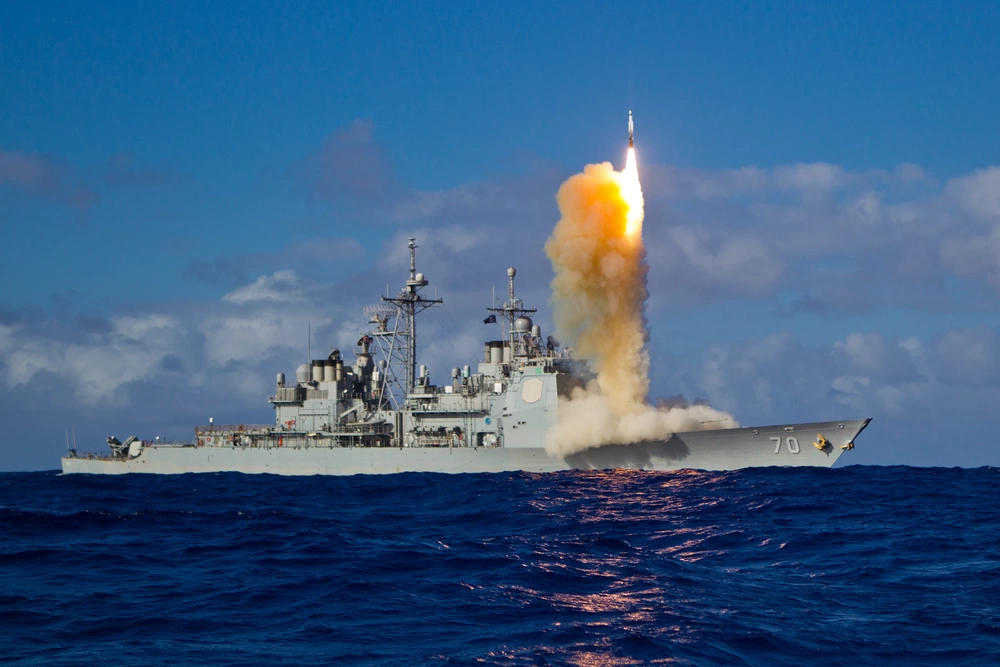
The Missile Defense Agency (MDA) has awarded Raytheon a noncompetitive, multi-year undefinitized contract action valued at up to $6,342,404,516 to manufacture and assemble Standard Missile-3 Block IB (SM-3 Block IB) All-Up Rounds, according to a Department of War contract announcement. Awarded on October 7, 2026, under contract HQ0851-27-C-E001, the deal carries a base value of $4,432,040,944, with work in Tucson, Arizona, and Huntsville, Alabama, scheduled to run through October 31, 2034.
The contract is the latest multi-year award under the five framework agreements Raytheon signed with the Department of War on February 4, 2026, after Tomahawk ($22.9 billion), the AIM-120 Advanced Medium-Range Air-to-Air Missile ($20.7 billion) and the Standard Missile-6 ($24.4 billion). It also revives a line the Pentagon had planned to close. The MDA’s fiscal 2025 and 2026 budget requests proposed ending Block IB production in favor of the more capable SM-3 Block IIA, before combat use against Iranian ballistic missiles changed the calculus. The fiscal 2027 request seeks 78 Block IB rounds for $1.246 billion.
SM-3 Block IB Contract Structure: Base Award, Options and Funding
Options account for $1,910,363,572 of the ceiling. Raytheon describes the vehicle as a five-year contract with two option years covering production and sustainment, mirroring the up-to-seven-year term of the February frameworks. The MDA obligated $454,215,132 in fiscal 2026 procurement funds at award, about 10 percent of the base value.
As an undefinitized contract action, the award lets Raytheon start work before final prices and terms are agreed through definitization. Neither the MDA nor Raytheon has disclosed the number of interceptors covered or a delivery schedule. The noncompetitive structure reflects Raytheon’s position as the sole SM-3 prime contractor.
In March 2026, the MDA added $266.9 million and 23 rounds to an earlier Block IB contract, bringing it to $1.36 billion for 78 interceptors with completion in May 2030. The new ceiling is more than four times larger and extends production by over four years. Raytheon President Phil Jasper framed the award as a way to rebuild depleted inventories against evolving threats. On August 14, 2026, the Department of War also signed seven-year frameworks with Boeing and Raytheon to raise output of the avionics and ejector assemblies Boeing supplies for both SM-3 variants.
The demand signal comes from combat. USS Carney (DDG 64) and USS Arleigh Burke (DDG 51) fired the first Block IB rounds used in combat on April 14, 2024, against Iranian ballistic missiles aimed at Israel. During the June 2025 Israel-Iran war, US ships reportedly fired about 80 SM-3s, equivalent to nearly a fifth of the 414 rounds in the MDA inventory at the end of 2025, according to the Center for Strategic and International Studies (CSIS). The Pentagon has not released expenditure figures for Operation Epic Fury, the US-Israeli campaign against Iran launched on February 28, 2026, though independent analysts estimate it may have consumed more than 100 additional SM-3s.
Two-Color Seeker and Cost: How Block IB Compares to Block IIA
The SM-3 Block IB is a three-stage, hit-to-kill interceptor launched from the Mk 41 Vertical Launching System aboard Aegis Ballistic Missile Defense (BMD) destroyers and from Aegis Ashore sites in Romania and Poland. It shares its Mk 72 booster and Mk 104 dual-thrust rocket motor with the SM-2 Block IV, adding a Mk 136 third-stage rocket motor to lift its kinetic warhead above the atmosphere for midcourse intercepts. Publicly available specifications indicate a length of about 6.55 meters, a 34.3-centimeter body diameter and a launch weight near 1,500 kilograms. Open-source estimates place its engagement range between roughly 700 and 900 kilometers, with intercept altitudes around 500 kilometers.
The kinetic warhead defines the variant. Its two-color infrared seeker senses targets in two wavebands, improving discrimination between reentry vehicles and debris or decoys, while an advanced signal processor and the Throttleable Divert and Attitude Control System (TDACS) give it finer endgame maneuvering than the Block IA. Raytheon describes the Block IB as combat proven, although the Navy has not published intercept results for its engagements against Iranian missiles.
The Block IIA, codeveloped with Japan, uses 21-inch upper stages and a larger kinetic warhead to defend wider areas, and it has intercepted an intercontinental ballistic missile-class target in testing. It also costs far more. The fiscal 2027 request averages about $16 million per Block IB round, while open-source estimates put the Block IIA between roughly $28 million and $40 million. CSIS has found that stop-start Block IB buying pushed unit costs from about $9 million in fiscal 2021 to nearly $24 million for fiscal 2024 supplemental rounds.
Analysis: The award formalizes a capacity-over-capability correction. Keeping the cheaper Block IB in production alongside the Block IIA gives the MDA magazine depth for regional fights in which Aegis ships face repeated salvos of short- and medium-range missiles, reserving the costlier IIA for longer-range threats, notably in the Indo-Pacific. A seven-year horizon also gives suppliers the stable baseline that uncertain annual buys never provided, from Boeing’s avionics to the Mk 72, Mk 104 and TDACS built by L3Harris’s Aerojet Rocketdyne unit. Whether it reverses the unit-cost growth will depend on the definitized price.
Near-term milestones are definitization of price and quantities and final fiscal 2027 funding, which will set early order volumes. Neither party has disclosed delivery rates, the metric that will show whether the line can rebuild an inventory drawn down by more than two years of combat use.