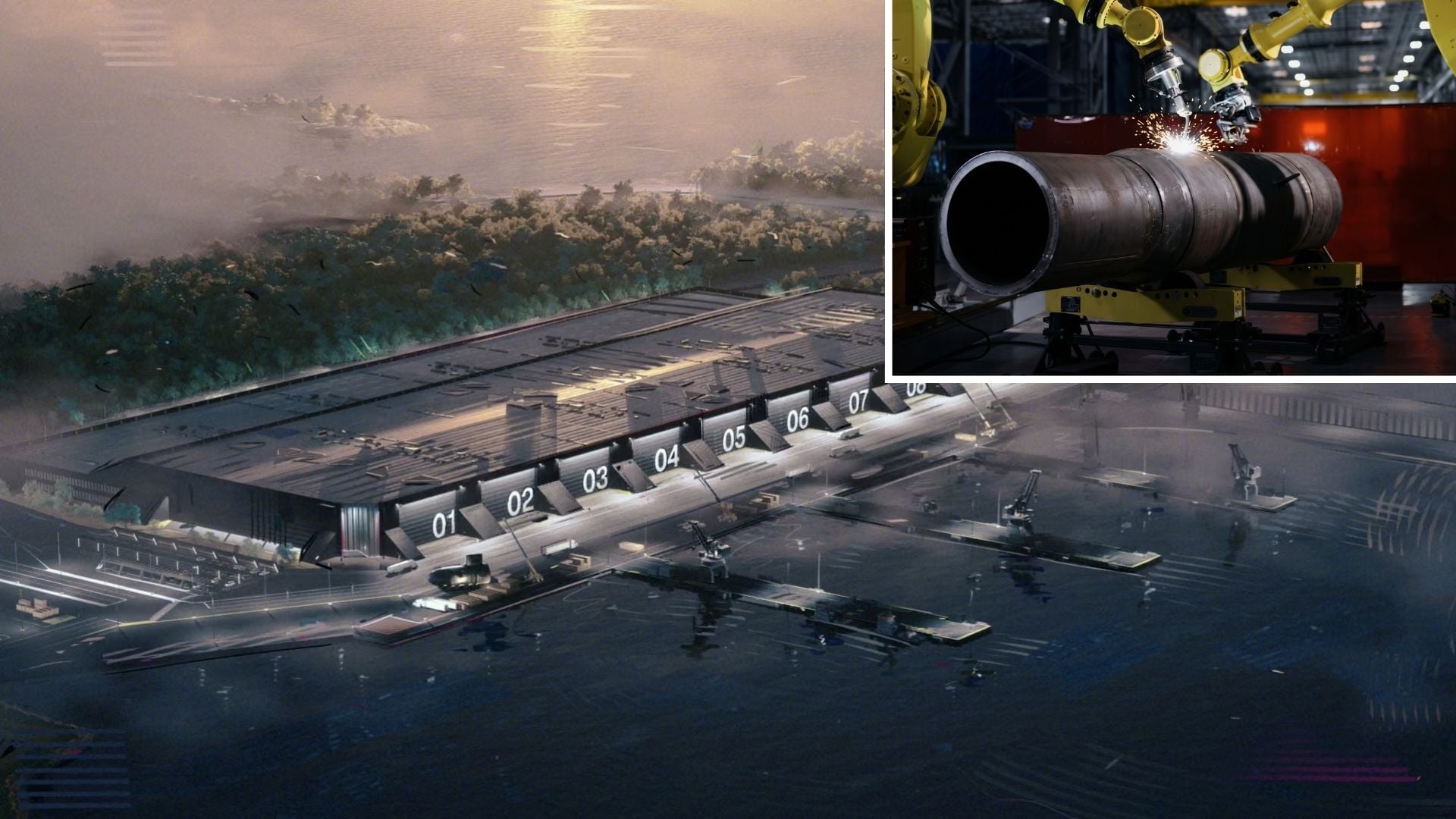
Gecko Robotics will deploy its robotic inspection systems and AI-driven quality assurance software inside Anduril Industries’ new submarine component factory in Orange County, California, under a partnership announced on October 8, 2026. The agreement targets a persistent constraint on Virginia-class attack submarine output: the time it takes to inspect and accept critical parts before they move down the production line.
The deal follows by two days the October 6 launch of Arsenal-2, Anduril’s planned shipyard at the Tradepoint Atlantic complex in Sparrows Point, Baltimore County, Maryland, unveiled by President Donald Trump and Secretary of War Pete Hegseth. Anduril is committing $3.7 billion in private capital to the project, while the U.S. Navy has awarded the company a contract worth up to $2.9 billion, with payments tied to demonstrated production outcomes. The gap is well documented: General Dynamics Electric Boat and HII’s Newport News Shipbuilding have delivered Virginia-class boats at roughly 1.1 to 1.3 per year since 2022, against a requirement of two per year, rising to 2.33 once AUKUS transfers to Australia are included.
How Gecko Robotics Fits Into Anduril’s Submarine Production Model
Gecko’s technology goes first into Anduril’s 160,000-square-foot protofactory in Orange County, which will manufacture critical Virginia-class components, including torpedo tubes, and develop the production processes and quality systems later transferred to Maryland. According to a senior administration official, torpedo tubes are currently among the components holding back boats already under construction. The California site is built to support SUBSAFE production qualification, the Navy’s certification regime for components that preserve a submarine’s watertight integrity and recovery capability, and gives Anduril roughly a two-year head start before Arsenal-2 begins initial operations in 2030.
Gecko’s offering pairs wall-climbing robots carrying ultrasonic and other sensors with Cantilever, its AI-powered data platform, which converts raw scans into thickness maps and flags suspect areas for review. At Orange County, that inspection output is being integrated with ArsenalOS, the Anduril industrial software that will run Arsenal-2’s production systems. Bill Noderer, Anduril’s vice president and general manager for shipbuilding, said the integration is already running in live production workflows, with the aim of cutting inspection wait times and establishing quality processes Anduril can carry to Maryland “from day one.”
Arsenal-2 itself will not assemble complete boats. Anduril plans more than 2 million square feet of production space on a 187-acre site, delivering components and large-scale assemblies to Electric Boat and Newport News, with a longer-term ambition to build major hull sections.
Automating Nondestructive Testing for Forged Submarine Components
Nondestructive testing (NDT), chiefly ultrasonic examination of welds and forgings for internal flaws, porosity, and wall loss, is mandatory for nuclear submarine hardware and has long depended on certified technicians who take years to train. Gecko says its systems have cut inspection timelines for forged components by up to 90% at other defense industrial base customers. Gecko reported the same figure from trials with BPMI, a contractor supplying components for Navy nuclear-powered aircraft carriers and submarines.
The company also claims that workers with no prior NDT background can become productive after roughly one hour of training, because inspection expertise is encoded in the robots and software rather than held by individual specialists. Neither figure has been independently validated, and the announcement does not specify which robotic platforms, sensor modalities, or inspector certification levels apply at Orange County.
The workforce dimension matters as much as throughput. The Navy’s long-range shipbuilding plan, released in May 2026, names supply chain stabilization and skilled workforce growth as near-term priorities for reaching the “1+2” rate of one Columbia-class and two Virginia-class submarines per year. Gecko already has a foothold in that effort: since November 2023 it has performed robotic weld inspection on the $132 billion Columbia-class program through BlueForge Alliance, the nonprofit integrator supporting the submarine industrial base, alongside maintenance work on Virginia-class boats and, since 2024, aircraft carriers.
Building a Digital Thread From Factory Floor to Fleet Sustainment
Both companies frame the partnership around a digital thread: every assessment of a new-build component feeds a record that follows the part from manufacture through decades of service. In practice, an as-built ultrasonic baseline lets maintainers compare later in-service scans against the part’s condition at delivery rather than against design tolerances alone, supporting predictive maintenance and reducing unplanned repair work during availabilities.
That capability addresses a recurring problem in the submarine force, where maintenance delays at public shipyards have repeatedly eroded attack submarine availability. Gecko has said that before its Navy work began, submarine maintenance data was kept largely in PDF documents. A machine-readable inspection history generated at manufacture would give planners fleet-wide data that has been hard to aggregate.
Analysis: The partnership exposes the core wager behind Arsenal-2: that software and automation, not floor space alone, will move the Virginia-class production rate. Quality assurance is where that wager is most exposed. SUBSAFE standards do not bend for new entrants; a first-time torpedo tube supplier must meet the same acceptance criteria as legacy vendors. Automated, data-rich NDT can accelerate throughput while generating the audit trail certifying authorities demand. Under a contract where Navy payments track demonstrated production, every day a component spends in an inspection queue is deferred revenue for Anduril, a direct incentive to industrialize inspection early. The tie-up also shows the venture-backed defense technology cohort building supply chains within its own network: Anduril co-founder Trae Stephens joined Gecko’s board through Founders Fund in December 2023.
Near-term milestones sit in Orange County: production qualification of the first torpedo tubes and Virginia-class test assets, and evidence that Gecko-generated inspection data is accepted as a basis for component acceptance under SUBSAFE. Maryland and Baltimore County incentives covering up to 13% of Anduril’s planned investment still require approval from the Maryland General Assembly and the Baltimore County Council. The financial terms and duration of the Gecko-Anduril agreement were not disclosed. The Navy projects two Virginia-class deliveries per year by 2031 or 2032, and the Orange County line will offer the first test of whether new entrants can shorten that timeline.