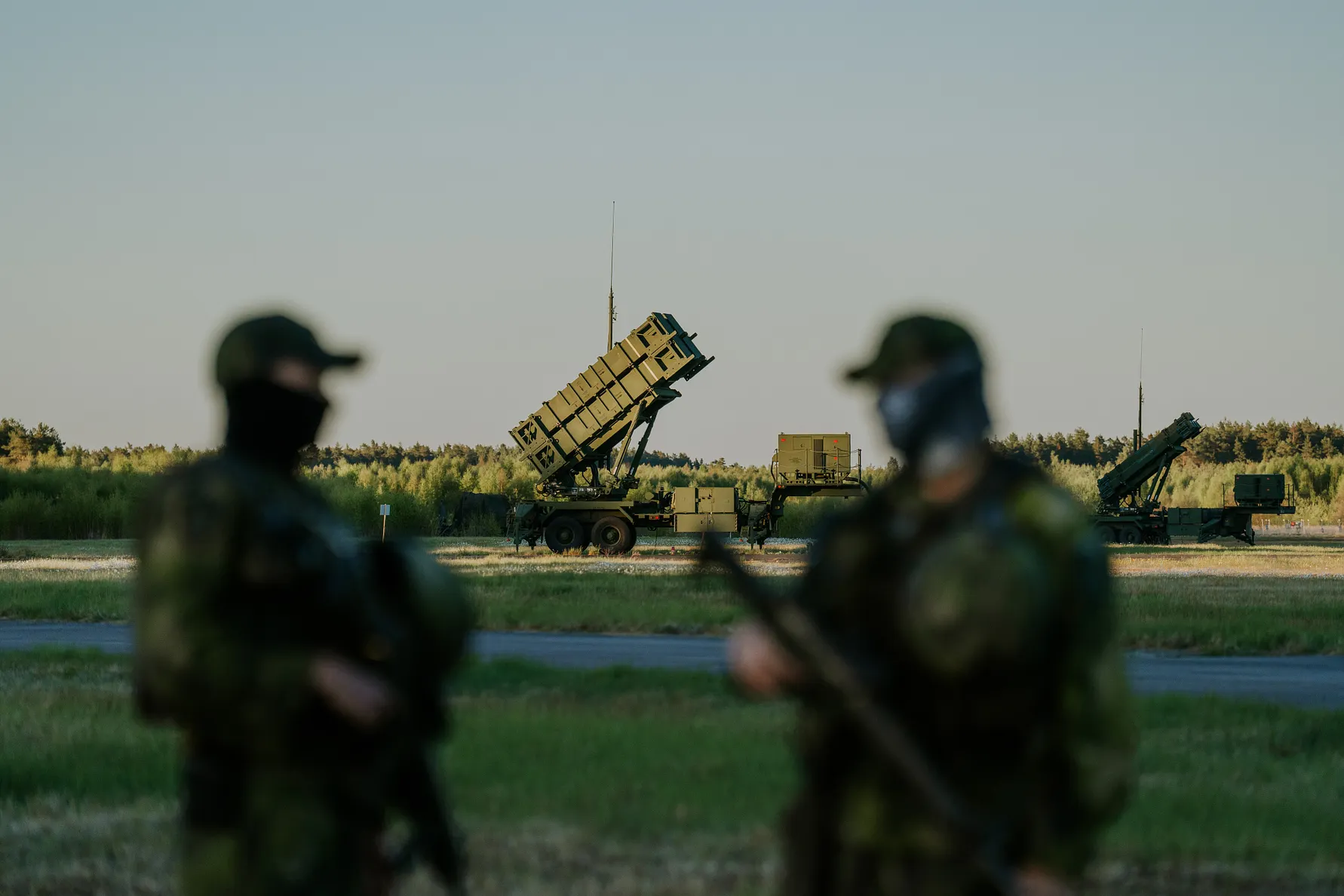
Sweden will deploy a Patriot air and missile defense unit and about 100 personnel to southeastern Poland in early December 2026 to protect NATO’s logistics hub at Rzeszów-Jasionka Airport, the main transit point for military and civilian aid bound for Ukraine. Prime Minister Ulf Kristersson announced the decision on October 6, 2026, marking the first Swedish Patriot deployment on a NATO operation.
The hub has become one of the Alliance’s most exposed rear-area assets. Operating under NATO Security Assistance and Training for Ukraine (NSATU), it handled roughly 18,000 tonnes of materiel per month according to NATO figures from late 2025, and Polish officials say more than 80 percent of military donations to Ukraine cross Polish territory. Defense Minister Pål Jonson tied the decision directly to the threat picture: “The serious security situation, with recurring violations of allied airspace and Russian attempts to influence support to Ukraine, shows the importance of protecting the logistics node in Poland.”
Swedish Patriot Deployment Replaces Dutch Batteries at Rzeszów
The contingent will come from the Air Defence Regiment (Lv 6) in Halmstad, supported by the Blekinge Air Wing (F 17), and will operate under NATO’s Allied Air Command as part of the Alliance’s Integrated Air and Missile Defence system. Kristersson framed the mission narrowly: “The task is to protect the logistics hub, and thereby ensure that important materiel reaches Ukraine.”
Sweden takes over from the Netherlands, which has defended the hub since December 1, 2025, initially with two Patriot fire units, a National Advanced Surface-to-Air Missile System (NASAMS) battery, counter-drone assets, and about 300 personnel. Stockholm has not disclosed how many fire units, launchers, or interceptors it will send. A contingent of roughly 100 personnel is consistent with a single Patriot fire unit, but the Swedish Armed Forces have not confirmed the order of battle.
The government mandate runs from early December through December 31, 2026, and the regiment plans to continue the mission through the first half of 2027. Its commander, Colonel Sofia Westermark, has described the operation as the most complex mission Sweden has undertaken since joining NATO in March 2024.
The Patriot unit layers onto a Swedish air component already in theater. Since October 2026, JAS 39 Gripen fighters have flown NATO air and missile defense missions over Poland, mostly from bases in Sweden with a small forward operating base on Polish soil. It is Sweden’s second such rotation, after Gripens supported the same hub from April to the end of August 2025. NATO now draws an airborne and a ground-based layer from the same ally over the same node.
Inside Luftvärnssystem 103: Sweden’s Patriot Radar, Launchers, and Interceptors
Sweden designates the system Luftvärnssystem 103 (LvS 103). The US State Department approved the sale in February 2018 with a ceiling of $3.2 billion, and the Swedish Defence Materiel Administration (FMV) signed that August for four Patriot Configuration 3+ Modernized Fire Units, up to 100 MIM-104E Guidance Enhanced Missile-TBM (GEM-T) interceptors, and up to 200 PAC-3 Missile Segment Enhancement (MSE) interceptors. LvS 103 reached initial operational capability in December 2021, replacing the MIM-23 Hawk, and FMV delivered the fourth fire unit in December 2022.
Each fire unit pairs an AN/MPQ-65 radar with an AN/MSQ-132 engagement control station and three M903 launchers. The AN/MPQ-65 is a phased-array radar that performs surveillance, tracking, and missile guidance from a single antenna; publicly available specifications indicate a primary search sector of roughly 120 degrees. A single battery must therefore face the expected threat axis, which is why Rzeszów relies on a layered, multinational architecture rather than on one system.
The two interceptors serve different ends. The PAC-3 MSE is a hit-to-kill missile with a Ka-band active radar seeker and a dual-pulse solid rocket motor, which FMV describes as optimized for ballistic missile defense. The GEM-T uses a blast-fragmentation warhead and primarily engages aircraft and cruise missiles; publicly available specifications put its range against aircraft at about 160 kilometers. Stockholm has not said which mix will deploy.
Magazine depth is the binding constraint for any deployment drawn from national stocks. In November 2024, Sweden joined Germany, the Netherlands, Romania, and Spain in a NATO Support and Procurement Agency (NSPA) order for up to 1,000 GEM-T missiles worth about 60 billion kronor, with Sweden’s share above 5 billion kronor and a new production line planned in Germany.
Analysis: The deployment turns Swedish NATO membership into a measurable share of the Alliance’s scarcest air defense asset. If, as the personnel figure suggests, Stockholm sends one fire unit, it commits a quarter of its national Patriot inventory abroad through the winter, the season in which Russia has concentrated long-range strikes on Ukraine. It also replaces a Dutch package built around two Patriot fire units with what appears to be a smaller upper-tier footprint, shifting more weight onto Polish short-range layers and Allied fighter cover, including Sweden’s own Gripens. Stockholm now treats the security of Ukraine’s supply chain as forward defense of Sweden.
The next milestones are the handover from the Dutch rotation in early December and a decision on extending the mandate beyond December 31, 2026. Open questions remain on the deployed order of battle, the interceptor load-out, whether Swedish short-range assets will accompany the Patriot unit, and which ally assumes the mission after June 2027.