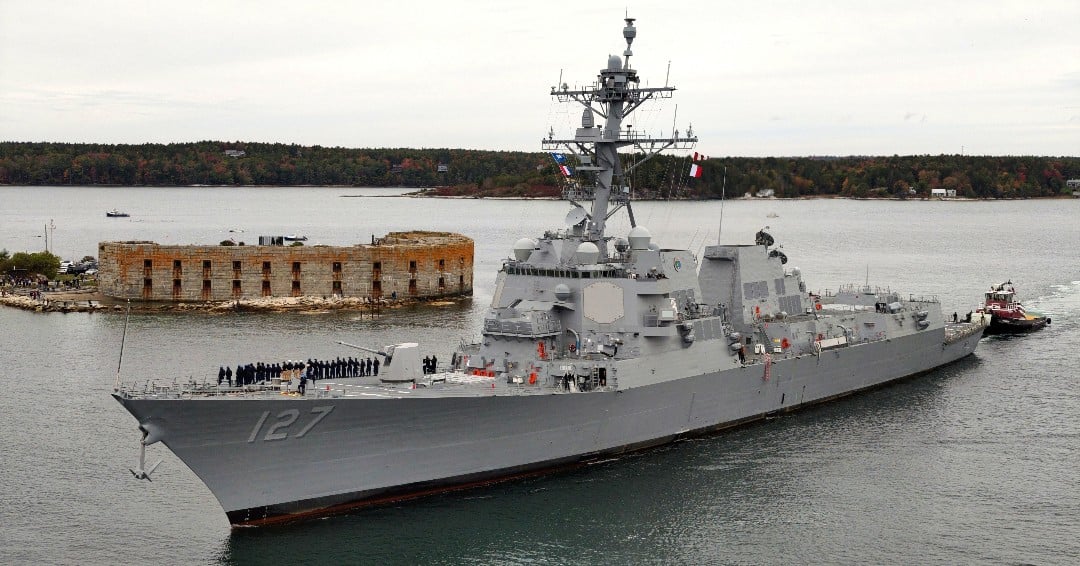
The future USS Patrick Gallagher (DDG 127) sailed from General Dynamics Bath Iron Works (BIW) in Bath, Maine, on the afternoon of October 11, 2026, transiting the Kennebec River to join the U.S. Navy fleet. The guided-missile destroyer is the last Arleigh Burke-class ship built in the Flight IIA configuration, closing a production line that began when the lead ship, USS Oscar Austin (DDG 79), was laid down in 1997.
The departure follows the Navy’s acceptance of the ship on May 28, 2026, more than two months ahead of schedule. According to the Navy, the gain came from a compressed builder’s trial that ran hull, mechanical, electrical and combat systems testing at sea in a single consecutive block after the destroyer first left the yard on April 27. DDG 127 is the 77th Arleigh Burke-class destroyer delivered to the Navy and the 41st built at Bath. It is scheduled to be homeported at Naval Station Norfolk, Virginia; the Navy has not announced a commissioning date.
Sensors, Weapons, and Aegis Baseline 9 Aboard USS Patrick Gallagher
DDG 127 belongs to the Flight IIA Technology Insertion subvariant, which folds selected Flight III elements into the legacy design while retaining the Lockheed Martin AN/SPY-1D(V) S-band passive phased-array radar. Technology Insertion ships pair that radar with the AN/SPQ-9B X-band search and fire-control radar, first integrated on a Flight IIA hull with USS Delbert D. Black (DDG 119), adding dedicated horizon search against low-altitude, sea-skimming targets.
The combat system is Aegis Baseline 9, the Navy’s integrated air and missile defense (IAMD) build, which lets a single destroyer conduct anti-air warfare and ballistic missile defense simultaneously rather than trading one mission for the other. The Navy credits Baseline 9’s added computing power and radar processing upgrades with longer detection range and shorter reaction time against modern air and ballistic threats.
Publicly available specifications indicate a length of 509 feet 6 inches, a beam of about 66 feet and a full-load displacement of roughly 9,200 tons. Four General Electric LM2500 gas turbines deliver about 100,000 shaft horsepower to two shafts for speeds above 30 knots, and the crew numbers more than 300 sailors. Armament centers on 96 Mk 41 vertical launch cells, 32 forward and 64 aft, compatible with Standard Missile interceptors, quad-packed Evolved SeaSparrow Missiles, Tomahawk land-attack missiles and vertical-launch ASROC. A Mk 45 Mod 4 5-inch/62-caliber gun, Mk 32 torpedo tubes and a hangar for two MH-60R Seahawk helicopters complete the fit.
That twin hangar, the defining Flight IIA addition, gives each ship organic anti-submarine and over-the-horizon targeting reach that Flight I and II hulls lack, a relevant asset for an Atlantic Fleet destroyer facing persistent submarine activity in the North Atlantic.
From SPY-1D(V) to SPY-6: Bath Iron Works Pivots to Flight III
DDG 127’s path to the fleet took nearly eight years. Fabrication began on November 9, 2018, and the keel was laid on March 30, 2022, the 55th anniversary of the death of the ship’s namesake, Marine Corps Cpl. Patrick Gallagher. Born in Ballyhaunis, County Mayo, Ireland, Gallagher received the Navy Cross for actions on July 18, 1966, during Operation Hastings, when he threw himself on an enemy grenade and then hurled it into a nearby river, sparing his fellow Marines. He was killed in action near Da Nang the following year. His three sisters christened the ship on July 27, 2024, and BIW’s send-off message closed with “Be Brave and Be Bold,” echoing the Gallagher family motto.
The hull numbers mask an industrial switch. BIW’s first Flight III ship, the future USS Louis H. Wilson Jr. (DDG 126), was christened on September 27, 2025, yet DDG 127 kept the older configuration. Flight III replaces SPY-1D(V) with Raytheon’s AN/SPY-6(V)1 Air and Missile Defense Radar, built from 37 radar modular assemblies per array face, which its manufacturer describes as roughly 30 times more sensitive than SPY-1D(V). Carrying it required expanded electrical generation and cooling, plus Aegis Baseline 10.
Only two Flight III ships are in commission: USS Jack H. Lucas (DDG 125), since October 2023, and USS Ted Stevens (DDG 128), commissioned in Whittier, Alaska, in early October 2026. Behind Louis H. Wilson Jr., BIW is building five more Flight III hulls: William Charette (DDG 130), Quentin Walsh (DDG 132), John E. Kilmer (DDG 134), Richard G. Lugar (DDG 136) and J. William Middendorf (DDG 138).
Analysis: The Navy is putting a brand-new destroyer into service around a radar it is already paying to strip from older hulls. Its Destroyer Modernization 2.0 effort has targeted about 20 Flight IIA ships for a 24-module AN/SPY-6(V)4, the SEWIP Block 3 electronic warfare suite and Aegis Baseline 10, at an estimated 18 to 24 months per hull, and the final number receiving the full package remains unsettled. Whether DDG 127, the youngest SPY-1D(V) ship in the fleet, is on that list has not been disclosed. If it is not, the Navy will run a mixed-radar destroyer force for decades, with diverging sustainment, training and software baselines.
Next come DDG 127’s transit to her planned Norfolk homeport and a commissioning ceremony the Navy has yet to schedule; plans aired at the 2024 christening for a post-commissioning port call in County Mayo have not been confirmed. At Bath, attention shifts to Louis H. Wilson Jr., the first test of whether the compressed trial model behind DDG 127 can carry over to a more complex Flight III integration.