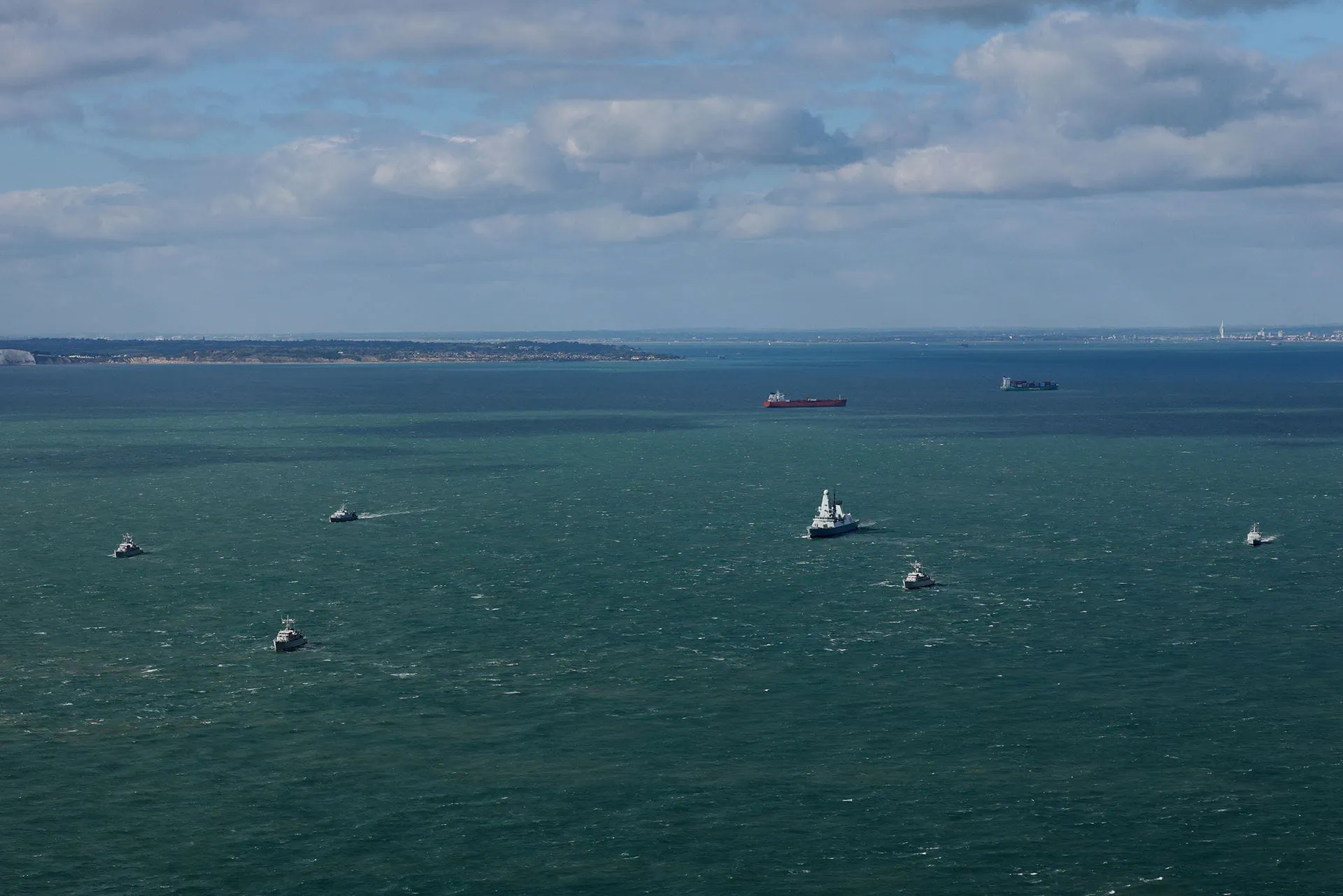
Five Ukrainian Navy minehunters completed seven days of intensive training off England’s south coast by sailing in close formation with Royal Navy Type 45 destroyer HMS Dauntless in the eastern Solent, the Royal Navy said on October 12, 2026. The drills closed the fifth and final phase of Exercise Lion Protector 26, the Joint Expeditionary Force (JEF) exercise that began on August 3.
The five ships, UNS Henichesk, Mariupol, Melitopol, Chernihiv and Cherkasy, operate from Portsmouth because Türkiye has applied the wartime provisions of the 1936 Montreux Convention since February 2022, closing the Turkish Straits to belligerent warships. Lion Protector opens a three-year JEF series, followed by Lion Sentinel in 2027 and Lion Shield in 2028. Earlier phases ranged from a roll-on, roll-off escort into Latvia to the first Royal Marines deployment to the Faroe Islands since World War II, focused on the Greenland-Iceland-UK (GIUK) Gap. The final phase shifted to protecting maritime infrastructure and sea lanes, with the Ukrainian squadron as its mine countermeasures (MCM) component.
How Ukrainian Minehunters Trained From Portland to the Solent
Under UK supervision, the crews opened with gunnery shoots off Portland to demonstrate ship self-defense, a baseline skill for small, lightly armed hulls expected to work close to contested coastlines. The program then moved to mine hunting: locating, identifying and, where necessary, destroying practice mines with Seafox, the remotely operated mine disposal system that has equipped Royal Navy minehunters for roughly two decades. Chernihiv and Cherkasy conducted live Seafox firings, ending in controlled detonations that neutralized the simulated mine threats.
Built by Germany’s Atlas Elektronik, Seafox applies the expendable mine disposal vehicle concept. Publicly available specifications indicate a vehicle roughly 1.2 meters long and about 43 kilograms, steered through a fiber-optic cable, with a top speed of 6 knots and an operating depth of up to 300 meters. The reusable Seafox I round uses its sonar and camera to inspect and identify contacts; the Seafox C combat round adds a shaped-charge warhead and destroys itself with the target. The one-shot design keeps the mother ship and divers outside a mine’s danger zone and shortens the find-to-neutralize cycle, a priority for a navy that will face wide contaminated areas with only five hulls available.
The week ended with small task group maneuvers around Dauntless, the second of the Royal Navy’s six Type 45 air defense destroyers, whose Sea Viper system fires Aster 15 and Aster 30 surface-to-air missiles. Sailing in company with a major warship rehearses the station-keeping, communications and tactical procedures MCM vessels require when they clear transit routes under escort.
Inside Ukraine’s Sandown and Alkmaar-Class Mine Countermeasures Fleet
The squadron mixes two Western designs. Chernihiv and Cherkasy are former Royal Navy Sandown-class minehunters transferred in 2023. Publicly available specifications indicate 52.5-meter glass-reinforced plastic hulls displacing about 600 tons, Voith Schneider propulsion for precise hovering over a contact, a Type 2093 variable-depth sonar that can be lowered beneath thermal layers, and a 30mm gun.
The other three belong to the Tripartite design developed by Belgium, France and the Netherlands, designated the Alkmaar class in Dutch service. In June 2025, Belgium handed over BNS Narcis and the Netherlands HNLMS Vlaardingen; the pair now sail as Mariupol and Melitopol. Henichesk, the former HNLMS Makkum, decommissioned on November 25, 2024, raised the Ukrainian ensign on June 15, 2026, taking the name of a Ukrainian minesweeper lost near the Kinburn Spit in June 2022. Open-source data indicate 51.5-meter non-magnetic hulls of similar displacement fitted with hull-mounted sonar of the Thales TSM 2022 family. Two hull types mean two sonar suites, two propulsion plants and two spares pipelines for a small navy to sustain.
Readiness is measured against NATO standards. During Sea Breeze 26-2, which ended on July 24 off the same coast, the two former Royal Navy ships worked toward NATO Operational Capabilities Concept Level Two while the Alkmaar-class pair targeted Level One. The Royal Navy ranks Lion Protector second only to Sea Breeze, the Ukrainian Navy’s premier annual exercise, in scope and complexity. Under Operation Interflex, more than 200 Ukrainian sailors have trained to crew the five minehunters over the past three years.
Analysis: Lion Protector shows London employing the Ukrainian squadron as a working MCM element inside an allied scenario rather than as donated hulls awaiting a ceasefire. Live Seafox firings and escorted task group drills give Ukrainian crews the NATO-compatible procedures needed to integrate with allied clearance forces in the Black Sea, including the Mine Countermeasures Naval Group that Türkiye, Romania and Bulgaria formed in January 2024. The constraint is legal and political, not technical: a United Nations estimate from late 2025 put potentially mine-contaminated Ukrainian waters at roughly 13,500 square kilometers, yet Montreux keeps Kyiv’s five Western-built MCM ships on the wrong side of the Bosporus. Meanwhile, the arrangement adds five crewed minehunters to the MCM assets operating alongside JEF navies in northern European waters.
Dauntless now prepares to escort HMS Prince of Wales when the carrier resumes Operation Firecrest, the UK Carrier Strike Group’s North Atlantic and High North deployment announced on February 14, 2026. Its first phase, with destroyer HMS Duncan and tanker RFA Tidespring, delivered NATO’s Arctic Sentry enhanced Vigilance Activity before the ships returned to Portsmouth for leave and maintenance. The Ukrainian squadron remains Portsmouth-based, with Sea Breeze and the JEF’s Lion Sentinel due in 2027. When the Turkish Straits reopen to Ukrainian warships remains the decisive unknown.