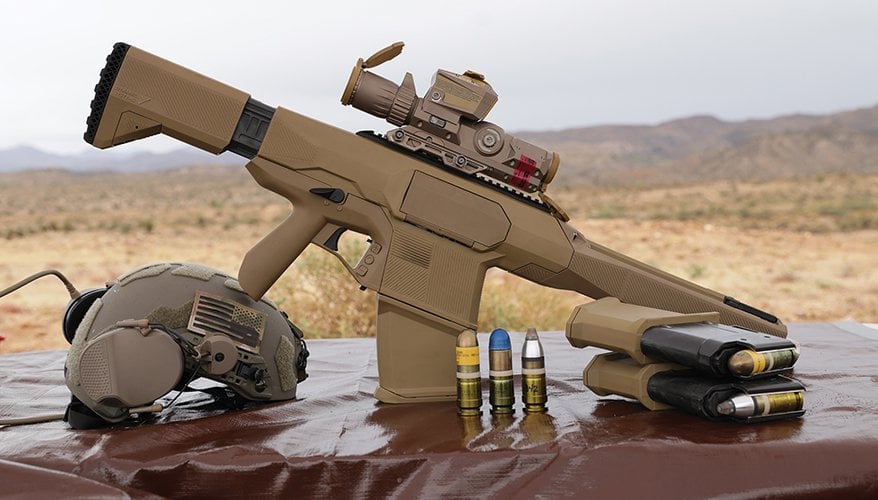
Northrop Grumman and Barrett Firearms have signed a teaming agreement under which Barrett will manufacture the weapon portion of Northrop Grumman’s Precision Grenadier System (PGS), a shoulder-fired, 25mm grenade launcher built to the US Army’s requirement for a successor to the M203 and M320. Announced on October 12, 2026, the deal places weapon production at Barrett’s Nashville, Tennessee, facility, with the system offered to both domestic and international customers.
The agreement arrives as the Army moves PGS from risk reduction into competitive prototyping. The service canceled the 25mm XM25 Counter Defilade Target Engagement system in 2018 over weight and cost concerns, the same year Northrop Grumman acquired XM25 prime contractor Orbital ATK. In April 2026, Army Contracting Command at Picatinny Arsenal issued a Prototype Project Opportunity Notice seeking up to two prototype Other Transaction Agreements, with the Army aiming to issue two precision launchers per rifle squad.
Inside the 25mm Precision Grenadier System Weapon and Ammunition Suite
Under the agreement, Northrop Grumman leads PGS prototyping and 25mm ammunition development. Barrett manufactures the weapon and integrates the inductive setter, the component that lets the grenadier program Northrop Grumman’s 25mm rounds. Programming occurs inductively inside the barrel, without physical electrical contacts, which the company presents as a reliability gain. The setter links fire control to fuze; if it fails, the airburst round loses its counter-defilade value.
Northrop Grumman specifications put the semi-automatic launcher at just under 12 pounds with a five-round magazine. Company product material cites a titanium barrel with a reinforced polymer over-mold, ambidextrous controls, and use of the Army’s XM157 fire control, fielded with the Next Generation Squad Weapon, to compute ballistic solutions and program rounds. Northrop Grumman has not published an effective range. The 500-meter defilade engagement requirement traces to the Army’s 2008 Small Arms Capabilities-Based Assessment; the M203 and M320 reach roughly 350 meters.
The ammunition suite covers four rounds. The High Explosive Air Burst (HEAB) round is a programmable, dual-warhead fragmenting projectile that functions in airburst or point-detonate mode. The High Explosive Proximity round uses an onboard sensor to detonate near stationary or moving small unmanned aircraft systems (sUAS) and needs no programming, shortening the engagement cycle against fast drones. A Close Quarter Battle buckshot round handles breaching, room and trench clearing, and close-range counter-UAS work, while an inert Target Practice round is ballistically matched to the HEAB and proximity rounds. Northrop Grumman says the family uses common components and existing automated medium-caliber production lines, its answer to the per-round cost that weighed on the XM25.
Army PGS Prototype Competition and the 25mm Versus 30mm Split
The April notice asks each prototype team for 16 weapons, 28 fire control units, and 25,400 rounds spanning counter-defilade, counter-sUAS, close quarters battle, and training types. Procurement database summaries of the notice point to follow-on production of up to 11,000 weapons and 15 million rounds under a potential $255.5 million ceiling. The proposal deadline moved from May 11 to June 1, 2026, and prototype awards had not been publicly announced at the time of writing.
Northrop Grumman’s 25mm design faces 30mm rivals. FN America received a $2 million prototype agreement in October 2025 to mature its MTL-30, and Barrett, teamed with MARS Inc., won the Army’s xTechSoldier Lethality competition in May 2025 with the 30mm Squad Support Rifle System. Barrett and MARS have since parted ways, and Barrett indicated in January 2026 that it would enter its own 30mm design while supporting Northrop Grumman’s bid. Northrop Grumman previously co-developed its launcher with Colt; the October 12 announcement does not mention Colt.
Analysis: The deal pairs Northrop Grumman’s ammunition and fuzing base with a small arms manufacturer that holds US military production credentials on the M107 and MK22 rifles, and it places setter integration, the step that decides whether programmable rounds perform, inside the factory that builds the gun. It also spreads Barrett’s exposure across both sides of the caliber debate. Broadly, 25mm trades payload per round for lighter ammunition and a larger basic load, while 30mm accepts heavier rounds for bigger effects. For Northrop Grumman, the lasting value sits in recurring 25mm ammunition demand, and its proximity round addresses a drone threat the XM25 was never designed around. Barrett’s ownership by Australia’s NIOA Group since January 2023 also offers a natural channel to the allied customers both firms cite.
The next decision point is the Army’s selection of up to two PGS prototype teams, followed by government testing of delivered weapons, fire control units, and ammunition. Neither company has disclosed the value of the teaming agreement, a production schedule for the Tennessee line, or whether the Barrett-built weapon has been submitted under the April notice. Those answers will show whether a 25mm design built on XM25 lessons can clear the weight and cost hurdles that ended its predecessor.