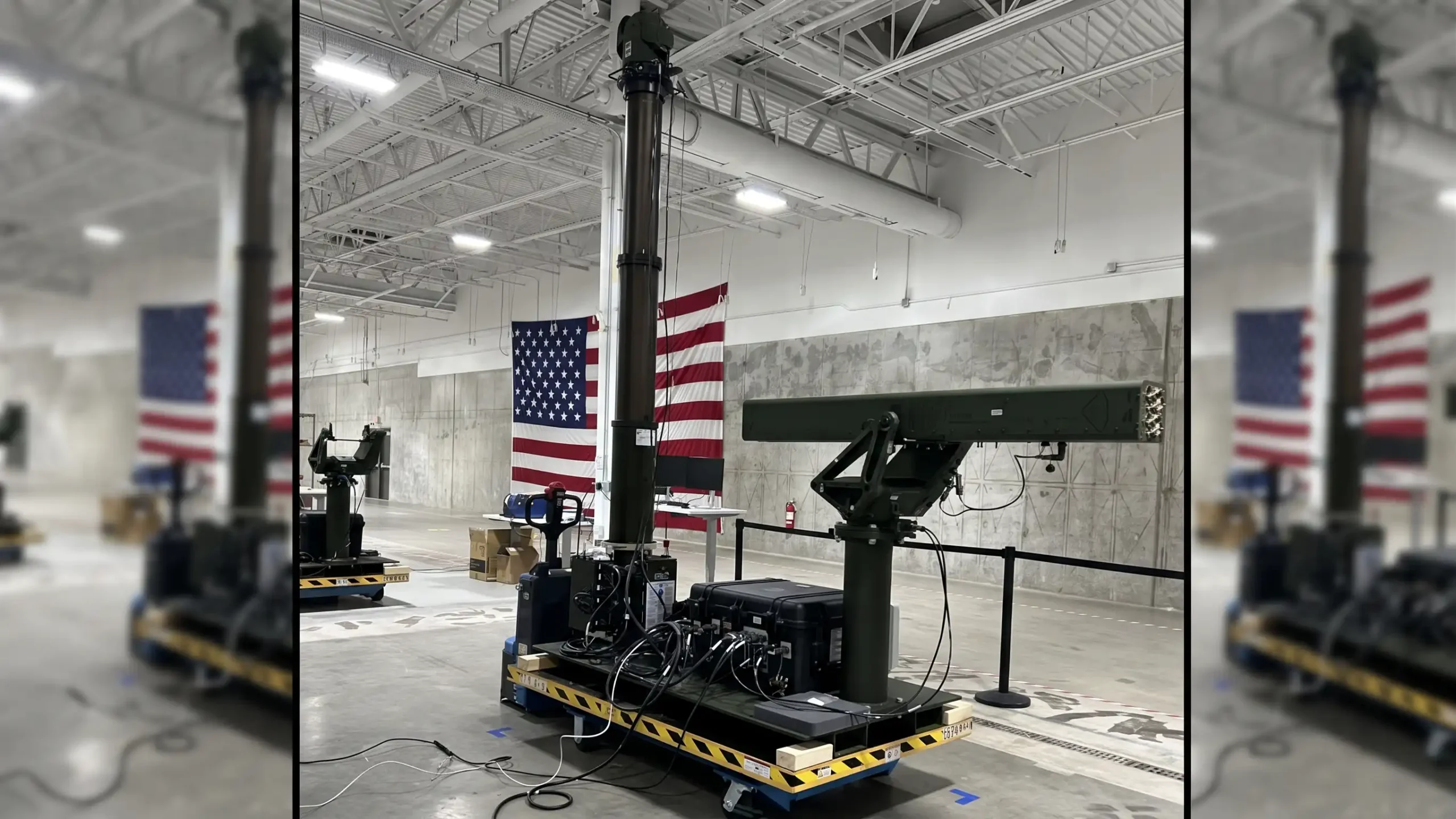
L3Harris Technologies has begun delivering VAMPIRE counter-unmanned systems to the U.S. Army, the company announced on October 13, 2026, with initial units arriving within two months of the service’s order worth up to $106 million. L3Harris did not disclose how many systems have been delivered, which formations are receiving them, or when the full order will be complete.
The Army selected VAMPIRE, short for Vehicle-Agnostic Modular Palletized ISR Rocket Equipment, on June 10, 2026, framing the buy as an urgent requirement within the layered U.S. counter-unmanned systems (C-UxS) architecture. The sub-two-month cycle reflects pressure to field affordable defenses against small drones and loitering munitions. “From day one, our team has worked side-by-side with the Army to rapidly field VAMPIRE systems,” said Chris Aebli, President of Communications & Spectrum Dominance at L3Harris.
How the L3Harris VAMPIRE Kit Turns a Flatbed Into a Shooter
VAMPIRE is a self-contained, palletized weapons kit designed to mount on virtually any commercial or military vehicle with a flat cargo bed, without permanent modifications to the chassis. L3Harris states that two personnel can install and integrate the system in approximately two hours. The pallet carries its own internal power block.
The sensor core is a stabilized WESCAM MX-10D RSTA or larger MX-15D RSTA electro-optical/infrared (EO/IR) gimbal on a pneumatic telescoping mast. The turret combines high-definition daylight and mid-wave infrared channels with an integrated laser rangefinder and designator, while an AI-assisted video tracker detects, classifies, and holds Group 1 to Group 3 unmanned aircraft against cluttered backgrounds. The effector is a four-round launcher for 70mm laser-guided rockets, built primarily around the Advanced Precision Kill Weapon System (APKWS), which converts unguided Hydra-70 rockets into semi-active laser-guided munitions by inserting a guidance section between motor and warhead. L3Harris added a proximity fuze to the warhead so the round detonates at the point of closest approach, fragmenting rotors and avionics without requiring a direct hit on a small, maneuvering target.
Fire control runs on a dedicated version of L3Harris’ Widow mission management software, which the company describes as compliant with Forward Area Air Defense Command and Control (FAADC2). That compliance matters operationally: VAMPIRE can ingest cueing from external radars and operate inside the Army’s existing short-range air defense network rather than as an isolated shooter. Because the primary targeting chain is passive optical, crews can track and engage without radiating, reducing their electronic signature. L3Harris cites an engagement range of approximately 6 kilometers (3.7 miles) against aerial targets from a ground platform, a figure not independently verified. The same chain can also engage ground vehicles or fast attack craft.
Combat Hours, Balikatan Trials, and the Huntsville Production Ramp
L3Harris developed VAMPIRE with company funding at the start of Russia’s full-scale invasion of Ukraine as a low-cost answer to Russian drones. The company says forces have logged more than 350,000 operational hours with the technology in European combat operations since 2023, a manufacturer figure released without an independent breakdown.
The Army had already been working with the system before the June order. During Exercise Balikatan 2026 in the Philippines, a VAMPIRE assigned to Bravo Battery, 1st Battalion, 51st Air Defense Artillery Regiment, 7th Infantry Division/Multi-Domain Command-Pacific, took part in a combined Integrated Air and Missile Defense live-fire event at Naval Station Leovigildo Gantioqui from April 26 to 29, 2026, alongside U.S. Marine, Philippine, and Japanese air defense units. The battalion’s commander described palletized systems positioned along shorelines as filling a precision-strike niche against small UAS within the broader air defense network.
On the industrial side, L3Harris launched high-volume VAMPIRE production at a dedicated facility in Huntsville, Alabama, on March 24, 2026. The site includes a flexible assembly, test, and installation area for integrating the kit onto ground vehicles and containerized weapon systems, with capacity the company says can scale with demand. The VAMPIRE family now spans the Stalker land vehicle variant, the Black Wake maritime variant, and the CASKET containerized variant, and the kit has been integrated on GM Defense’s Infantry Squad Vehicle. On September 8, 2026, the U.S. Navy also selected VAMPIRE for littoral C-UxS defense, without disclosing value, quantity, or schedule. L3Harris has further demonstrated an open munitions architecture by live-firing Thales Belgium’s FZ275 70mm laser-guided rocket.
Analysis: VAMPIRE’s value to the Army lies less in any single specification than in the cost-per-engagement equation it brings to short-range air defense. Publicly reported unit costs place an APKWS round well below most surface-to-air interceptors, allowing commanders to reserve higher-end missiles for cruise missiles and crewed aircraft. The constraint then shifts to ammunition. APKWS guidance kits, produced by BAE Systems, are also in demand for rotary-wing strike and fighter-launched counter-drone missions, so sustained VAMPIRE employment will depend on 70mm guided rocket output as much as on Huntsville’s launcher throughput. Qualification of the Thales FZ275 gives allies a second source, but no U.S. Army decision to adopt alternative rounds has been announced.
Key unknowns remain the number of systems covered by the $106 million order, the receiving units, and whether the Army will convert this urgent buy into a sustained program with follow-on funding in future budget requests. Navy deliveries and the maritime configuration are the next milestones to watch.