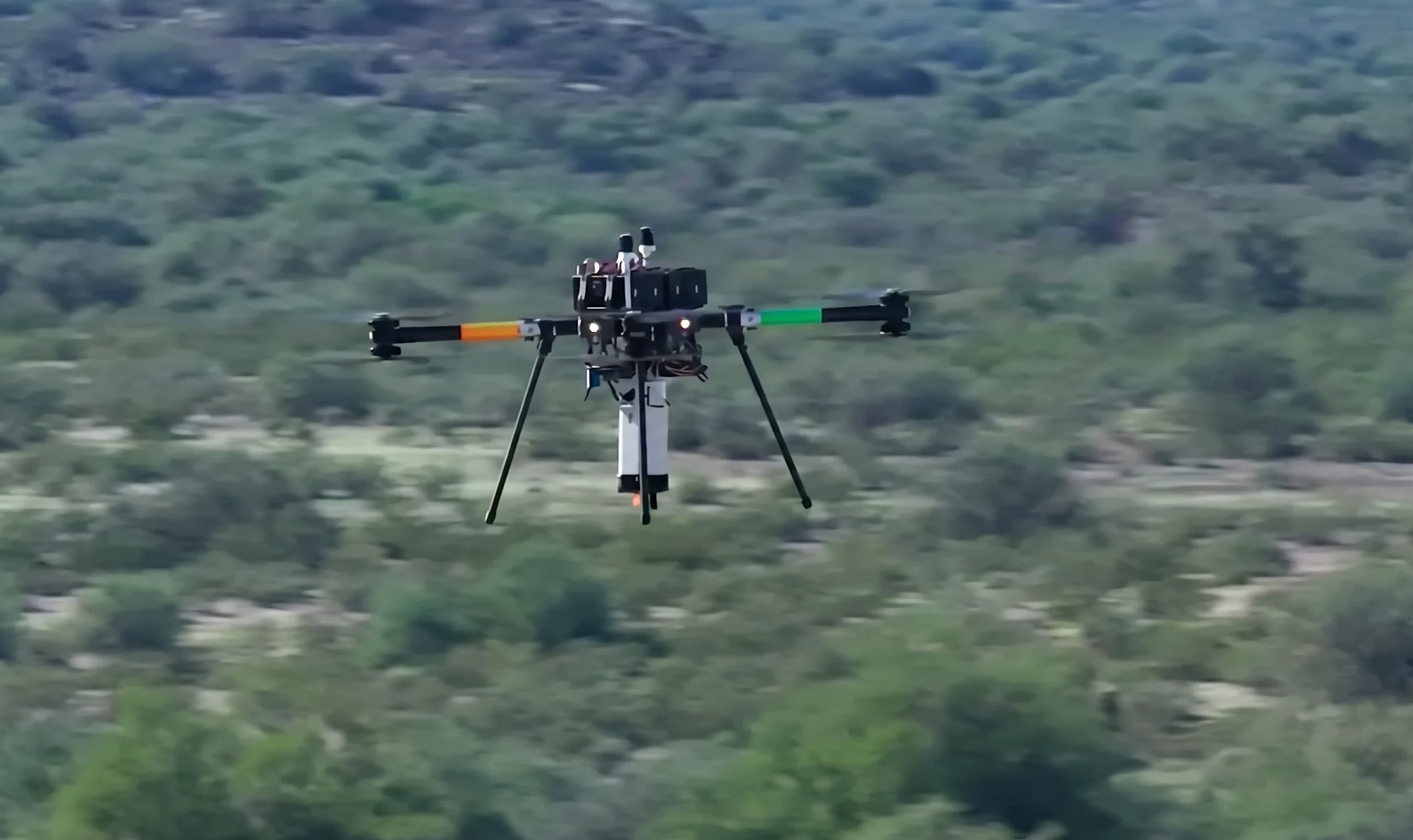
Honeywell Aerospace and Shield AI completed a coordinated intelligence, surveillance, and reconnaissance (ISR) mission near Phoenix on October 8, 2026, with two aircraft flying on Shield AI’s Hivemind autonomy software and an AI target detection model built by Honeywell engineers. Announcing the result on October 13, the companies said Honeywell’s autonomy team had flown its first autonomous aircraft about six weeks after starting work on the Hivemind Enterprise platform, against an internal estimate of 54 weeks.
The flights are the first public results of the memorandum of understanding (MoU) the two firms signed at the Farnborough International Airshow on July 22, 2026, under which Honeywell is building an autonomy software stack on Hivemind and integrating its Anthem avionics, navigation, and sensing portfolio. They also arrive barely three months after Honeywell Aerospace completed its spin-off from Honeywell International on June 29, 2026, and began trading on Nasdaq as HONA. The Phoenix-based supplier, with more than 36,000 employees, now has to define its own position in defense autonomy.
From Training to First Flight: Six Weeks on Shield AI Hivemind
Honeywell’s autonomy team began training on Hivemind Enterprise in late April 2026. The product packages Shield AI’s development environment with its onboard autonomy software, providing core functions such as route planning, mission management, and aircraft-to-aircraft communication. Integrators can then focus on their own AI models, sensors, and mission logic.
In mid-June, the team flew a Honeywell-owned BFD-SE8 multirotor autonomously for the first time. The SE8 comes from BFD Systems of Pennsauken, New Jersey, a builder of industrial heavy-lift multirotors; publicly available specifications indicate the airframe is designed to remain under the 55-pound ceiling of Federal Aviation Administration Part 107 small drone rules. Honeywell did not disclose the payload, endurance, or compute configuration it flew.
The first official demonstration followed on July 8 in Plymouth, Minnesota. The aircraft took off on its own, flew a planned route, rerouted around a no-fly zone, and returned to base. Those are baseline behaviors, but dynamic airspace avoidance is what regulators will demand before autonomous aircraft leave test ranges.
Tom Schaefer, vice president of Hivemind Enterprise at Shield AI, said Honeywell’s engineering leads had estimated the work would normally take about a year, and that Hivemind covered “the autonomy basics” so the team could concentrate on its detection and tracking model. The 54-to-six-week compression is a company estimate and has not been independently verified, but the ninefold reduction is the core commercial claim behind Shield AI’s partner model.
Scout and Delivery Roles in the Two-Aircraft ISR Mission
Work on the second demonstration started immediately after the July flight. Over three months, Honeywell trained and deployed its own target detection and tracking model, built the mission in simulation, and tested it in Minnesota and Arizona.
During the October 8 sortie near Phoenix, a scout aircraft used onboard cameras and Honeywell’s AI model to detect, identify, and track a target. Hivemind passed the target location to a second aircraft, which navigated autonomously to the target, delivered a payload, and returned to base with the scout. According to the companies, the two aircraft shared target information and divided mission tasks without a human assigning each step.
Several parameters remain undisclosed: the nature of the payload, standoff distances, the datalink architecture, whether an operator approved the delivery, whether GNSS was degraded during the run, and whether both aircraft were BFD-SE8 airframes. The task split itself is the operationally relevant element. Separating the sensor role from the effector role across two airframes mirrors the find, fix, and finish chain that loitering munition and resupply concepts depend on, and lets a cheaper platform absorb the exposure of closing on a target.
HGuide o480 Navigation and the Anthem Integration Path
Both aircraft in the ISR mission carried Honeywell’s HGuide o480 inertial navigation system (INS), launched in May 2025 as a single-card INS/GNSS unit. It fuses Honeywell micro-electromechanical system (MEMS) gyroscopes and accelerometers with a Septentrio Mosaic receiver, offered as a triple-frequency Mosaic X5 with one antenna or a dual-frequency, dual-antenna Mosaic H when GNSS attitude aiding is needed. Septentrio’s AIM+ technology provides anti-jamming and anti-spoofing protection.
Publicly available specifications list the o480 at 71.1 by 45.7 by 8 millimeters, 26 grams, and roughly 1.5 watts, with a 400 Hz blended navigation output. Paired with velocity aiding such as Honeywell’s Radar Velocity Sensor, the company rates GNSS-denied drift at under 0.5% of distance traveled. Honeywell markets the unit for UAVs, loitering munitions, and uncrewed ground and marine vehicles. Route planning and target handoff are only as reliable as the navigation state feeding them, and GNSS jamming is now routine in contested theaters.
The MoU frames this as a trust problem. Matt Milas, president of Defense and Space at Honeywell Aerospace, said at Farnborough that trust must be “engineered into the architecture, not bolted on after.” Hivemind has already piloted more than 40 platforms, from F-16s and helicopters to uncrewed surface vessels and a satellite in low Earth orbit.
Analysis: The demonstrations show Honeywell positioning itself as the certified navigation and avionics layer beneath a third-party autonomy core, rather than as a competing autopilot developer. If six-week integration cycles hold across other partners, baseline autonomy becomes a commodity, and differentiation shifts to proprietary perception models and assured navigation, precisely where Honeywell spent its three months of effort. That architecture fits the modular open systems approach the Pentagon requires on major programs, but it also concentrates dependency on a single autonomy vendor, a risk acquisition offices will weigh.
Next, the companies will define how Hivemind connects with Honeywell’s integrated avionics, navigation, and sensing systems, then apply the work to larger uncrewed aircraft and to commercial aviation. Under the July MoU, they will also evaluate joint pursuits of defense uncrewed aircraft programs in the United States and abroad, while Shield AI assesses Honeywell safety-critical products for its own aircraft. No customer, contract, platform, or schedule has been announced. The indicators to watch are a GNSS-denied demonstration, a move to a larger airframe class, and a first named program bid.